Trading Axi select: Why position sizing, not strategy, determines who gets funded

Abstract
This paper examines trader behaviour within the Axi Select framework, focusing on how position sizing, rather than strategy selection, determines survival and progression. Using a $500 entry account as the baseline, we analyze how different risk-per-trade models interact with drawdown constraints, market volatility, and trade sequencing. The findings show that while a higher risk (5% to 10%) can accelerate outcomes, it materially reduces the probability of passing the evaluation phase. In contrast, a controlled risk framework of 1%-2.5% maximizes the trader’s ability to survive volatility and complete the required trade sequence. The conclusion is clear: in Axi Select, the edge is not what you trade, but how much you risk while trading it.
1. The Axi select reality: You are being tested on survival
Axi Select is often approached as a trading opportunity.
In reality, it is a risk management test disguised as a trading program.
The structure implicitly rewards:
- Consistency over aggression.
- Discipline over conviction.
- Survival over short-term performance.
This creates a mismatch between how traders want to trade and how they must trade to progress.
2. The $500 constraint: Small capital, big consequences
With a $500 starting balance, every decision is magnified.
At this scale:
- 1% risk = $5.
- 5% risk = $25.
- 10% risk = $50.
This matters because the effective failure threshold is typically in the range of 10% drawdown.
Which means:
The account is not designed to absorb mistakes — it is designed to expose them.
3. The core trade-off: Speed vs survival
There are two distinct ways to approach Axi Select:
Path A: High Risk (5%–10%)
- Faster P&L swings.
- Potential for rapid progression.
- Extremely sensitive to loss sequencing.
Path B: Controlled Risk (1%–2.5%)
- Slower growth.
- Higher consistency.
- Greater tolerance for variance.
The key insight:
Axi Select rewards completion of the process, not speed through it.
4. Variance compression in Axi select
At elevated risk levels, traders experience variance compression.
At 10% risk:
- 1 loss = -10%.
- 2 losses = -19%.
At 2.5% risk:
- 3 losses = -7.3%.
- 5 losses = -12%.
In Axi Select terms:
- High risk reduces the number of allowable errors to near zero.
- Moderate risk allows the trader to complete the required trade sequence.
5. The “Not behind the 8 ball” argument — and Why It still fails
It is technically correct that:
One 10% loss does not place the trader at an immediate disadvantage.
However, Axi Select is not a single-trade game.
It is a multi-trade consistency test.
After one large loss:
- Risk tolerance collapses.
- Psychological pressure increases.
- Trade selection becomes distorted.
The trader is not mathematically impaired, but is operationally constrained
6. Market regime matters: Why now is the hard mode
Current conditions are defined by:
- Oil-driven volatility.
- Geopolitical headline risk.
- Cross-asset instability.
In this regime:
- FX behaves less predictably.
- Stops are more likely to be triggered by noise.
- Correlations break down.
Which leads to a critical adjustment:
A 2.5% risk in this environment can behave like 4% or more in normal conditions
7. The 20 trade reality: Process over outcome
Axi Select requires a sequence of trades.
This transforms trading into:
- A process completion exercise.
- Not a single high-conviction opportunity.
The implication:
Traders must optimize for consistency across trades, not magnitude within trades
A structured approach, such as a 20-trade test phase, becomes essential for:
- Measuring discipline.
- Validating execution.
- Managing emotional variance.
8. Recommended framework for axi select
A practical structure aligned with survival and progression:
Risk Allocation
- Base trades: 1%.
- High-conviction trades: 2% to 2.5%.
- Absolute maximum: 3%.
Execution Rules
- 1 to 3 trades per day.
- Pause after two consecutive losses for an interday time out.
- Predefined stop loss on every trade (I will discuss that in another blog post).
Market Selection
- Focus on:
- EUR/USD.
- USD/JPY (with yield awareness).
- AUD/NZD.
- Avoid:
- Oil-sensitive pairs.
- Highly reactive instruments during geopolitical spikes.
9. When not trading is the trade
One of the most underutilized edges in Axi Select is selectivity.
In unstable regimes:
- The signal-to-noise ratio deteriorates.
- False moves increase.
- Execution quality declines.
Choosing not to trade is not inactivity.
It is risk preservation
10. Conclusion: The trader who lasts, passes
Axi Select does not reward the most aggressive trader.
It rewards the trader who:
- Maintains discipline under constraint.
- Survives variance.
- Completes the process.
The central takeaway is this:
In Axi Select, position sizing is the strategy.
Everything else is secondary.
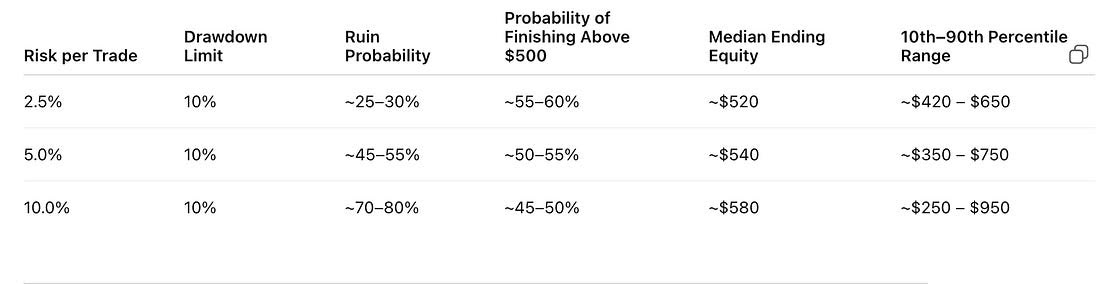
Risk of ruin across position sizing (Axi select framework)
Assumptions: 20 trades, $500 starting equity, 50% win rate, 1.2R average winner, fixed fractional risk model
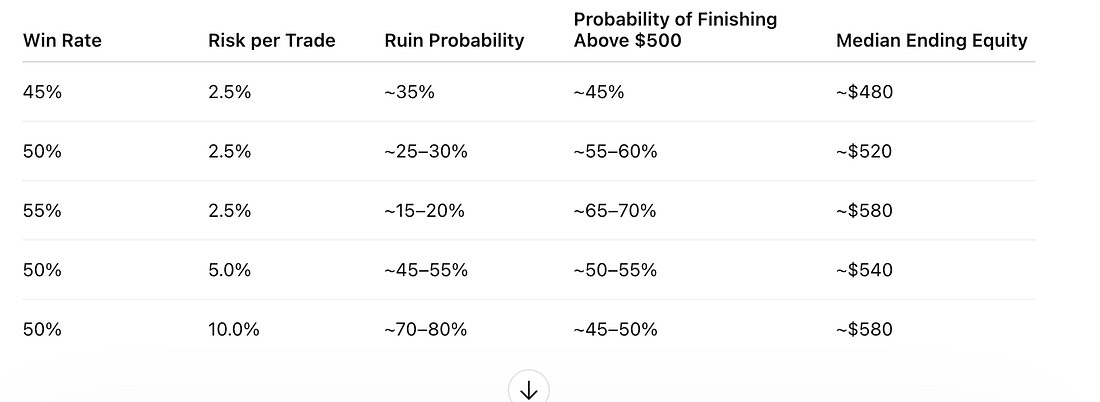
Sensitivity to Win Rate (10% Drawdown Limit)
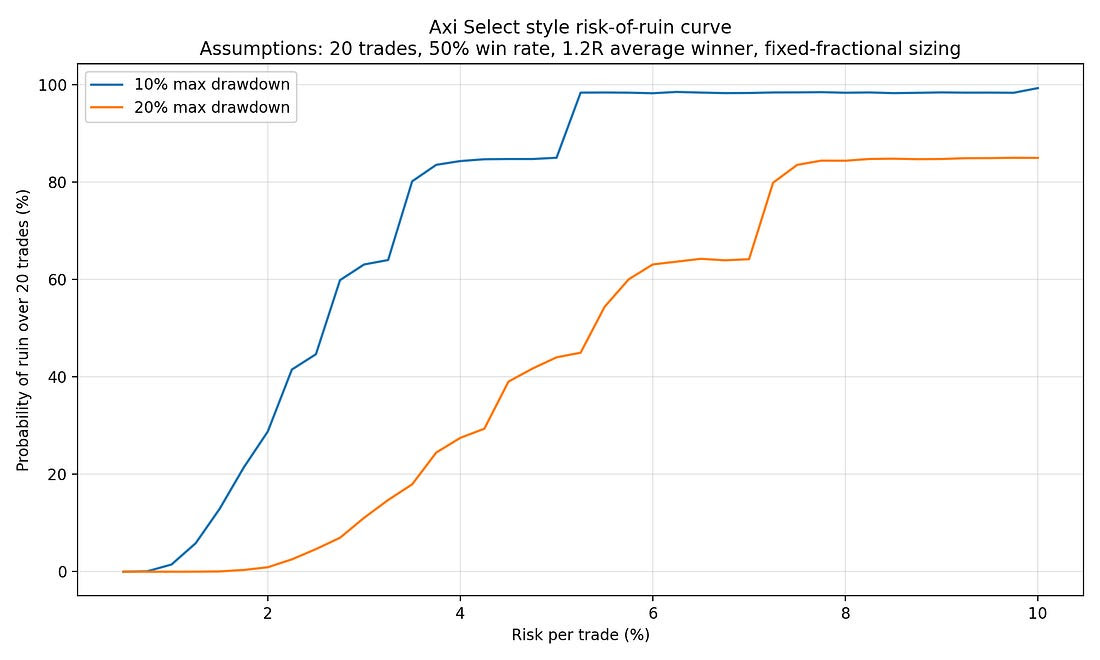
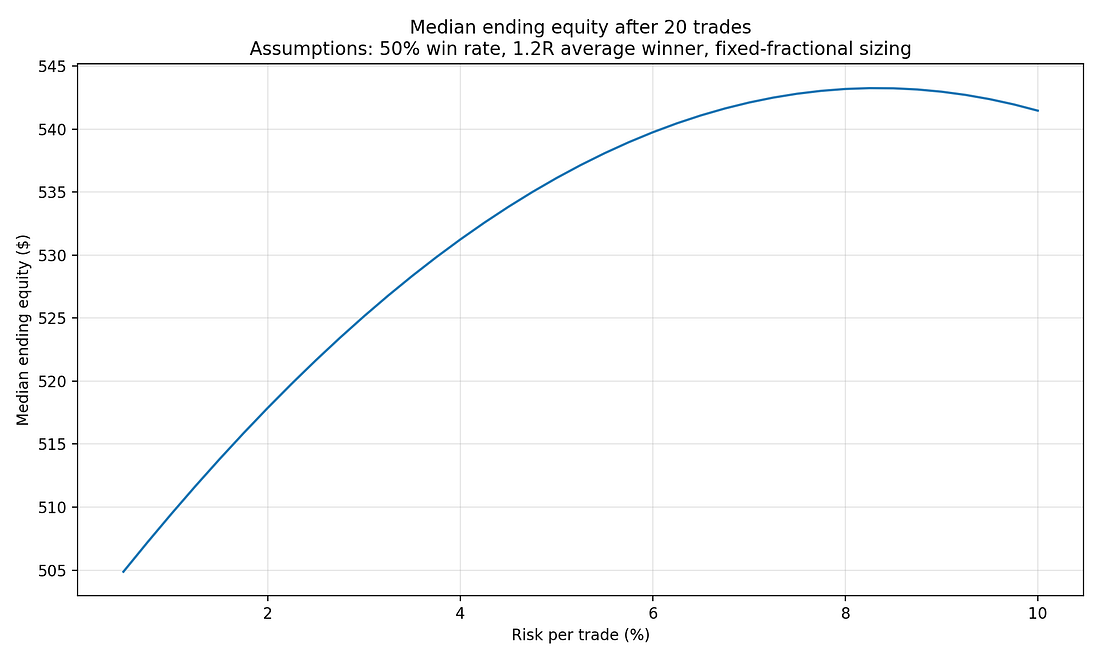
Key assumption set:
20 trades, $500 starting equity, fixed fractional sizing, 50% win-rate baseline, 1.2R average winner, with ruin defined as breaching a maximum drawdown threshold.
Author

Stephen Innes
SPI Asset Management
With more than 25 years of experience, Stephen has a deep-seated knowledge of G10 and Asian currency markets as well as precious metal and oil markets.