The January ratio and market evolution

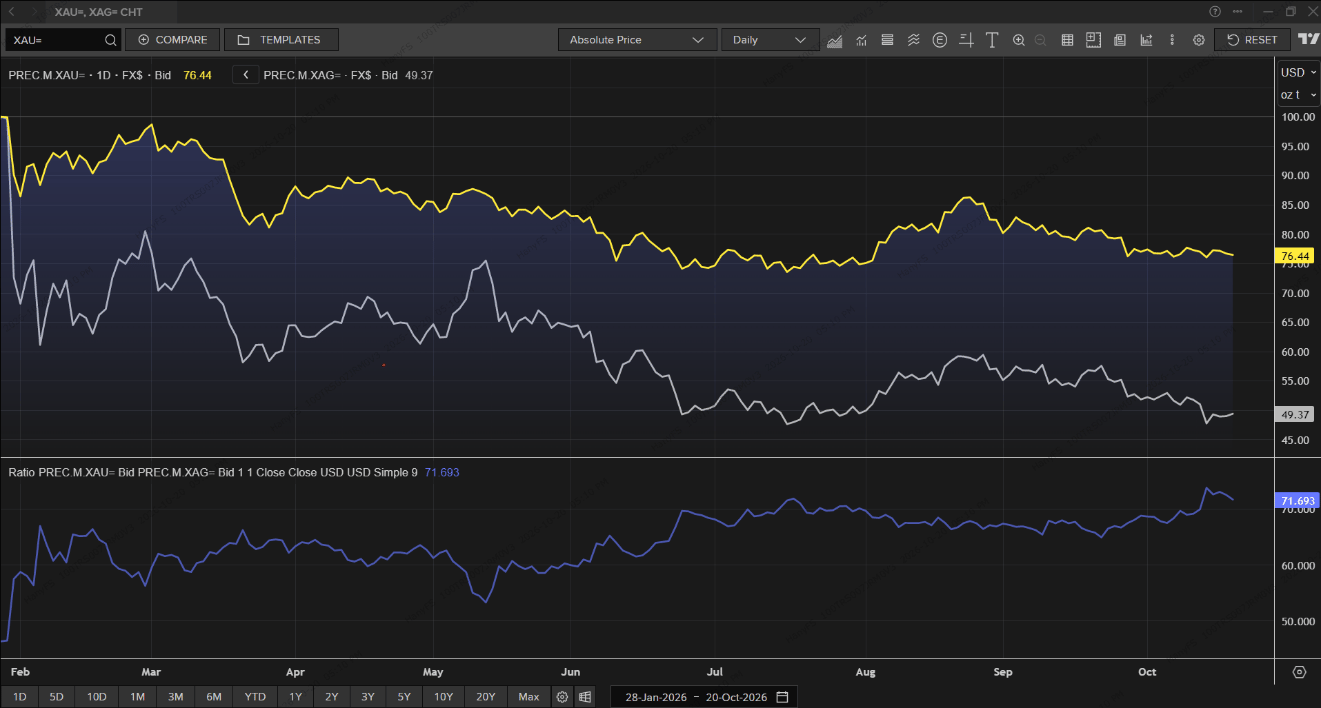
Earlier this year on January 29, global precious metals markets reached an explosive inflection point. Driven by safe-haven demand, central bank accumulation, and acute supply constraints, spot gold surged toward the $5,600 threshold, while spot silver rallied aggressively to touch the $120 level. During this parabolic phase, the Gold to Silver Ratio (GSR) compressed to an average of approximately 46, signaling extreme relative strength in silver.
As macroeconomic conditions and liquidity dynamics evolved through October, the landscape shifted. The GSR has since widened back out to approximately 72, reflecting a notable rotation in relative performance between the two monetary metals.
Divergent Pullbacks: Gold’s Resilience vs. Silver’s Deep Correction
Analyzing these price actions on a logarithmic scale highlights a stark divergence in post-peak retracements:
Gold has exhibited robust structural support, treading near 76% of its lifetime high.
Silver, by contrast, experienced a much steeper technical correction of roughly 50% from its January peak.
This deeper correction, combined with a GSR that has stretched far above its January baseline of 46, forms a compelling technical case. It establishes a foundation for significantly greater upside asymmetry in silver compared to gold as the market recovers its equilibrium.
The Fundamental Disconnect: The actual mining ratio of gold to silver out of the ground is roughly 10 to 1.
This persistent divergence between real-world physical scarcity and current market pricing highlights an underlying structural imbalance.
As market valuations stabilize and long-term trends attempt to bridge this gap toward mean-reverting norms, silver is uniquely positioned to outperform gold, offering investors an exceptional vehicle for higher percentage gains than Gold.
Author

Hany Saleeb
Independent Analyst
Hany Saleeb is a highly experienced Senior Treasurer. With over a decade of experience in treasury, served as Head of Treasury at BM in France and head of research in Sinai Securities.