Gaps, pro versus novice


Price gaps in markets are events that successful traders understand very well. This is because when you really understand gaps - why they occur, and how to trade them - you realize how powerful and opportunistic these events really are. Gaps represent the ultimate supply and demand imbalance, which is key when attempting to identify market turning points. Whether we are talking about Stocks, Futures, Forex, or Options, the logic and rules for gaps don’t change.
Gaps occur when there is a supply and demand imbalance. Specifically, when there is more demand than supply at the prior day’s closing price, the market will gap higher the following day. When supply exceeds demand at the prior day’s closing price, the market will gap down the following day. Let’s take gaps a little bit deeper and dive into part of a lesson from the Extended Learning Track (XLT).
While we have a big lesson on gaps in the XLT that covers all the significant gap opportunities, today I will share one set of gaps that you may want to pay attention to, Professional Gaps versus Novice Gaps. Later in this piece, I will explain where these gaps get their names from. For now, here are the definitions and proper actions.
Professional Gap: A gap that occurs after a move in price, in the opposite direction of that move. These gaps occur at the beginning of moves and ignite them.
Professional Gap High Probability Action: Join the gap on a pullback in price to the origin of the gap so long as the opportunity has a significant profit margin.
Novice Gap: A gap that occurs after a move in price, in the direction of that move. These gaps tend to be found at the end of moves and lead to reversals.
Novice Gap High Probability Action: Fade the gap when price reaches a support or resistance level so long as there is a significant profit margin. S&P.
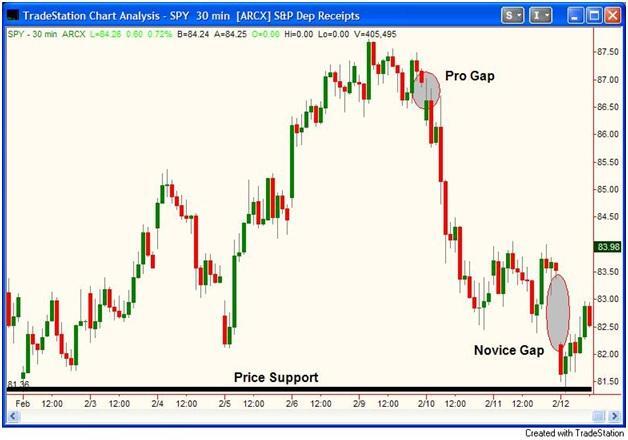
Figure 1: S&P Chart
Above is a chart of the S&P. Identified by the grey shaded areas are a Professional Gap and a Novice Gap. As you can see, the Pro Gap is after a big rally in price, in the opposite direction of that rally. This gap ignites the move lower in price. After the gap open to the downside, often price will quickly rally and fill the gap and then proceed lower. The astute trader can look to sell short near the origin of the gap as that is the low risk / higher reward way to join that gap down in price.
Lower on the chart, we have the Novice Gap. This one is a gap down in price, after a decline in price. We call this a novice gap because someone is selling AFTER a decline in price and DURING a gap down. This combination is a very novice move and typically leads to losses for the seller (and gains for the buyer). The proper action on a novice gap down is to first identify the nearest support level and look to fade this gap down with a long position. This is the low risk / higher reward trading idea with the presence of a novice gap.
There are other types of gaps to consider when trading the open of a market. Typically, it is at the open of a market that prices are at levels where supply and demand are most out of balance. I witnessed and facilitated this for a long time handling institutional order flow at the Chicago Mercantile Exchange. Translating these areas of imbalance onto a price chart helps attain an edge over your competition. Only put your money at risk when the odds are stacked in your favor and the risk is low, which means identifying novice action in a market and taking the other side of the novice’s trade.
Lastly, trading the open of a market is not for a beginner or novice trader. However, once you have attained the ability to quantify demand and supply in any market and any time frame, you are likely to find trading the open a very opportunistic time to trade.
Author
Sam Seiden
Independent Analyst
Sam began his career at the Chicago Mercantile Exchange, the largest financial exchange in the world where he facilitated institutional order flow.