Loyalty programmes and faster onboarding: How Forex brokers are rethinking the client experience


Gamified rewards, guided account opening and automated identity checks are spreading across retail brokerage. This article explains how they work, where regulators draw the line and what traders should check, using FSCA-regulated broker RaiseFX as an example.
For much of its history, online brokerage competed on headline terms: spreads, leverage and deposit incentives. Those factors still matter, but many traders now judge a broker on the wider experience. How quickly can an account be opened? Is the platform easy to navigate? Does the firm provide the context needed to interpret a volatile session? And does the relationship feel coherent from the first login onwards?
That shift has turned the client experience into an area of investment in its own right. Websites, client portals, support tools and engagement features increasingly operate as one system, and in 2026 two developments stand out: gamified loyalty programmes and redesigned onboarding with faster identity verification. This article looks at how each works and what traders should weigh up, drawing on the example of RaiseFX, an FSCA-regulated CFD and forex broker that introduced both in November 2026.
Why some brokers build their own client technology
Most retail brokers rely on established third-party platforms such as MetaTrader 5 for trade execution, and many also license white-label software for their client portal, CRM and payments. A growing number now develop part of that stack internally. The main argument is control: a broker that owns its portal and CRM can change how they share information, and respond to regulatory changes or client feedback, without waiting for an external vendor.
The trade-off is cost and responsibility, since proprietary systems need continuous investment in engineering, security and reliability. RaiseFX follows this model. Its CRM and client portal were developed in-house, an AI support assistant was added in April 2026 alongside human support during stated operating hours, and an internal team of 11 developers redesigned its website in July 2026. Trading itself still takes place on MetaTrader 5; the in-house work covers the services around it, such as a position-size calculator, market sentiment data and economic news in the client area.
How gamified loyalty programmes work
Online loyalty schemes are not new in retail trading: cashback and volume-based rebates have existed for years. The newer generation borrows from gaming and consumer apps. Participants complete tasks, build streaks of regular activity and earn points or experience levels that can be exchanged for rewards. RaiseFX’s Raise Rewards programme, launched on 4 November 2026, follows this structure, with quests, mini-games, competitions, streaks and a store where points can be redeemed for items such as gift cards. Eligibility and redemption rules are set out by RaiseFX.
For traders, the key question is what triggers a reward. Programmes that reward account tasks, learning or regular platform use are structurally different from those that reward trading volume, because volume-based incentives can encourage more frequent or larger trades than a trader would otherwise place.
Before joining any broker loyalty scheme, it is worth checking which actions earn points, whether any reward depends on deposits or trading activity, how and when points can be redeemed, and whether rewards expire or differ by country.
Eligibility usually varies by jurisdiction, and not every reward is offered to every client, so the programme’s official terms remain the reference.
Where regulators draw the line
Gamification in trading apps has drawn close attention from regulators. The UK Financial Conduct Authority and the European Securities and Markets Authority have both examined design features that may encourage retail clients to trade more often or take on more risk, and the EU’s product intervention measures on CFDs restrict benefits offered as an incentive to trade. The common principle is a clear separation between engagement rewards and trading decisions. Rewards should not be read as an incentive to take on additional financial risk, and they do not offset trading losses.
What a modern onboarding process looks like
Regulated brokers must verify a client’s identity and address before trading can begin, under know-your-customer (KYC) and anti-money-laundering rules. These checks cannot be skipped, but the way they are presented can be made clearer.
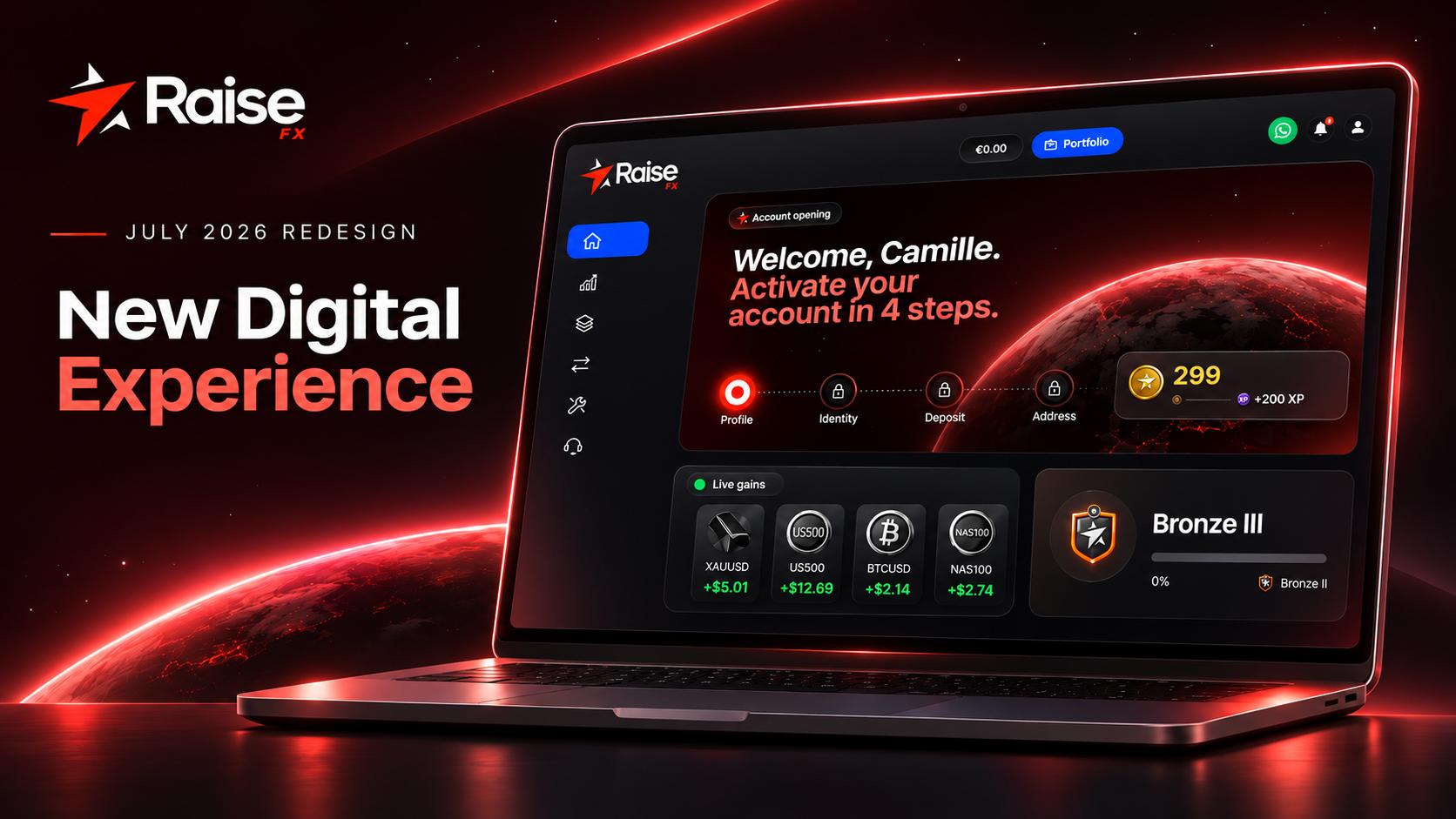
Common improvements include a progress tracker showing completed and remaining steps, automated document checks, and portal sections that unlock as each step is finished. RaiseFX’s onboarding, available to new registrations since 5 November 2026, takes this approach: a Getting Started page tracks profile completion, first deposit, identity verification and proof of address, and an optional guided tour introduces the portal.
Automated identity verification can cut approval times to minutes, or seconds in straightforward cases, but manual review still applies when documents are unclear or further checks are needed. A faster process does not mean fewer checks.
Some brokers also link onboarding to their loyalty programmes. At RaiseFX, completed onboarding steps earn points in Raise Rewards, with a bonus for finishing all required steps within 24 hours. As with any incentive, traders are better served by completing onboarding at their own pace and reading the account terms carefully than by rushing to meet a deadline.
What traders should take from these changes
Loyalty programmes, guided onboarding and in-house tools can make a broker easier to use, and RaiseFX’s November launches show how these elements are being combined in practice. They do not change the factors that matter most when choosing a broker: regulation, trading costs, execution quality, the protection of client funds and the risks of leveraged products. A well-designed reward scheme or a quicker sign-up is a convenience to weigh alongside those fundamentals, not a substitute for them.
Frequently Asked Questions
What is a gamified broker loyalty programme?
It is a rewards scheme that uses game mechanics such as missions, streaks and levels to recognise client activity. Points are usually redeemable under the programme’s terms. RaiseFX’s Raise Rewards, launched on 4 November 2026, is one example.
Does faster onboarding mean fewer identity checks?
No. Regulated brokers must still verify each client’s identity and address. Automation can speed up straightforward cases, but documents may still require manual review.
Can loyalty rewards affect trading results?
Rewards are separate from trading outcomes. They do not guarantee profits or offset losses, and they should not influence the size or frequency of trades.
Risk warning: Trading CFDs and forex involves a high level of risk and may not be suitable for all investors. Leverage can magnify both gains and losses. Consider your investment objectives, experience and risk tolerance before trading. This sponsored article is for information only and does not constitute investment advice or a recommendation. Loyalty rewards do not guarantee profits. RaiseFX is operated by Raise Global SA (Pty) Ltd (company registration 2018/616118/07), an authorised Financial Services Provider regulated by the Financial Sector Conduct Authority of South Africa (FSP licence 50506). Its services are not intended for residents of all jurisdictions, including certain EU, US, Australian and Singaporean residents, and eligibility depends on local regulation.
Author