Bitcoin's losing streak hits eight weeks, wiping out more than 30% of its value


Bitcoin (BTC) extends its losing streak into its eighth week, and macroeconomic headwinds, combined with US-listed BTC Exchange Traded Funds (ETFs) recording their largest monthly outflow ever, surpassing $5 billion, signal further downside potential, threatening the $50,000 psychological threshold and the worst November return in the Crypto King’s history.
Bitcoin (BTC) trades around $60,000 at the time of writing, down more than 50% from its record high of $126,198. The prevailing reasoning behind the crash is the US Dollar’s (USD) renewed strength ahead of further interest rate increases from the Federal Reserve (Fed). Institutional investors have significantly reduced their BTC exposure, with US-listed BTC spot ETFs approaching their largest monthly outflow since their inception. Bitcoin is on a path to record its worst November in history if the price closes below the $50,000 psychological threshold.
Eight bearish weeks wipe out 30% of Bitcoin’s value
Bitcoin’s downward trend began in early October, as it failed to withstand heavy selling around $87,000, resulting in a 3% decline in the week to October 11. The initial pullback coincided with rising 10-year Treasury yields and a stronger US Dollar after the Fed hiked interest rates by 0.25% in September, its first increase since July 2023, to tackle persistent inflation.
This triggered a bearish domino effect, resulting in week-after-week losses in BTC’s price.
Meanwhile, hot US inflation reports and heavy selling by institutional investors fueled Bitcoin’s correction in early November.
In addition to the macro headwinds, Jensen Huang’s resignation as Nvidia’s CEO added to market uncertainty, fueling the worst weekly decline in BTC, roughly 13%, in the week to November 15.
Over the last eight weeks, the Crypto King has lost more than 30% in the spot market, including a 24% decline in November so far.
BTC is headed for one of its worst November returns, second only to the 36% correction in November 2018. As of Thursday, the BTC price hovers around $60,000 after hitting a two-year low of $55,130 on Saturday, wiping out the 25% gains from August.
Strong US Dollar prices in the next potential rate hike
A stronger Greenback usually signals tighter monetary policy or reflects higher Fed interest rate expectations, which could contract the money supply. It also constricts financial conditions worldwide, as global trade and debt are denominated in the US Dollar, forcing institutional and retail investors to withdraw liquidity from speculative assets.
Over the last four weeks, the US Dollar Index (DXY), which measures the US Dollar against six other major currencies, has climbed to its highest level since late March 2025, reflecting higher odds of further Fed interest rate increases. The FedWatch Tool shows a 97.5% likelihood that the central bank will raise interest rates by another 25 basis points, to the 4.00%-4.25% range, in December.
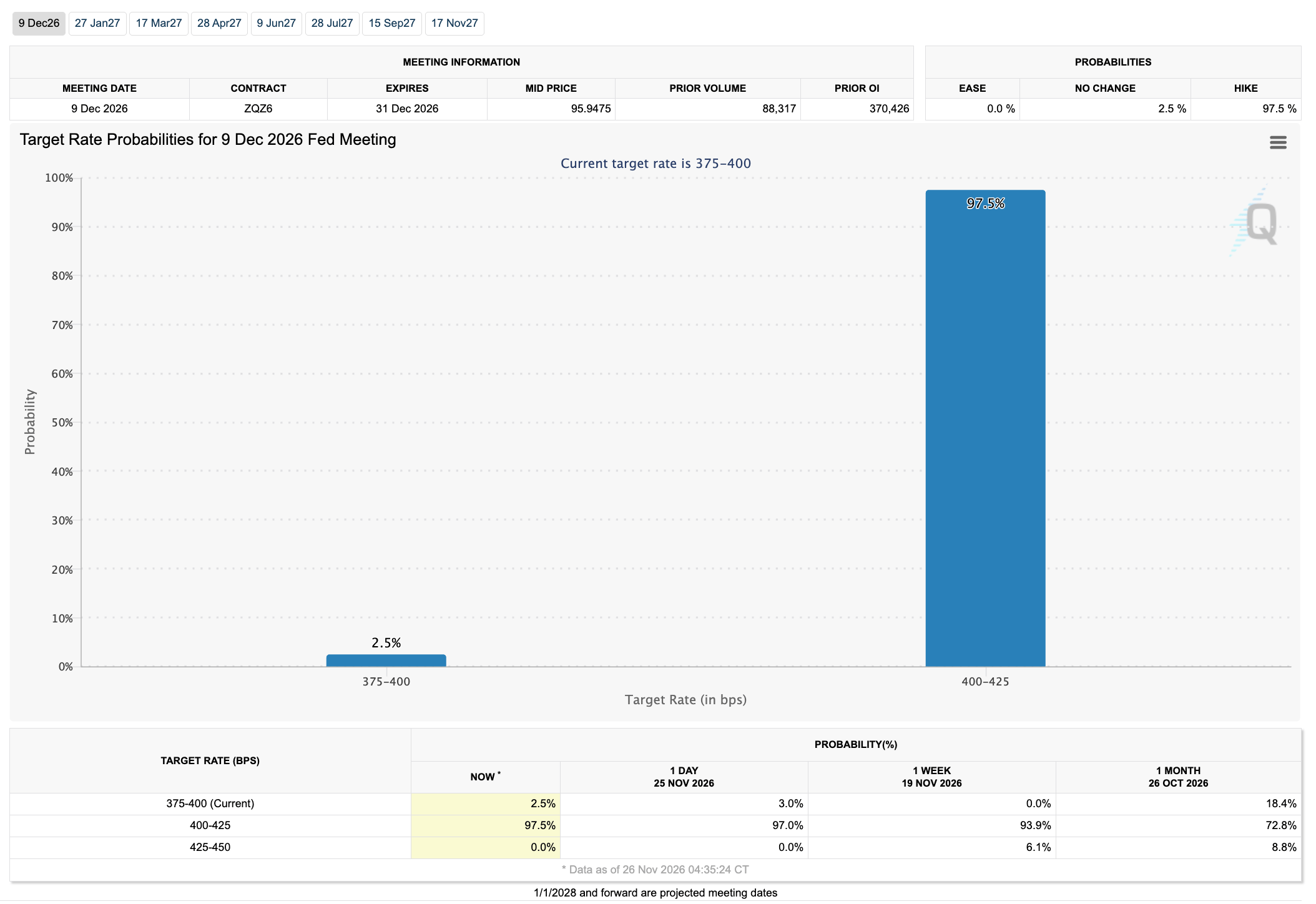
Meanwhile, the US Personal Consumption Expenditures (PCE) Price Index rose 3.8% year over year in October, up from a revised 3.7% in September. However, US Treasury yields and the DXY remain largely unchanged as PCE numbers match market expectations, and US markets close for the Thanksgiving Holiday on Thursday, suggesting that markets have priced in the possibility of another rate hike in December.
What is not priced is the path afterward: economists are debating whether tightening runs into January and March, and the dot plot, which shows where each Fed official expects rates to go, will reveal that. A signal of one hike and then a pause would remove that tail risk and could stop the selling, but a durable rally needs the sellers to stop, said Christopher Gannatti, Global Head of Research at WisdomTree, in an exclusive interview with FXStreet.
Bitcoin ETFs surpass $5 billion in outflows this November
As of Thursday, US Bitcoin spot ETFs have recorded $1.25 billion in outflows this week, heading toward the fourth consecutive week of outflows exceeding $1 billion and bringing the monthly total outflows to $5.39 billion so far in November. Based on the current data, this marks the largest monthly outflow from BTC ETFs since their inception.
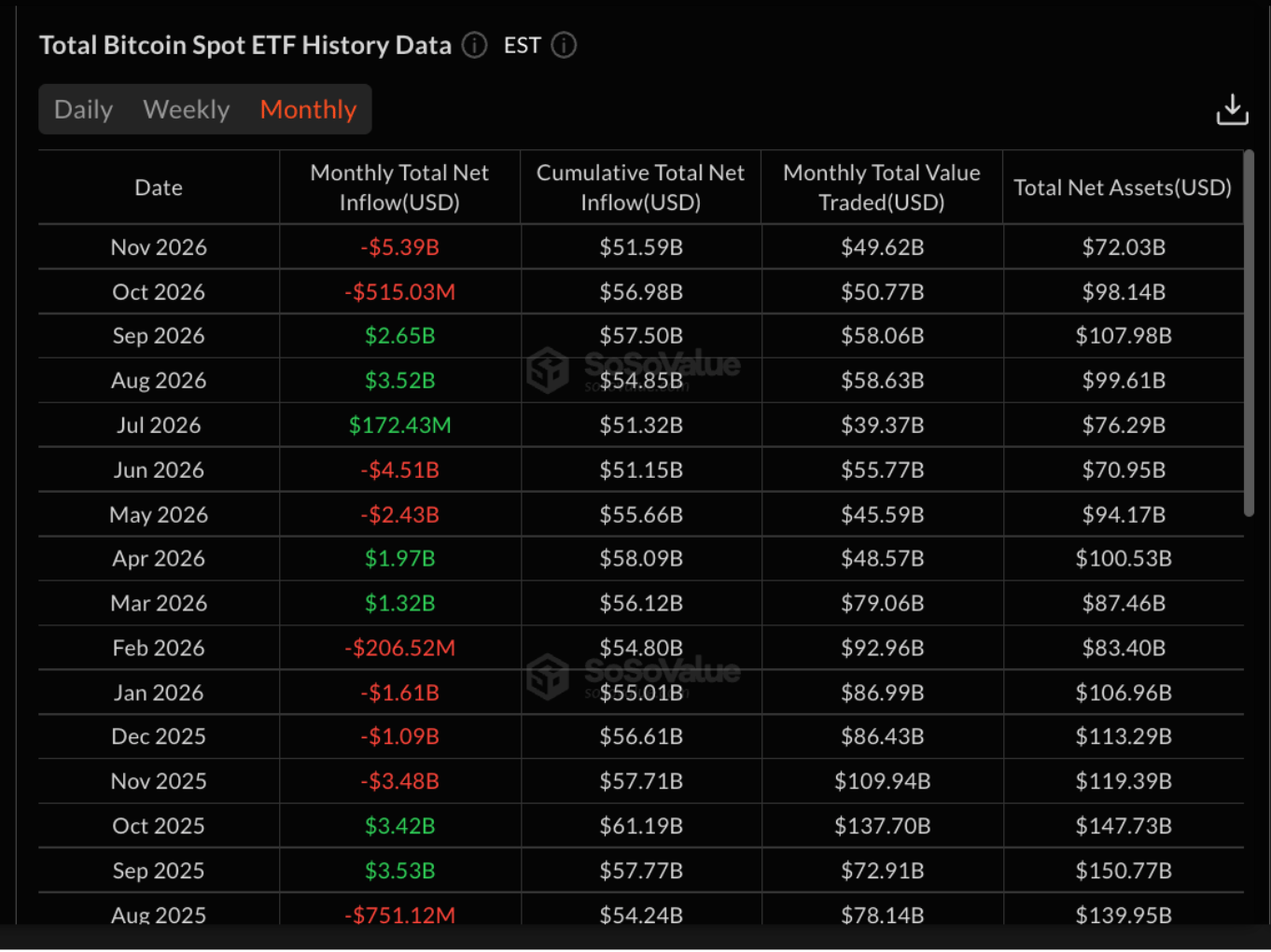
One possible explanation here is a broader "dash for cash" to meet year-end liquidity demands. A broad liquidity squeeze redirects capital into cash, money-market funds, and US Treasuries, and away from traditional inflation hedges such as Gold and Bitcoin, as high short-term interest rates increase the appeal of holding cash and short-term bills.
Will BTC crash below $50,000 for its worst November ever?
CoinGlass data shows four long squeeze incidents with over $1 billion in liquidations (forced closings of leveraged positions) in November, including roughly $1.72 billion in long liquidations on November 20, when Bitcoin dipped nearly 5% before bouncing about 9% off a low near $55,300 the next day. Even Monday’s spike to $64,500 faded just as quickly.
As per Christopher Gannatti, “lasting follow-through needs spot buyers, and the ETFs have been sellers: roughly 70,000 Bitcoin sold in November versus about 10,000 net bought by large holders, per Nansen estimates.”
Prediction markets have emerged as a strong indicator of social sentiment for crypto and the broader financial market. Polymarket shows an active prediction pool on “What price will Bitcoin hit in November?” with more than $16 million in volume, and 51% of bets expect the BTC price to decline to $57,500, while 50% of bets expect the price to reach $62,500 during November.
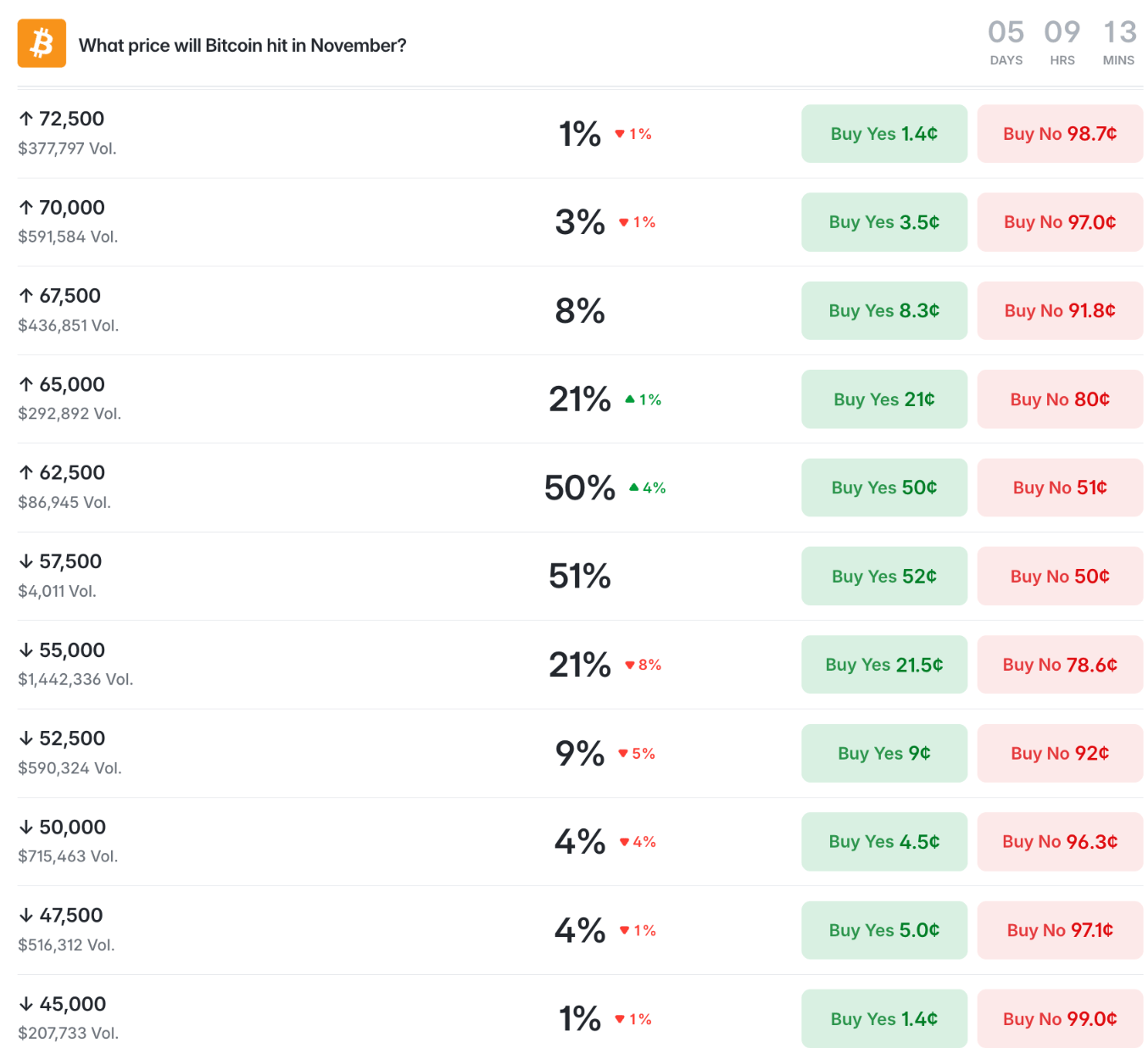
However, the belief that the Bitcoin price will fall below $50,000 has dipped from 8% to 4%, with less than a week left until the monthly close. Still, persistent macroeconomic factors weigh on institutional investors' risk appetite and market liquidity, adding to downside risk.
Author
Vishal Dixit
FXStreet
Vishal Dixit holds a B.Sc. in Chemistry from Wilson College but found his true calling in the world of crypto.