XRP declines as weak derivatives, risk-off mood reinforce downtrend
- XRP extends its correction from this week’s high of $1.40, amid intensifying bearish sentiment in the broader crypto market.
- The XRP derivatives market remains significantly depressed as falling futures Open Interest weighs.
- XRP trades within a broadly defined bearish trend, with price action persistently rejected at key moving averages.

Ripple (XRP) is edging lower for a second consecutive day, below its weekly peak of $1.40 and trading at around $1.33 at the time of writing on Thursday. The remittance token aligns with the broader crypto market’s outlook, which appears largely defined by increasing doubts over the United States (US) and Iran’s ceasefire deal.
Although holding, the ceasefire remains edgy, with Iran still blocking passage through the Strait of Hormuz and US President Donald Trump warning that strikes will continue if Iran does not strike a deal.
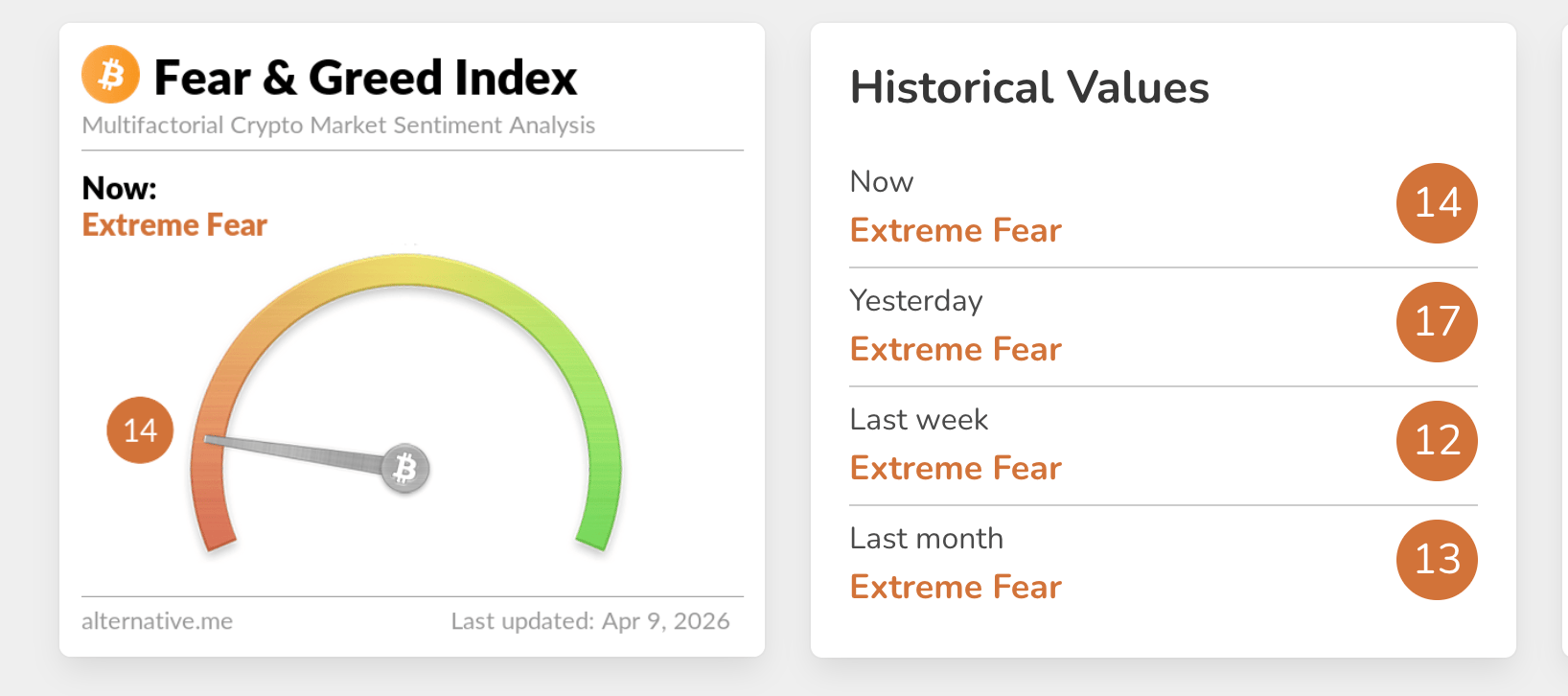
Crypto market sentiment has significantly deteriorated since the war broke out in late February, as reflected in the Fear & Greed Index, which reads 14 in the extreme fear region on Thursday, down from 17 the previous day. This outlook shows that investors lack conviction in the broader market’s ability to sustain short to medium-term recovery.
XRP falters, weighed down by weak derivatives
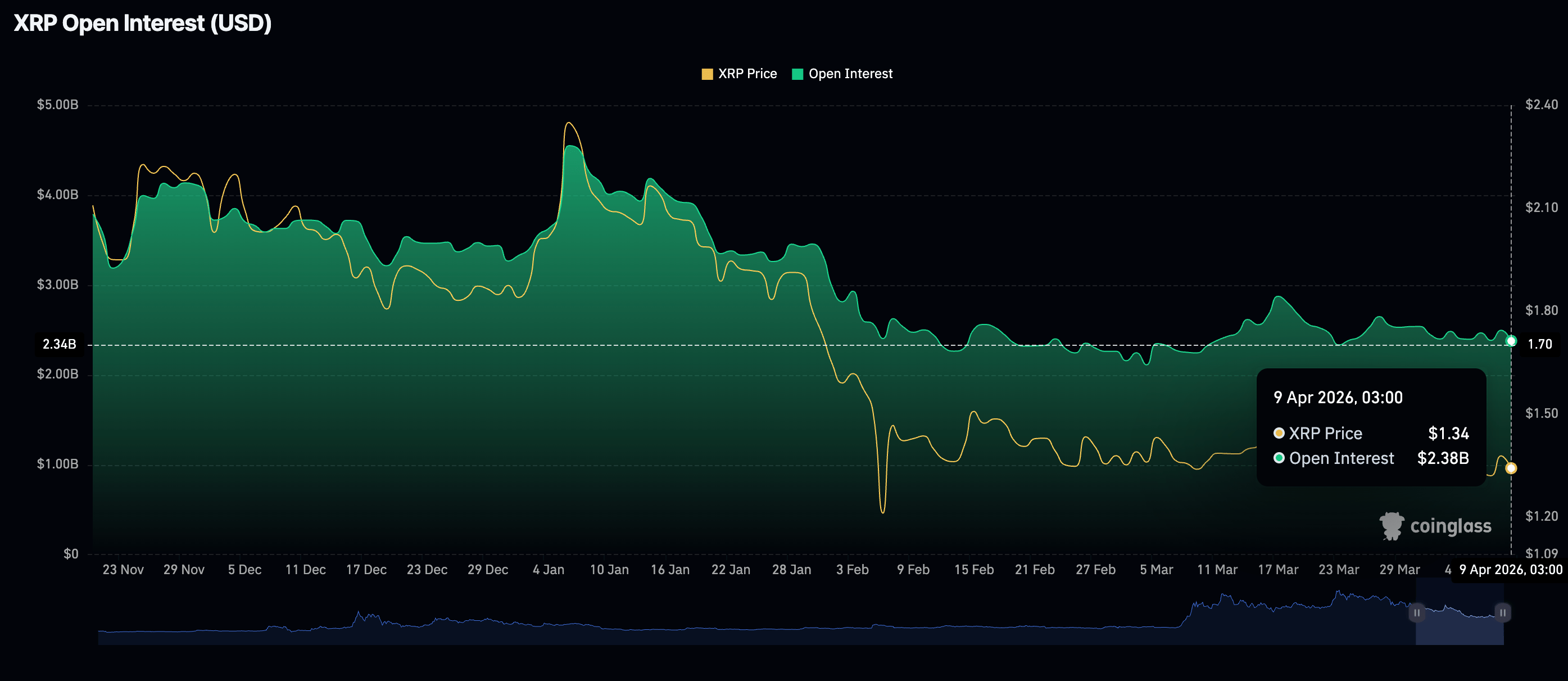
Retail demand is weakening, as Open Interest (OI), which reflects the value of outstanding futures and options contracts, falls to $2.38 billion on Thursday from $2.50 billion the previous day. If the decline persists, XRP will likely remain confined to the broader downtrend toward support at $1.30.
Technical outlook: XRP faces increasing downside risks as technicals falter
XRP is trading at roughly $1.33, under clear downside pressure, with price holding beneath the 50-day, 100-day, and 200-day Exponential Moving Averages (EMAs) at $1.42, $1.58, and $1.83, respectively, which keeps the broader trend tilted to the downside despite the recent bounce.
The Relative Strength Index (RSI) near 44 on the daily chart suggests only modest negative bias rather than outright oversold conditions, while the Moving Average Convergence Divergence (MACD), hovering just above the zero line, hints at tentative recovery attempts that are still capped by a solid overhead structure.
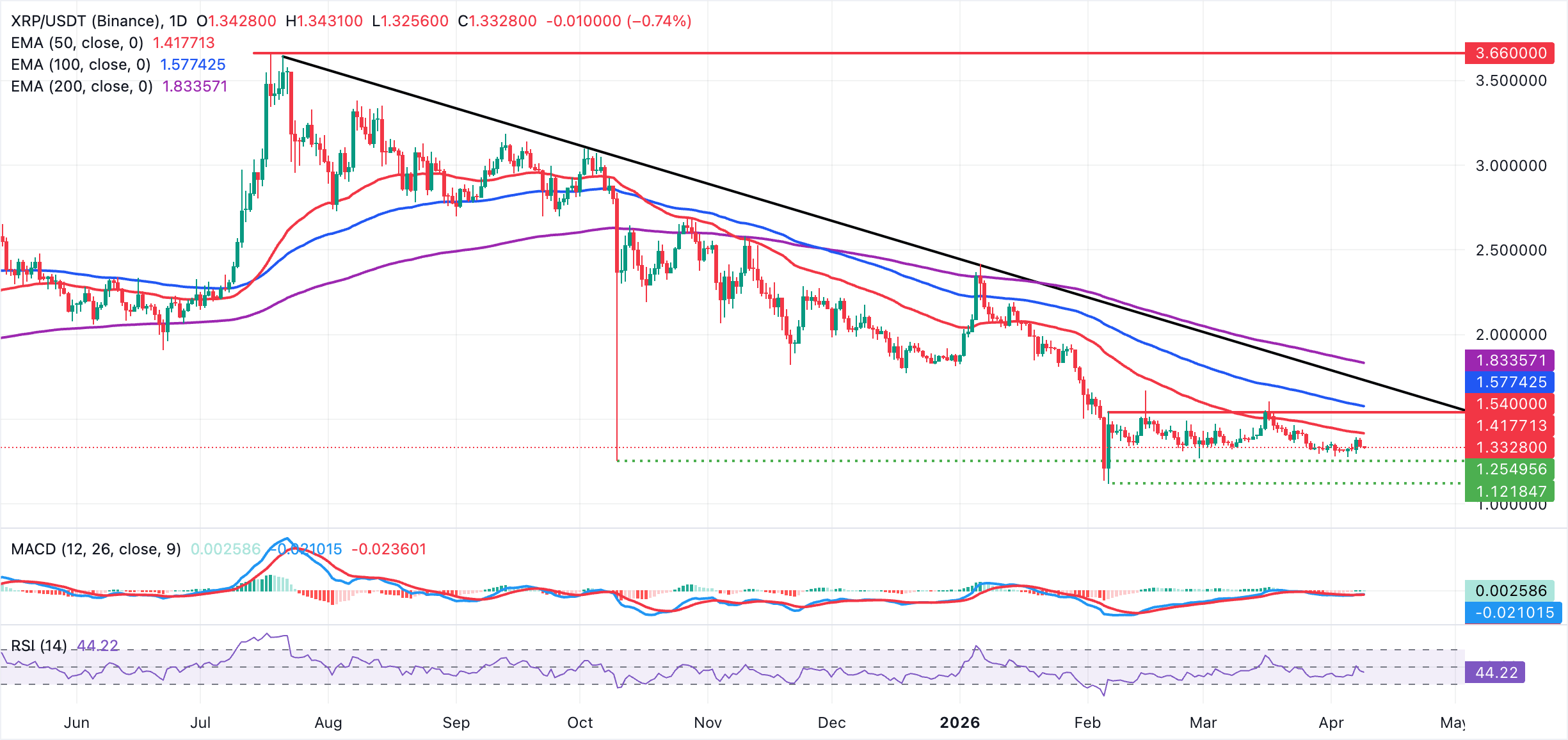
On the topside, XRP's initial resistance is at the 50-day EMA around $1.42, with further hurdles at the 100-day EMA near $1.58 and the descending trendline break zone around $1.73. The 200-day EMA at $1.83 reinforces this broader supply band that would need to be reclaimed to ease the bearish backdrop.
With no clearly defined moving-average support levels on the daily chart, traders may look to recent swing lows at $1.30 and $1.28 for interim floors, while recognizing that the dominant risk remains and that rallies will likely fade against these layered EMAs until buyers can secure a sustained daily close above the first resistance cluster.
Ripple FAQs
Ripple is a payments company that specializes in cross-border remittance. The company does this by leveraging blockchain technology. RippleNet is a network used for payments transfer created by Ripple Labs Inc. and is open to financial institutions worldwide. The company also leverages the XRP token.
XRP is the native token of the decentralized blockchain XRPLedger. The token is used by Ripple Labs to facilitate transactions on the XRPLedger, helping financial institutions transfer value in a borderless manner. XRP therefore facilitates trustless and instant payments on the XRPLedger chain, helping financial firms save on the cost of transacting worldwide.
XRPLedger is based on a distributed ledger technology and the blockchain using XRP to power transactions. The ledger is different from other blockchains as it has a built-in inflammatory protocol that helps fight spam and distributed denial-of-service (DDOS) attacks. The XRPL is maintained by a peer-to-peer network known as the global XRP Ledger community.
XRP uses the interledger standard. This is a blockchain protocol that aids payments across different networks. For instance, XRP’s blockchain can connect the ledgers of two or more banks. This effectively removes intermediaries and the need for centralization in the system. XRP acts as the native token of the XRPLedger blockchain engineered by Jed McCaleb, Arthur Britto and David Schwartz.
(The technical analysis of this story was written with the help of an AI tool.)
Author

John Isige
FXStreet
John Isige is a seasoned cryptocurrency journalist and markets analyst committed to delivering high-quality, actionable insights tailored to traders, investors, and crypto enthusiasts. He enjoys deep dives into emerging Web3 tren