XRP tests rebound strength supported by steady ETF inflows
- XRP trades sideways around $1.05 on Monday, mirroring a mild recovery in the broader crypto market.
- US-listed XRP spot ETFs saw steady inflows of $23 million last week, while futures Open Interest remains weak at $2.36 billion.
- XRP’s technical outlook remains weak, defined by downward-sloping moving averages and weak momentum indicators.

Ripple (XRP) pares losses and trades around $1.05 at the time of writing on Monday. The cross-border remittance token is attempting a recovery after last week’s sell-off, which intensified as the United States (US) and Iran exchanged fire.
Steady gains above $1.05 would affirm a bullish turnaround, given that Bitcoin (BTC) and Ethereum (ETH) are also edging higher.
XRP attracts modest capital inflows
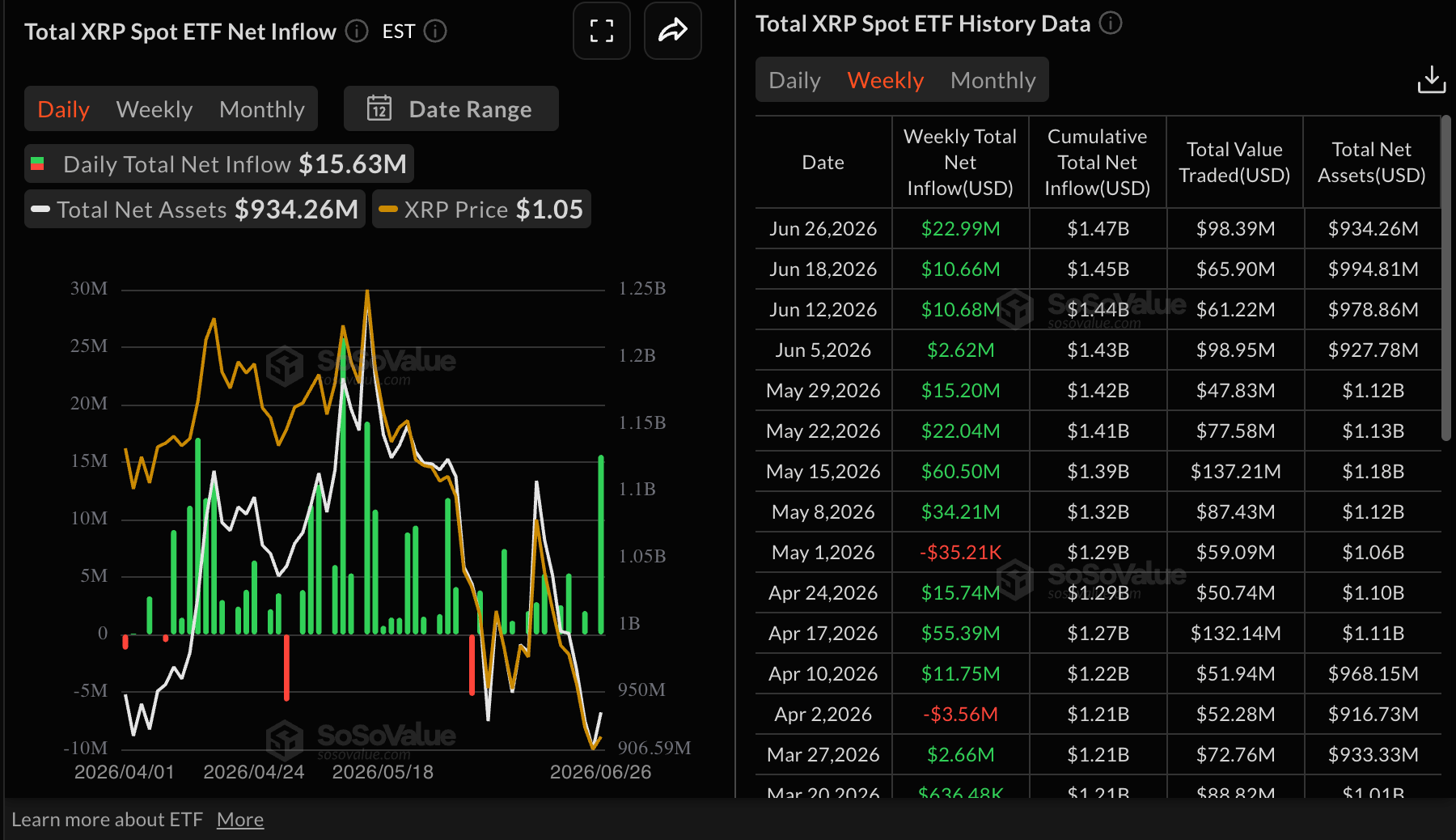
XRP spot Exchange-Traded Funds (ETFs) posted inflows on several days last week. According to SoSoValue data, US-listed spot ETF inflows more than doubled totalling to $23 million, up from nearly $11 million the previous week.
Cumulative inflows currently stand at $1.47 billion, up from the $1.45 billion recorded the week before, while assets under management dropped to $934 million from $995 million.
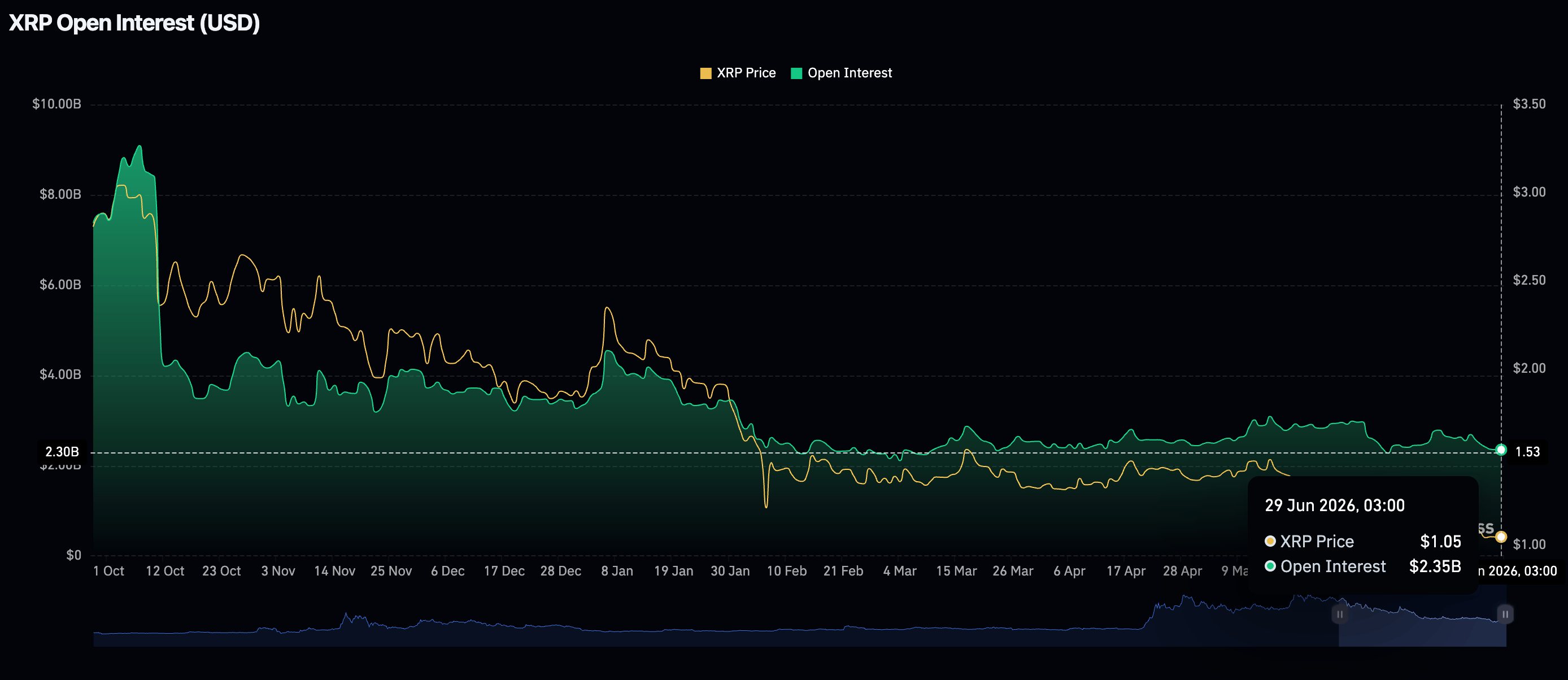
Steady institutional interest is required to offset a significantly suppressed retail market. CoinGlass data show that perpetual futures Open Interest (OI) has remained relatively stable at $2.36 billion, down from $2.69 billion on June 1. Compared to the record $10.94 billion in July, the current OI indicates that risk-averse sentiment dominates in the retail market. The return of retailers would be key for the resumption of the uptrend.
Price analysis: XRP holds key support amid a broader bearish trend
XRP trades at $1.05, keeping a clear bearish near-term tone as price holds well beneath the key Exponential Moving Averages (EMAs), with the 50-day EMA at $1.21, the 100-day EMA at $1.31 and the 200-day EMA at $1.53 all acting as overhead resistance.
The pair is also capped below the Bollinger Bands' middle boundary at $1.12, while the lower band near $1.01 offers the nearest technical floor.
Meanwhile, the Moving Average Convergence Divergence (MACD) histogram remains marginally negative and flat on the daily chart, while the Relative Strength Index (RSI) which sits at 33 sits, suggests subdued downside momentum.
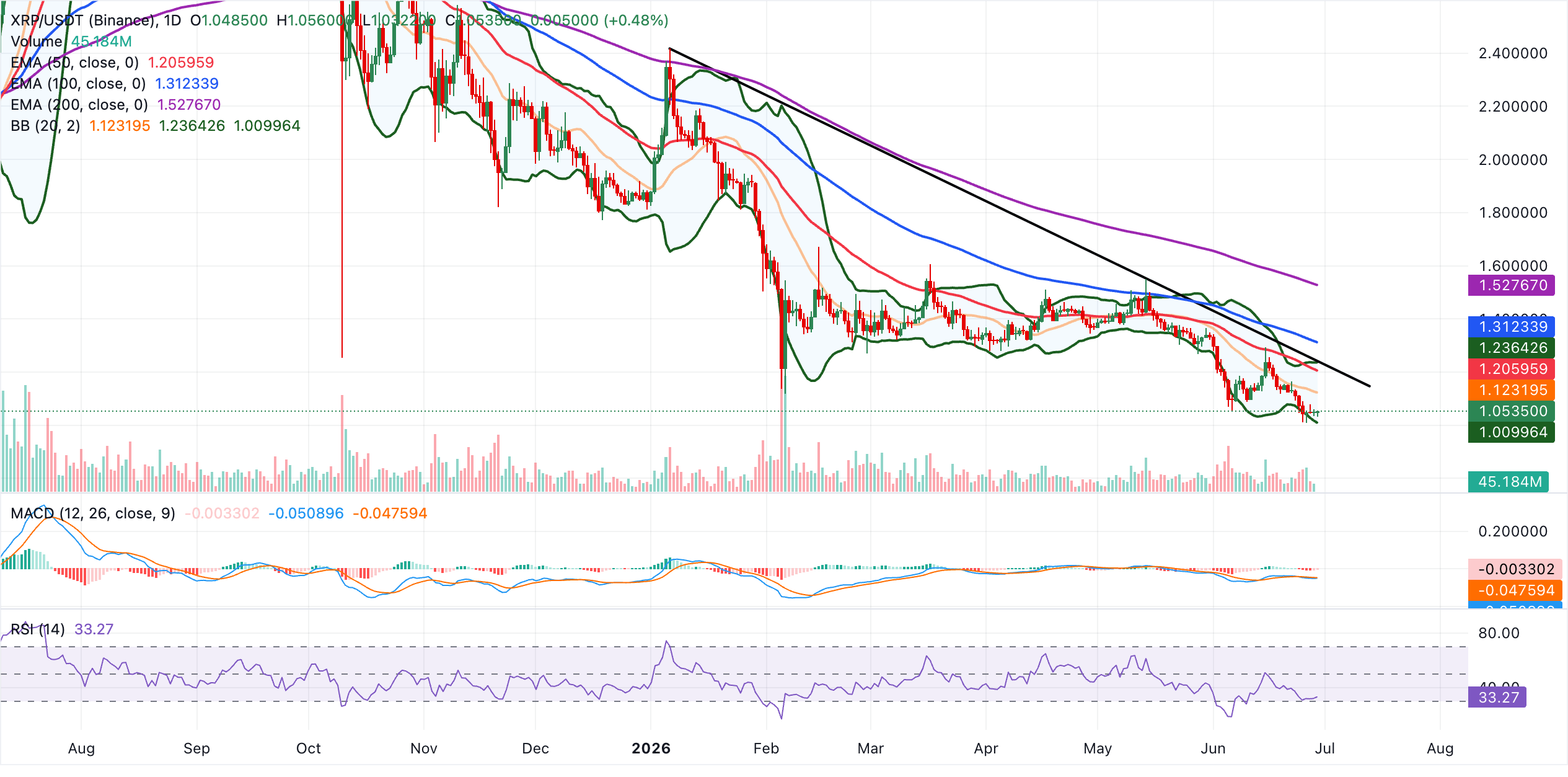
Initial resistance is seen at the Bollinger middle band around $1.12, ahead of a tighter cluster in the $1.23-$1.24 region where the Bollinger upper band aligns with the downward trendline’s break price. A daily close above this zone would be needed to ease the broader bearish pressure and target the 50-day EMA at $1.21 and. Further up, the 100-day EMA at $1.31 and the 200-day EMA at $1.53 would keep XRP constrained.
Looking down, immediate support is seen at the Bollinger lower band near $1.01. A decisive move below this level would expose fresh weakness, opening the door to a deeper retracement while keeping the overall structure firmly biased to the downside.
(The technical analysis of this story was written with the help of an AI tool.)
Ripple FAQs
Ripple is a payments company that specializes in cross-border remittance. The company does this by leveraging blockchain technology. RippleNet is a network used for payments transfer created by Ripple Labs Inc. and is open to financial institutions worldwide. The company also leverages the XRP token.
XRP is the native token of the decentralized blockchain XRPLedger. The token is used by Ripple Labs to facilitate transactions on the XRPLedger, helping financial institutions transfer value in a borderless manner. XRP therefore facilitates trustless and instant payments on the XRPLedger chain, helping financial firms save on the cost of transacting worldwide.
XRPLedger is based on a distributed ledger technology and the blockchain using XRP to power transactions. The ledger is different from other blockchains as it has a built-in inflammatory protocol that helps fight spam and distributed denial-of-service (DDOS) attacks. The XRPL is maintained by a peer-to-peer network known as the global XRP Ledger community.
XRP uses the interledger standard. This is a blockchain protocol that aids payments across different networks. For instance, XRP’s blockchain can connect the ledgers of two or more banks. This effectively removes intermediaries and the need for centralization in the system. XRP acts as the native token of the XRPLedger blockchain engineered by Jed McCaleb, Arthur Britto and David Schwartz.
Author

John Isige
FXStreet
John Isige is a seasoned cryptocurrency journalist and markets analyst committed to delivering high-quality, actionable insights tailored to traders, investors, and crypto enthusiasts. He enjoys deep dives into emerging Web3 tren