Ripple Price Forecast: XRP sell-off persists as $1.00 support level beckons
- XRP falls below $1.10, reflecting a broader, incessant sell-off in the crypto market.
- Institutional and retail demand remains subdued amid XRP spot ETF outflows and declining futures Open Interest.
- XRP bearish pressure is mounting, with a negative MACD histogram and oversold RSI.

Ripple (XRP) sustains downside pressure, slipping below $1.00 at the time of writing on Tuesday. The path of least resistance remains firmly downward, as the token’s upside is capped by downtrending technical indicators.
XRP mirrors the broader crypto market’s weakness, with Bitcoin (BTC) falling below $75,000. This has persisted for the sixth straight day, aligning with risk-off sentiment driven by macro uncertainties and other factors.
Traders are looking ahead to the United States (US) Consumer Price Index (CPI) report later on Tuesday, an inflation gauge the Federal Reserve (Fed) uses to shape monetary policy direction.
ETF and retail demand fade as XRP falters
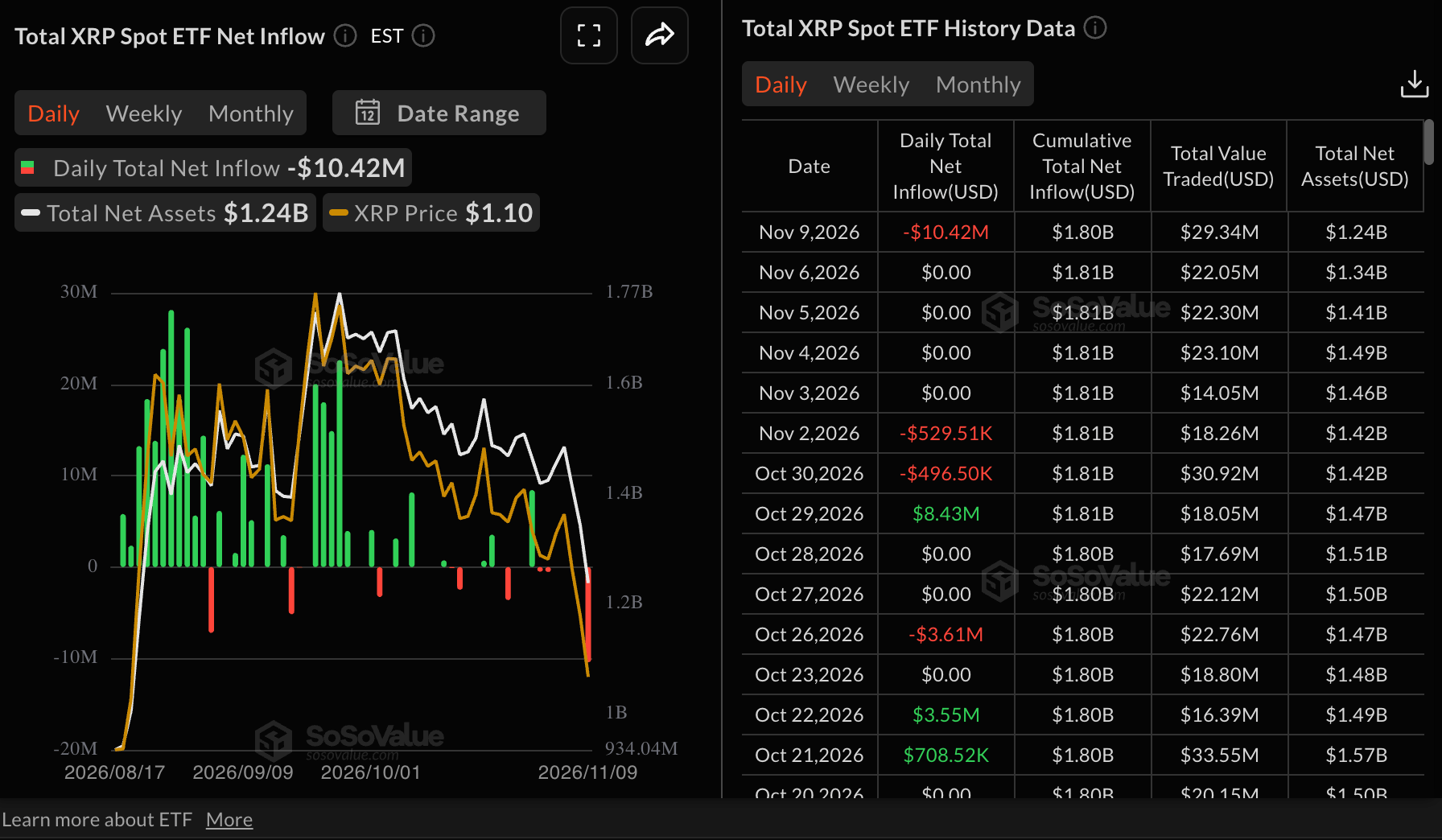
XRP spot Exchange-Traded Funds (ETFs) recorded $10 million in outflows on Monday, backing the risk-off sentiment. Looking back, activity had remained muted for four consecutive days since Tuesday last week. The lack of demand for XRP digital investment products indicates that the token lacks cushioning against headwinds, raising the odds of an extended downtrend.
Nonetheless, cumulative inflows stand at $1.8 billion, with net assets under management at $1.24. This setup suggests that investor interest in the underlying token is positive in the long term.
The derivatives market, however, remains largely subdued, with perpetual futures Open Interest (OI) at 2.24 billion XRP on Tuesday, down only marginally from 2.26 billion XRP the previous day. More broadly, OI holds below November highs of 2.35 billion XRP, and September’s 2.46 billion, according to CoinGlass. If retail demand stays low, price recovery may be an uphill battle, while sell-off odds multiply toward the $1.00 critical zone.
Technical analysis: XRP at risk of deeper losses
XRP trades at $1.08, extending a bearish near-term bias as it holds well below the main Exponential Moving Averages (EMAs) and a descending resistance trend line. The 50-day EMA at $1.30, the 100-day EMA at $1.30, and the 200-day EMA at $1.35 all sit overhead, suggesting the market is firmly capped by medium and longer-term supply, while the SuperTrend indicator at $1.26 reinforces that rallies remain corrective within a broader downtrend.
The Relative Strength Index (RSI) has slipped to about 25, entering oversold territory, and the Moving Average Convergence Divergence (MACD) histogram remains negative near, suggesting bearish momentum is stretched but not yet showing a convincing reversal signal.
Initial resistance emerges at the SuperTrend line around $1.26, ahead of a confluence band between the 50-day EMA at $1.29 and the downward resistance trendline break price near $1.30, which together define the first major hurdle for any rebound. Further up, the 100-day EMA at $1.30 and the 200-day EMA at $1.35 form a broader supply zone that would need to be reclaimed to ease the prevailing bearish structure.
With no clear nearby support levels on the daily chart, price remains vulnerable to further downside as long as it trades beneath this stacked resistance cluster.
(The technical analysis of this story was written with the help of an AI tool. Know more.)
Open Interest, funding rate FAQs
Higher Open Interest is associated with higher liquidity and new capital inflow to the market. This is considered the equivalent of increase in efficiency and the ongoing trend continues. When Open Interest decreases, it is considered a sign of liquidation in the market, investors are leaving and the overall demand for an asset is on a decline, fueling a bearish sentiment among investors.
Funding fees bridge the difference between spot prices and prices of futures contracts of an asset by increasing liquidation risks faced by traders. A consistently high and positive funding rate implies there is a bullish sentiment among market participants and there is an expectation of a price hike. A consistently negative funding rate for an asset implies a bearish sentiment, indicating that traders expect the cryptocurrency’s price to fall and a bearish trend reversal is likely to occur.
Author

John Isige
FXStreet
John Isige is a seasoned cryptocurrency journalist and markets analyst committed to delivering high-quality, actionable insights tailored to traders, investors, and crypto enthusiasts. He enjoys deep dives into emerging Web3 tren