XRP wobbles amid broader crypto market drawdown
- XRP extends sell-off to $1.37, falling alongside the broader cryptocurrency market on Thursday.
- XRP trades within a broadening bearish structure, defined by descending major moving averages.
- XRP ETFs see mild inflows of $1.21 million amid persistent risk-off sentiment.

Ripple (XRP) losses are deepening below the $1.40 pivotal level and is trading at $1.37 at the time of writing on Thursday. The decline is part of a persistent drawdown from the weekly high of $1.61, reached on March 17, and aligns with a broader crypto market sell-off driven by macroeconomic uncertainty and geopolitical tensions, especially in the Middle East.
XRP sees mild capital inflows as risk-off sentiment persists
Interest in XRP digital investment products remains on shaky ground, as observed through the uptake of spot Exchange-traded Funds (ETFs). Despite inflows extending for consecutive days, they have been significantly low at $1.12 million on Wednesday and $1.4 million on Tuesday.
On Monday, activity remained quiet, with no flows recorded. SoSoValue data shows that there were only two days of inflows last week, where US-listed ETFs received $1.98 million on Friday and nearly $5 million on March 17.
Meanwhile, total assets under management have slipped to approximately $996 million, down from $1.65 billion at the beginning of the year, and cumulative inflows average $1.21 billion.
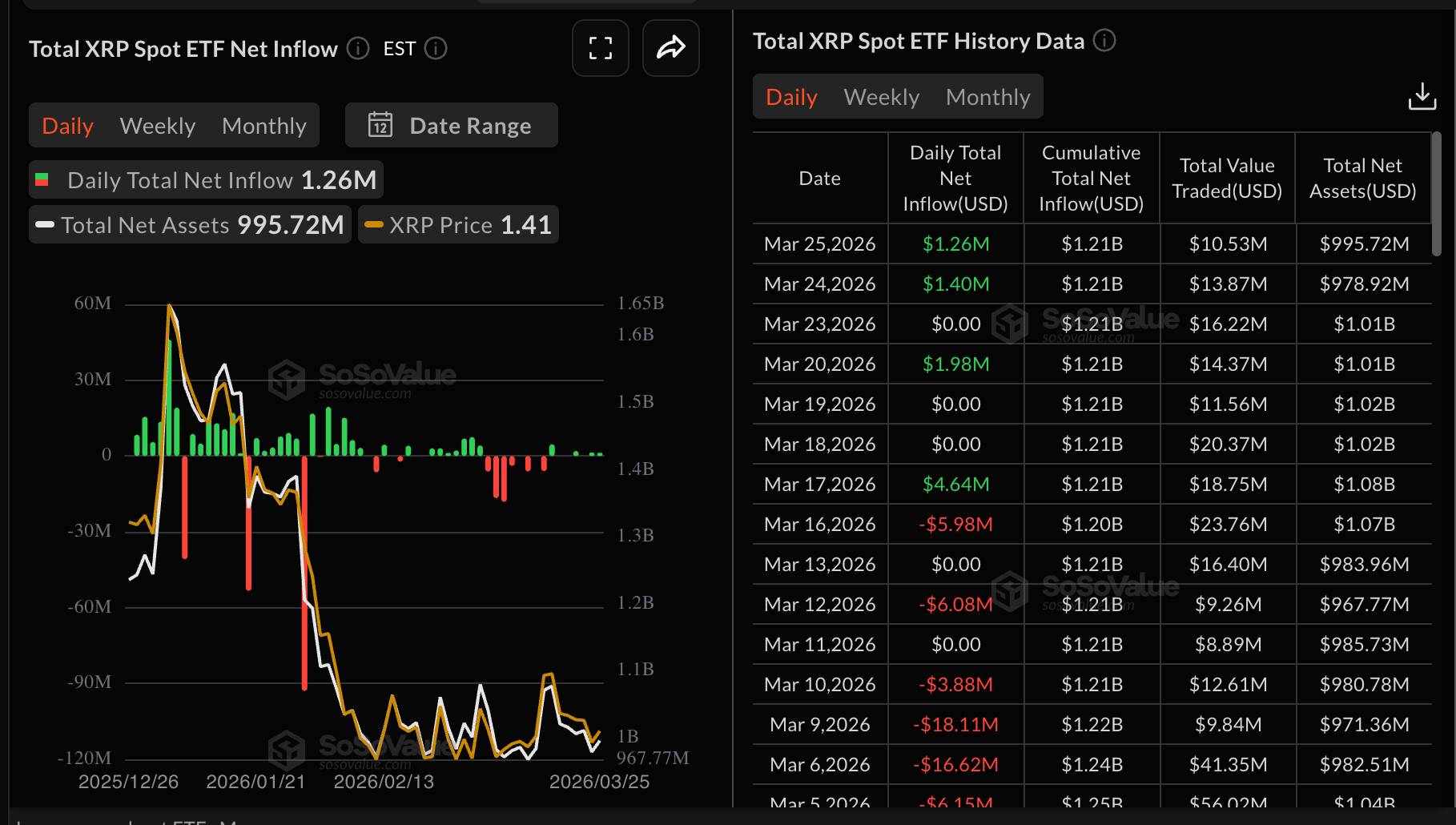
Persistent risk-off sentiment indicates a lack of confidence in XRP’s recovery potential or the token’s ability to sustain rallies. If this outlook persists, rebounds will continue to be absorbed by increasing supply, as investors reduce their risk exposure.
Technical outlook: XRP sellers tighten their grip
XRP sellers are largely in control, pushing the price downward to $1.37 at the time of writing on Thursday. The near-term bias is mildly bearish as XRP extends the pullback from the recent spike around $1.54 and holds well below the downward-curving 50-day, 100-day and 200-day Exponential Moving Averages (EMAs), which cluster above $1.48 and maintain a broader downward trend.
The rising support trendline from $1.12 has been broken, suggesting fading buying interest after the sharp mid-month advance. Similarly, the Moving Average Convergence Divergence (MACD) indicator has slipped marginally below its signal line on the daily chart, confirming waning bullish momentum. The Relative Strength Index (RSI) around 43 remains below the 50 midline on the same chart, reinforcing a bearish tone.
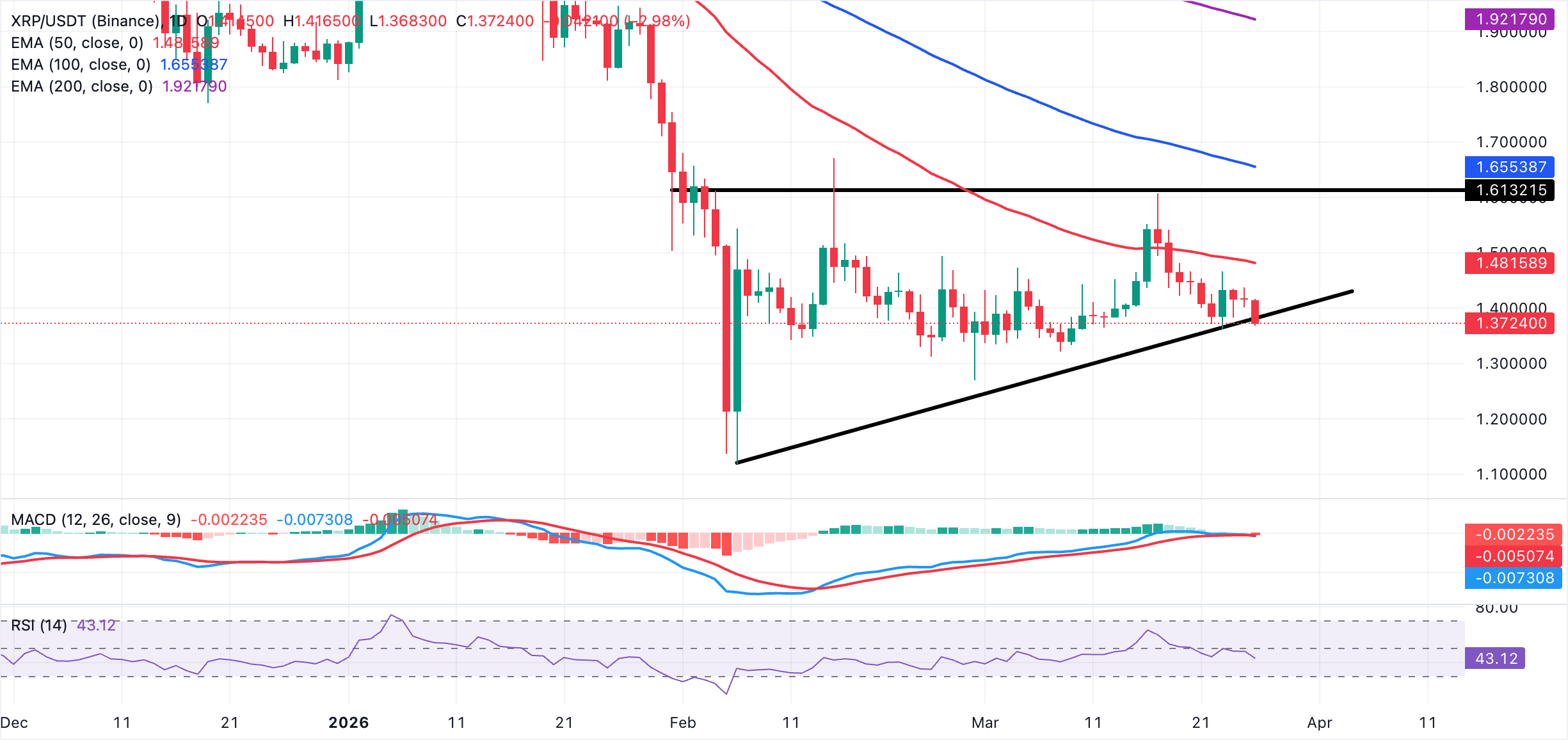
Initial resistance appears at the pivotal $1.40 threshold and the supply area at $1.43, where recent rebounds stalled. A stronger hurdle lies near the 50-day EMA at $1.48, followed by the $1.54 area. Above that area, the 100-day EMA at $1.66 would come within the scope. On the downside, immediate support lies at the weekly low of $1.36, with a clear break lower opening the door toward $1.32 as the next key demand zone.
Ripple FAQs
Ripple is a payments company that specializes in cross-border remittance. The company does this by leveraging blockchain technology. RippleNet is a network used for payments transfer created by Ripple Labs Inc. and is open to financial institutions worldwide. The company also leverages the XRP token.
XRP is the native token of the decentralized blockchain XRPLedger. The token is used by Ripple Labs to facilitate transactions on the XRPLedger, helping financial institutions transfer value in a borderless manner. XRP therefore facilitates trustless and instant payments on the XRPLedger chain, helping financial firms save on the cost of transacting worldwide.
XRPLedger is based on a distributed ledger technology and the blockchain using XRP to power transactions. The ledger is different from other blockchains as it has a built-in inflammatory protocol that helps fight spam and distributed denial-of-service (DDOS) attacks. The XRPL is maintained by a peer-to-peer network known as the global XRP Ledger community.
XRP uses the interledger standard. This is a blockchain protocol that aids payments across different networks. For instance, XRP’s blockchain can connect the ledgers of two or more banks. This effectively removes intermediaries and the need for centralization in the system. XRP acts as the native token of the XRPLedger blockchain engineered by Jed McCaleb, Arthur Britto and David Schwartz.
(The technical analysis of this story was written with the help of an AI tool.)
Author

John Isige
FXStreet
John Isige is a seasoned cryptocurrency journalist and markets analyst committed to delivering high-quality, actionable insights tailored to traders, investors, and crypto enthusiasts. He enjoys deep dives into emerging Web3 tren