XRP upholds sideways action amid mild ETF inflows
- XRP consolidates near $1.37 as modest buy-the-dip interest emerges.
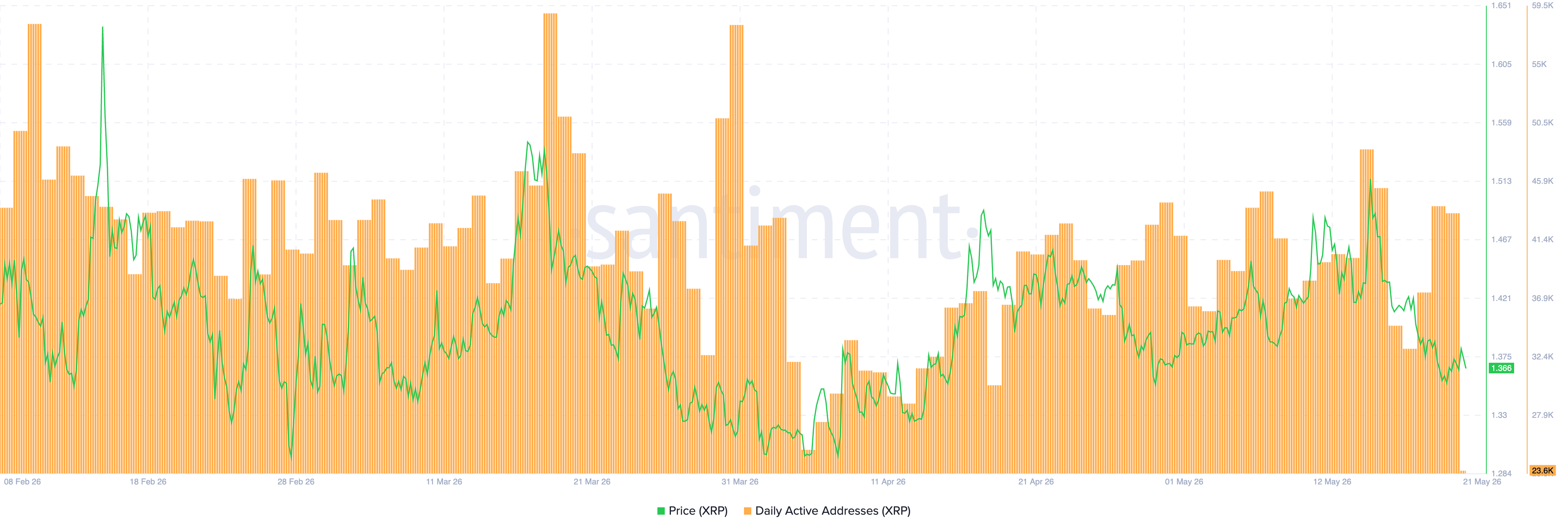
- Active addresses on the XRP Ledger approach 24,000 on Thursday, signaling a sustained uptick in speculative activity.
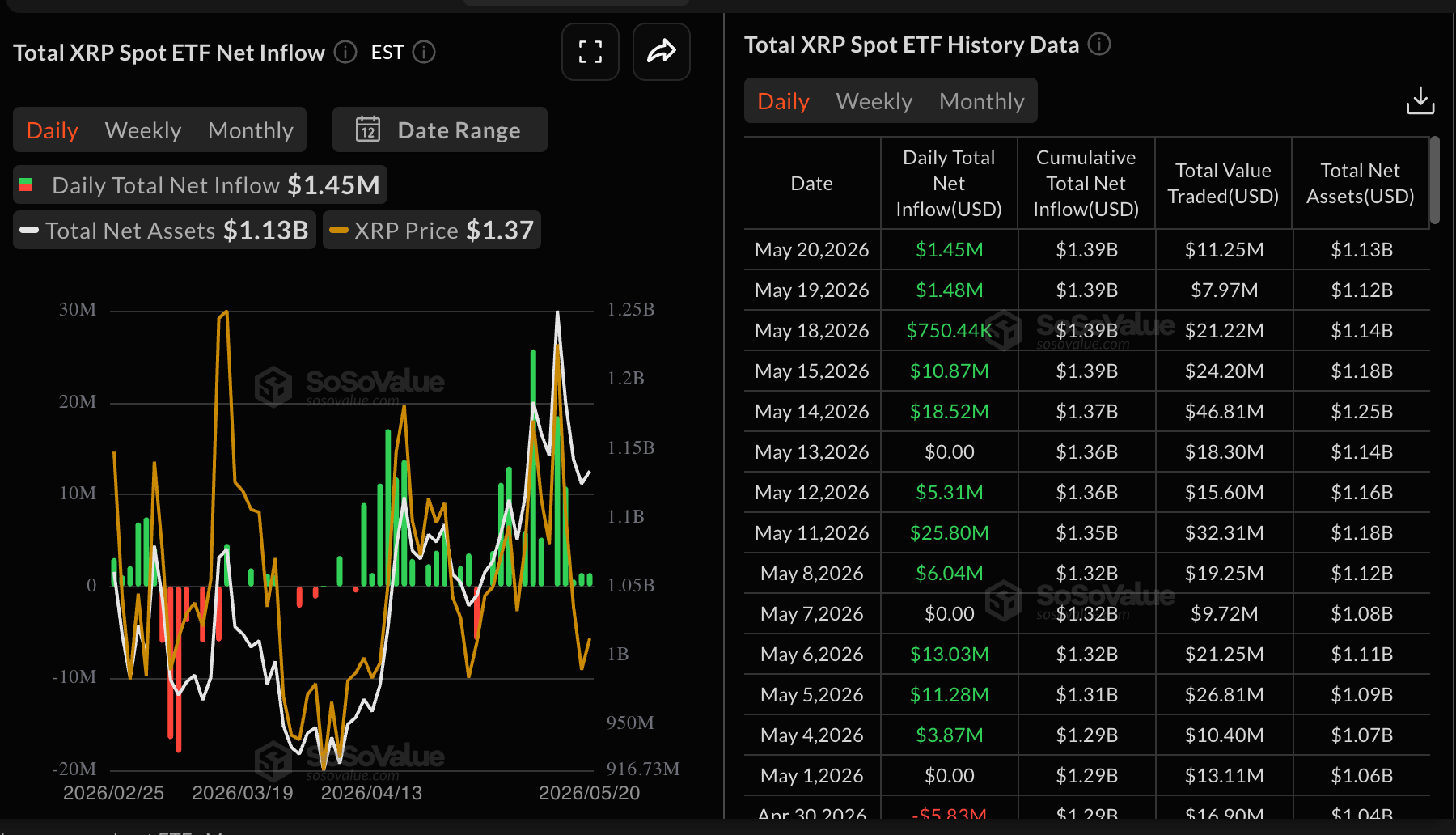
- XRP ETFs recorded steady but mild inflows of $1.45 million on Wednesday.

Ripple (XRP) remains calm, trading around $1.37 at the time of writing on Thursday. The current sideways action follows a subtle recovery from support at $1.35, and reflects broader optimism for a US-Iran peace deal.
Iran is reportedly reviewing a peace proposal from the US, delivered through Pakistan, the mediator. US President Donald Trump said on Wednesday that the two countries are in the final stages of peace negotiations. However, Trump added that the situation could escalate if Iran does not make a deal, prompting caution across global markets.
Network activity builds on the XRP Ledger
The number of active addresses on the XRP Ledger (XRPL) has gained traction since Monday, nearing 24,000 on Thursday, according to Santiment data. Active addresses track wallets that interact with the network by sending or receiving assets over a given period.
A steady increase suggests growing user engagement and speculative interest. At the same time, investor confidence tends to improve when on-chain activity affirms price strength and reduces bearish conviction.
Institutions are showing mild speculative interest, as XRP spot Exchange-Traded Funds (ETFs) extended their bullish streak with inflows totaling $1.45 billion on Wednesday. According to SoSoValue, cumulative XRP ETF inflows have stabilized at $1.39 billion, with average net assets under management at $1.13 billion. Sustained ETF growth will be crucial to bolstering bullish sentiment and underpinning XRP’s near-term rebound.
Price analysis: XRP consolidation persists
XRP trades around $1.37, keeping a bearish near-term bias as price holds below all its major Exponential Moving Averages (EMAs) and a recently broken rising trendline. The 50-day EMA at $1.41, backed by the ascending trendline around $1.40, acts as immediate overhead supply, while the 100-day and 200-day EMAs, at $1.48 and $1.70 respectively, reinforce the broader topping tone.
Momentum supports this cautious view, with the Relative Strength Index (RSI) hovering near 43 and the Moving Average Convergence Divergence (MACD) histogram in negative territory, hinting that rallies are likely to face selling pressure.
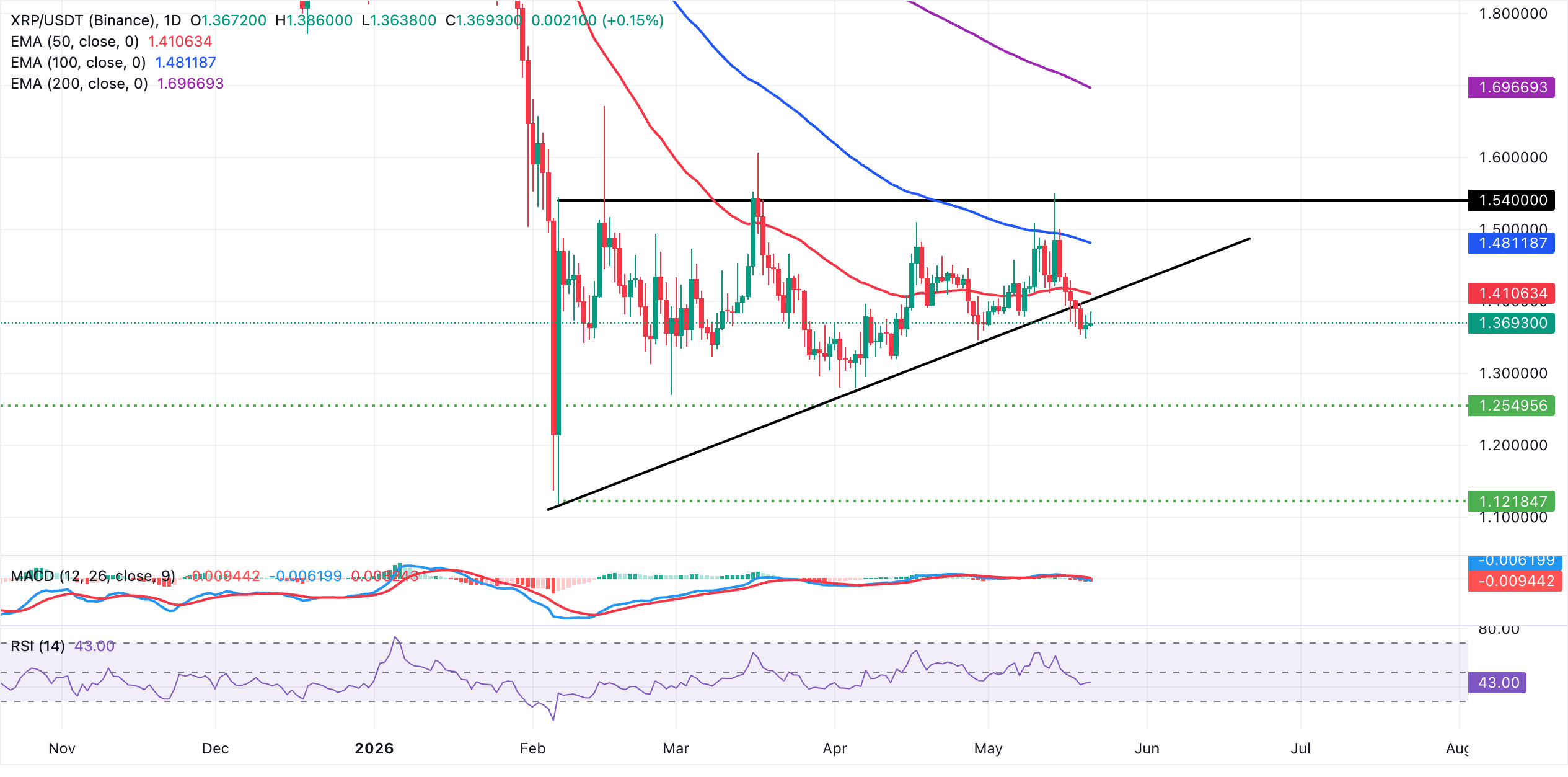
On the topside, initial resistance emerges at the former trendline support turned barrier near $1.40, followed closely by the 50-day EMA at $1.41, forming a nearby cap that bulls would need to reclaim to ease immediate downside pressure. Above that, the 100-day EMA at $1.48 and the 200-day EMA near $1.70 define progressively stronger resistance zones that currently frame the broader bearish structure. If selling activity overwhelms demand, XRP may drop to retest support at $1.35, with a deeper correction likely to extend toward $1.30.
(The technical analysis of this story was written with the help of an AI tool.)
Crypto ETF FAQs
An Exchange-Traded Fund (ETF) is an investment vehicle or an index that tracks the price of an underlying asset. ETFs can not only track a single asset, but a group of assets and sectors. For example, a Bitcoin ETF tracks Bitcoin’s price. ETF is a tool used by investors to gain exposure to a certain asset.
Yes. The first Bitcoin futures ETF in the US was approved by the US Securities & Exchange Commission in October 2021. A total of seven Bitcoin futures ETFs have been approved, with more than 20 still waiting for the regulator’s permission. The SEC says that the cryptocurrency industry is new and subject to manipulation, which is why it has been delaying crypto-related futures ETFs for the last few years.
Yes. The SEC approved in January 2024 the listing and trading of several Bitcoin spot Exchange-Traded Funds, opening the door to institutional capital and mainstream investors to trade the main crypto currency. The decision was hailed by the industry as a game changer.
The main advantage of crypto ETFs is the possibility of gaining exposure to a cryptocurrency without ownership, reducing the risk and cost of holding the asset. Other pros are a lower learning curve and higher security for investors since ETFs take charge of securing the underlying asset holdings. As for the main drawbacks, the main one is that as an investor you can’t have direct ownership of the asset, or, as they say in crypto, “not your keys, not your coins.” Other disadvantages are higher costs associated with holding crypto since ETFs charge fees for active management. Finally, even though investing in ETFs reduces the risk of holding an asset, price swings in the underlying cryptocurrency are likely to be reflected in the investment vehicle too.
Author

John Isige
FXStreet
John Isige is a seasoned cryptocurrency journalist and markets analyst committed to delivering high-quality, actionable insights tailored to traders, investors, and crypto enthusiasts. He enjoys deep dives into emerging Web3 tren