XRP slips under $1.20 as sentiment stays fragile
- XRP corrects to trade below $1.20 following early-week rejection at $1.28 and broader crypto market weakness.
- Ripple has invested in Flutterwave’s Series E funding round, aimed at bridging stablecoin payments across Africa.
- XRP remains under pressure from declining major moving averages, undermining the MACD buy signal.

Ripple (XRP) remains weak on Wednesday as investors cautiously await the Federal Reserve’s (Fed) interest rate decision. Market participants have fully priced in the Federal Open Market Committee’s (FOMC) rate decision, with nearly unanimous expectations of no change. However, crypto traders are closely watching Fed Chair Kevin Warsh’s post-meeting press conference for forward guidance, as surging inflation, now at a three-year high, heightens sensitivity to any signals on future monetary policy.
The United States (US) and Iran are expected to sign the Memorandum of Understanding (MoU), which lays out a peace agreement to end the war in the Middle East, on Friday.
The reopening of the Strait of Hormuz and the removal of the blockade on Iranian ports mark the first achievements of the deal. Negotiations on Iran’s nuclear program and sanctions will begin Friday, leveraging the 60-day tentative peace arrangement.
Cryptocurrency prices show notable weakness, trimming early-week gains as investors navigate macroeconomic uncertainty and geopolitical tensions. XRP, for instance, is trading below the $1.20 resistance and remains vulnerable to losses.
Ripple expands stablecoin footprint in Africa
Ripple has announced a strategic investment in Flutterwave’s Series E funding round, aimed at integrating the network’s US Dollar (USD)-denominated stablecoin, RLUS, into Flutterwave’s payments infrastructure.
Flutterwave is a major provider of blockchain-based enterprise solutions for traditional and digital finance in Africa. The partnership will boost the Nigerian-based company’s efforts to enable stablecoin payments across the continent through institutional-grade solutions and liquidity.
“Our investment will establish RLUSD within that infrastructure, with Flutterwave driving stablecoin flows over the XRPL and deepening its role as a settlement layer for real-world payments across the continent,” Reece Merrick, Ripple’s Managing Director, MEA, said.
RLUSD is an institutional-grade stablecoin issued by Ripple through its subsidiary, Standard Custody & Trust Company. It has a market capitalization of $1.6 billion and ranks 10th among other stablecoins.
Price analysis: XRP vulnerable to extended losses
XRP trades below $1.20 keeping a bearish near-term bias. The remittance token also holds well below the 50-day, 100-day and 200-day Exponential Moving Averages (EMAs), which cluster between roughly $1.28 and $1.58 and act as an overarching supply zone. Despite the Moving Average Convergence Divergence (MACD) histogram turning positive on the daily chart, the broader structure remains capped.
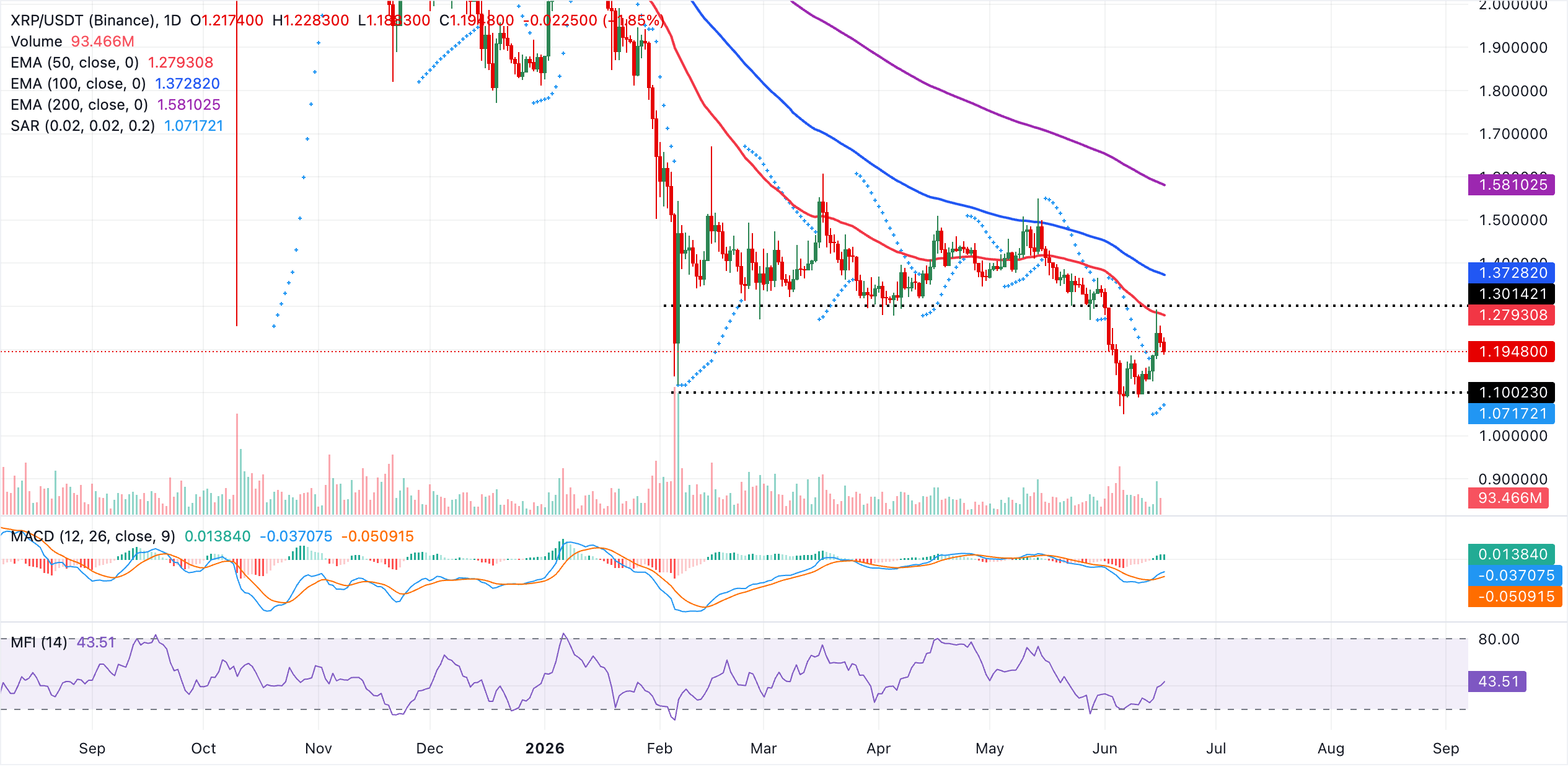
XRP's initial resistance is seen at the 50-day EMA near $1.28, followed by the 100-day EMA around $1.37, with the 200-day EMA higher up near $1.58 reinforcing a medium-term ceiling. On the downside, the first notable support aligns with the latest Parabolic SAR print at $1.07. A daily close below this level would likely reopen the path toward lower levels despite the modest improvement in money flows reflected by the Money Flow Index (MFI) hovering in the low-40s.
(The technical analysis of this story was written with the help of an AI tool.)
Cryptocurrency prices FAQs
Token launches influence demand and adoption among market participants. Listings on crypto exchanges deepen the liquidity for an asset and add new participants to an asset’s network. This is typically bullish for a digital asset.
A hack is an event in which an attacker captures a large volume of the asset from a DeFi bridge or hot wallet of an exchange or any other crypto platform via exploits, bugs or other methods. The exploiter then transfers these tokens out of the exchange platforms to ultimately sell or swap the assets for other cryptocurrencies or stablecoins. Such events often involve an en masse panic triggering a sell-off in the affected assets.
Macroeconomic events like the US Federal Reserve’s decision on interest rates influence crypto assets mainly through the direct impact they have on the US Dollar. An increase in interest rate typically negatively influences Bitcoin and altcoin prices, and vice versa. If the US Dollar index declines, risk assets and associated leverage for trading gets cheaper, in turn driving crypto prices higher.
Halvings are typically considered bullish events as they slash the block reward in half for miners, constricting the supply of the asset. At consistent demand if the supply reduces, the asset’s price climbs.
Author

John Isige
FXStreet
John Isige is a seasoned cryptocurrency journalist and markets analyst committed to delivering high-quality, actionable insights tailored to traders, investors, and crypto enthusiasts. He enjoys deep dives into emerging Web3 tren