Prediction markets monthly volume hits $26B, driven by retail activity, Bitcoin and sports
- Prediction markets trading volume rose to $25.7 billion by March, up from roughly $1.2 billion in 2025.
- Trading volume on Polymarket is largely skewed toward retail, with 82% of users trading under $10,000 throughout Q1.
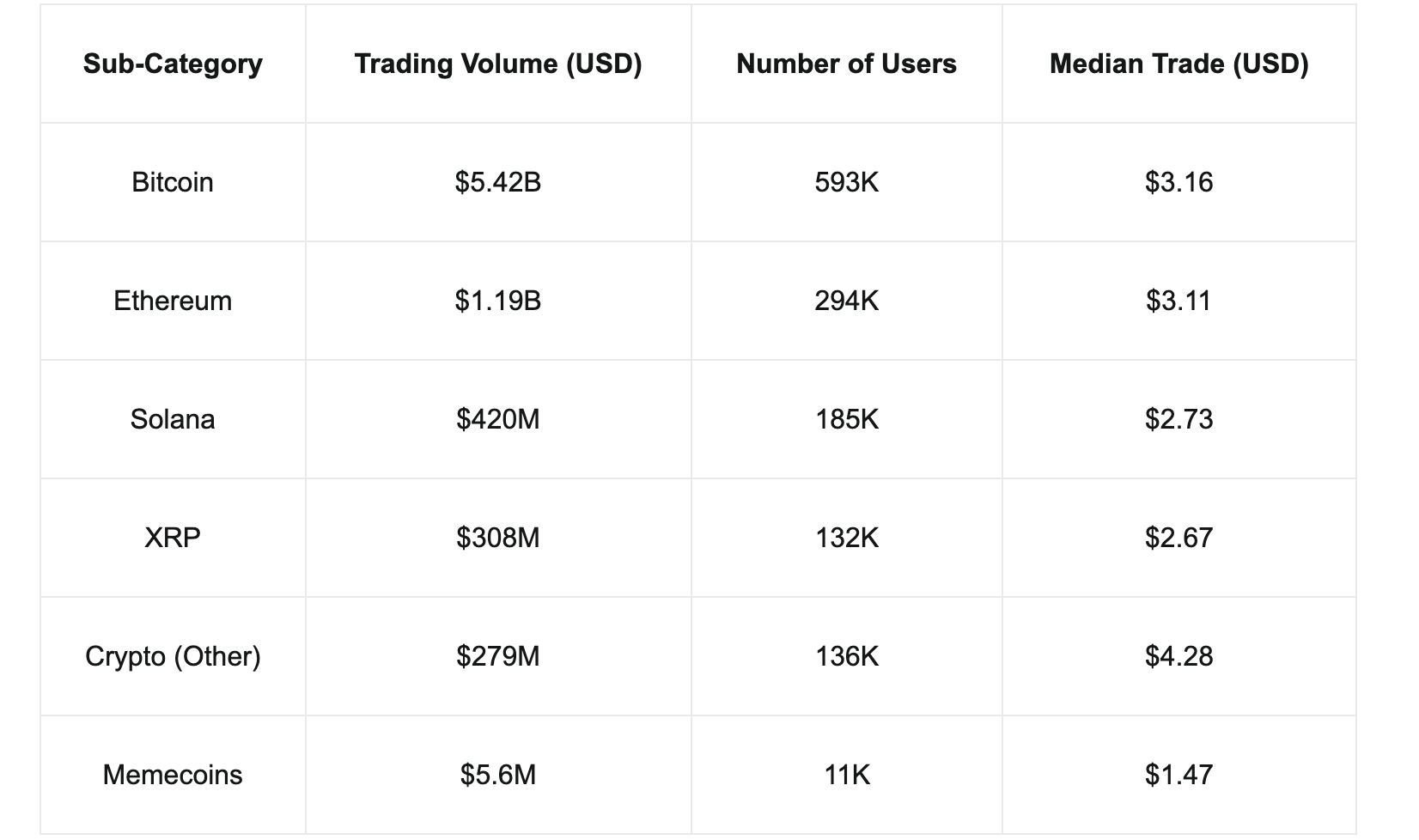
- Bitcoin draws nearly 600,000 users, trading a total of $5.42 million in volume with an average trade of $3.16.

Prediction markets continue to gain traction in 2026, with monthly trading volume nearing $26 billion in March, according to a Wednesday report from Bitget Wallet, prepared in collaboration with Polymarket and Dune Analytics.
Retail scales prediction markets growth
The report found that roughly 82% of users on Polymarket, the largest prediction markets platform, traded under $10,000 across the first quarter, with only 2.5% crossing the $100,000 mark.
The majority of transactions on Polymarket were dominated by micro users, averaging $35, with light investors trading $392. This translates into millions of transactions by individual traders rather than “a handful of institutions moving large positions,” the report states.
Prediction markets appear to be scaling fast, with volume surging to $26 billion in March, a 95% increase from $1.2 billion in 2025. Bitget Wallet’s report estimates that prediction markets could grow to hit $240 billion in annual volume in 2026 and reach $1 trillion by 2030.
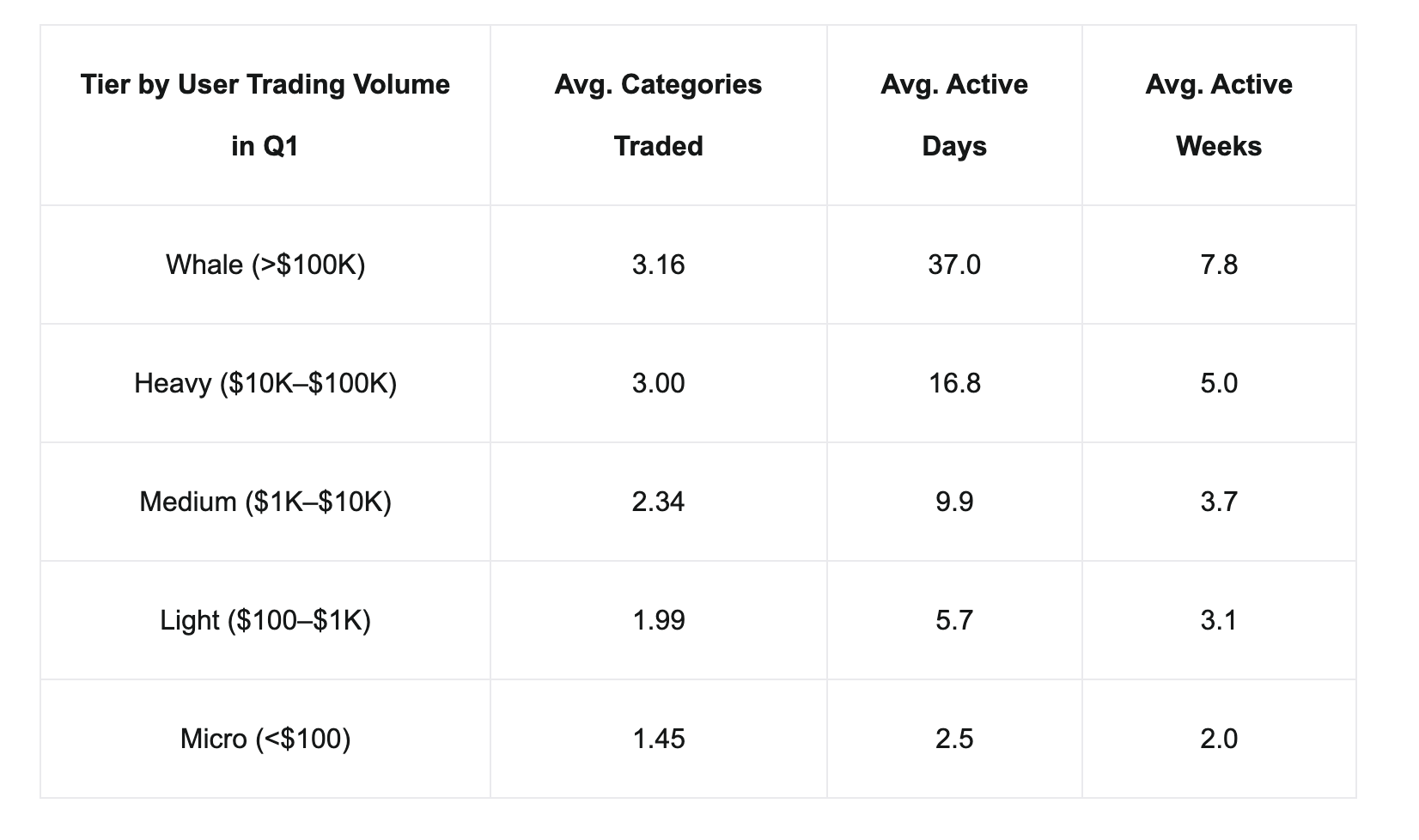
The report highlighted a distinct pattern in which users focus on broadening their scope rather than increasing trade sizes. Micro traders logged an average of 2.5 active days across 1.45 categories, while medium-tier users logged 9.9 active days across approximately 2.3 categories.
“Each new category a user explores becomes another reason to return. This shows that retention is not driven by taking bigger risks, but by expanding the range of opportunities users can engage with,” Bitget Wallet explained in the report.
Crypto dominates prediction markets
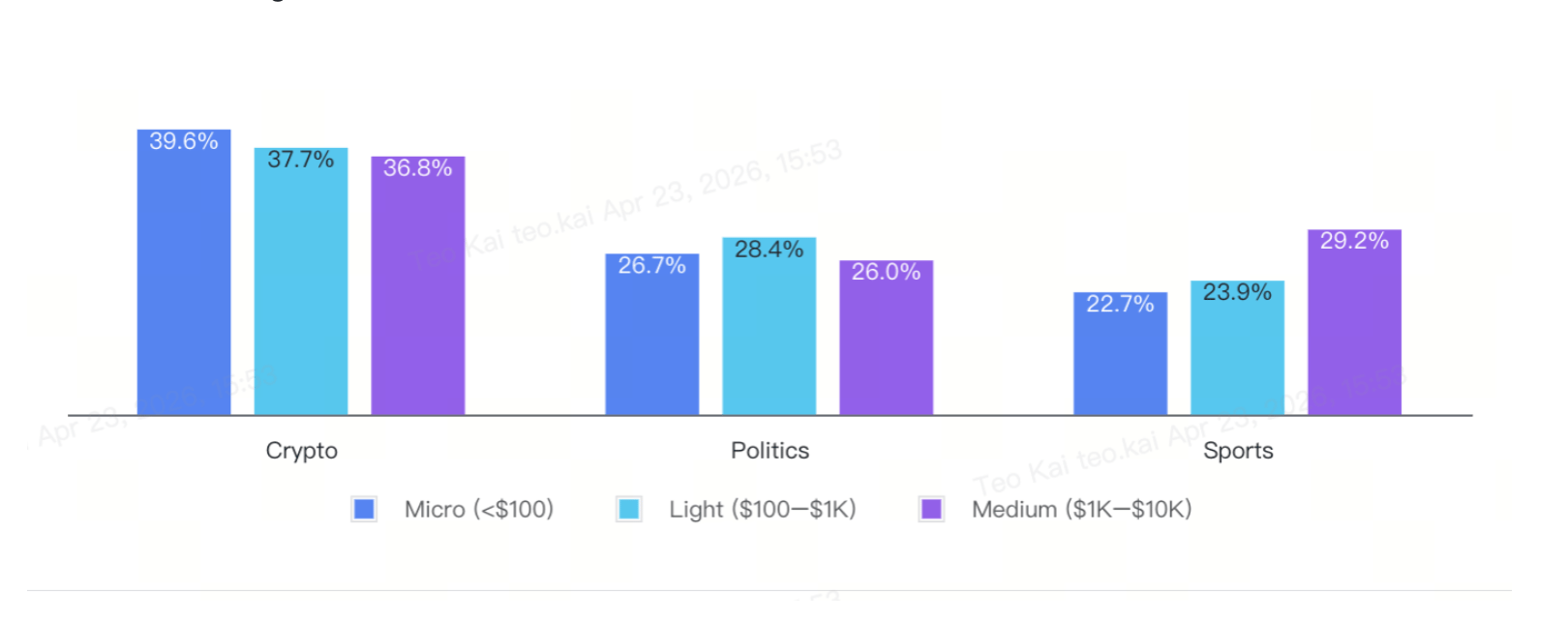
Crypto remains the key driver of prediction markets, accounting for 39.6% of activity among the smallest traders in Q1. Notably, the activity is highly concentrated in Bitcoin, drawing approximately 593,000 users and $5.42 billion in volume, with an average trade of $3.16. Bets across altcoins such as Ethereum (ETH), Ripple (XRP), and Solana (SOL) carried a median trade size of $2 to $3.
It is worth mentioning that while crypto appears to be the front door to prediction markets, its share drops as users get more active, averaging 36.8% among mid-tier users.
Another observation that stands out is the shift from crypto toward real-world events. Sports events increased from 22.7% among micro traders to 29.2% among mid-tier traders in Q1. Political events remained steady, averaging 28% across all segments.
Prediction markets and macro signals
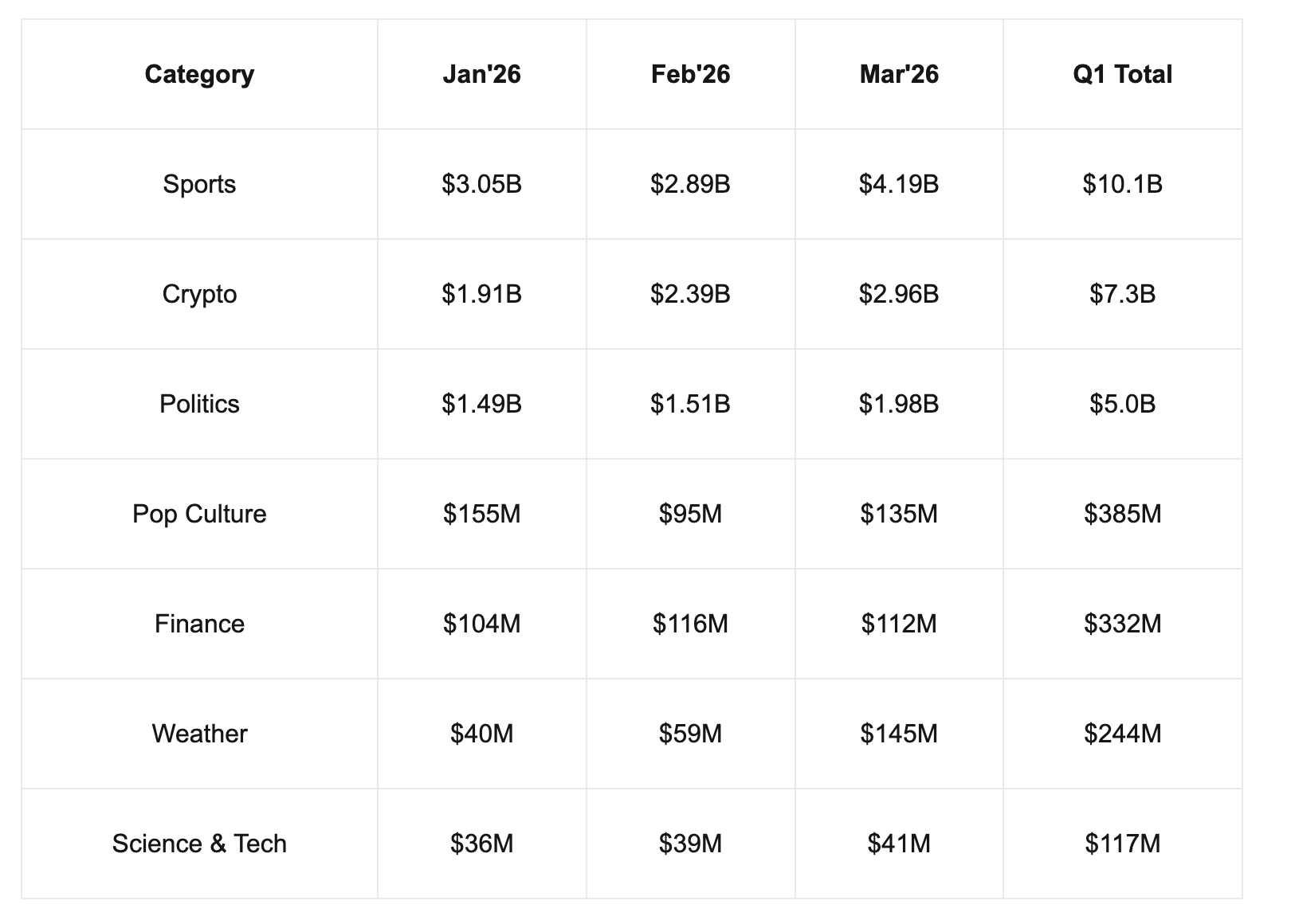
Prediction markets are growing beyond trading and becoming macro-layered signals amid global uncertainty. Politically centered markets generated up to $1 billion in Q1, driven by roughly 377,000 users. Elections accounted for $942 million, cutting across policy, trade relations and macro developments and not just single moments.
The report concludes that prediction markets are maturing into a full-fledged industry, rather than a market driven by occasional trades. To achieve the projected growth, stakeholders should not focus only on building more markets but also on helping users access information, discover key movers, interpret signals and act on them with minimal friction.
Bitcoin, altcoins, stablecoins FAQs
Bitcoin is the largest cryptocurrency by market capitalization, a virtual currency designed to serve as money. This form of payment cannot be controlled by any one person, group, or entity, which eliminates the need for third-party participation during financial transactions.
Altcoins are any cryptocurrency apart from Bitcoin, but some also regard Ethereum as a non-altcoin because it is from these two cryptocurrencies that forking happens. If this is true, then Litecoin is the first altcoin, forked from the Bitcoin protocol and, therefore, an “improved” version of it.
Stablecoins are cryptocurrencies designed to have a stable price, with their value backed by a reserve of the asset it represents. To achieve this, the value of any one stablecoin is pegged to a commodity or financial instrument, such as the US Dollar (USD), with its supply regulated by an algorithm or demand. The main goal of stablecoins is to provide an on/off-ramp for investors willing to trade and invest in cryptocurrencies. Stablecoins also allow investors to store value since cryptocurrencies, in general, are subject to volatility.
Bitcoin dominance is the ratio of Bitcoin's market capitalization to the total market capitalization of all cryptocurrencies combined. It provides a clear picture of Bitcoin’s interest among investors. A high BTC dominance typically happens before and during a bull run, in which investors resort to investing in relatively stable and high market capitalization cryptocurrency like Bitcoin. A drop in BTC dominance usually means that investors are moving their capital and/or profits to altcoins in a quest for higher returns, which usually triggers an explosion of altcoin rallies.
Author

John Isige
FXStreet
John Isige is a seasoned cryptocurrency journalist and markets analyst committed to delivering high-quality, actionable insights tailored to traders, investors, and crypto enthusiasts. He enjoys deep dives into emerging Web3 tren