MiCA locked USDT out of Europe: The liquidity didn't disappear, it moved
A liquidity read on MiCA's stablecoin shake-out, and where the flows may be heading
On July 1, the world's largest stablecoin lost its access to regulated Europe. Tether's USDT, with around $184 billion in circulation, is now unusable on every licensed exchange across the EU.
Not banned. Delisted. For anyone moving size through these markets, that distinction is the whole story.
Under MiCA, only stablecoins issued by an authorized entity can be offered on a licensed European venue. Tether never applied. So when the grace period ended, Coinbase, Kraken, Crypto.com and the rest of the licensed field pulled USDT, while Circle's USDC and euro-pegged EURC, both authorized, stayed listed.
The market moved ahead of the deadline. USDT volume on EU venues fell more than 70% while USDC nearly doubled. A rulebook, not a price signal, relocated a whole flow of liquidity from one rail to another.
Size stopped being a defense
The deeper, more heavily traded token got shown the door. USDT dwarfs USDC in volume, and none of it mattered, because scale was never the moat. The license was.
Tether wasn't alone. Binance couldn't secure authorization from any EU regulator and exited the same day, but for a different reason. Tether chose not to comply. Binance couldn't get licensed, caught by the fit-and-proper test after years in the grey zone. One walked away from the door; the other was turned away at it.
The safety paradox
Here's what the headlines miss:
“Compliant” doesn't mean “safer.”
When Silicon Valley Bank collapsed in March 2023, the token that cracked was USDC; it fell to $0.87 with billions stuck in a failing bank. USDT held its peg through the same week.
That paradox underlies Tether's refusal. MiCA requires issuers to hold roughly 60% of reserves in EU bank deposits; Tether keeps the bulk in short-dated US Treasuries and argues the rule forces the exact bank-failure risk that broke USDC. Compliance and stability, it turns out, are two different questions.
What it means for positioning
USDT doesn't vanish. You can still hold it, send it, swap it on-chain. But the regulated door has closed, and it's still closing: Revolut is now phasing USDT out for European users too.
For institutions, there was never a workaround. A regulated EU desk can't self-custody around the rules; USDC isn't the better option, it's the only permitted one.
BNY Mellon has already made USDC the first stablecoin on its custody platform, and Crédit Agricole's CACEIS launched its own compliant euro token.
The structural read: of more than 1,200 EU crypto firms once registered, only around 210 cleared authorization, under one in five, with fines up to €15 million or 12.5% of turnover for the rest. This is consolidation, not collapse. The field is maturing.
One last thing, for the chart-watchers
Now pull up the supply charts, because they raise a question MiCA was never meant to answer.
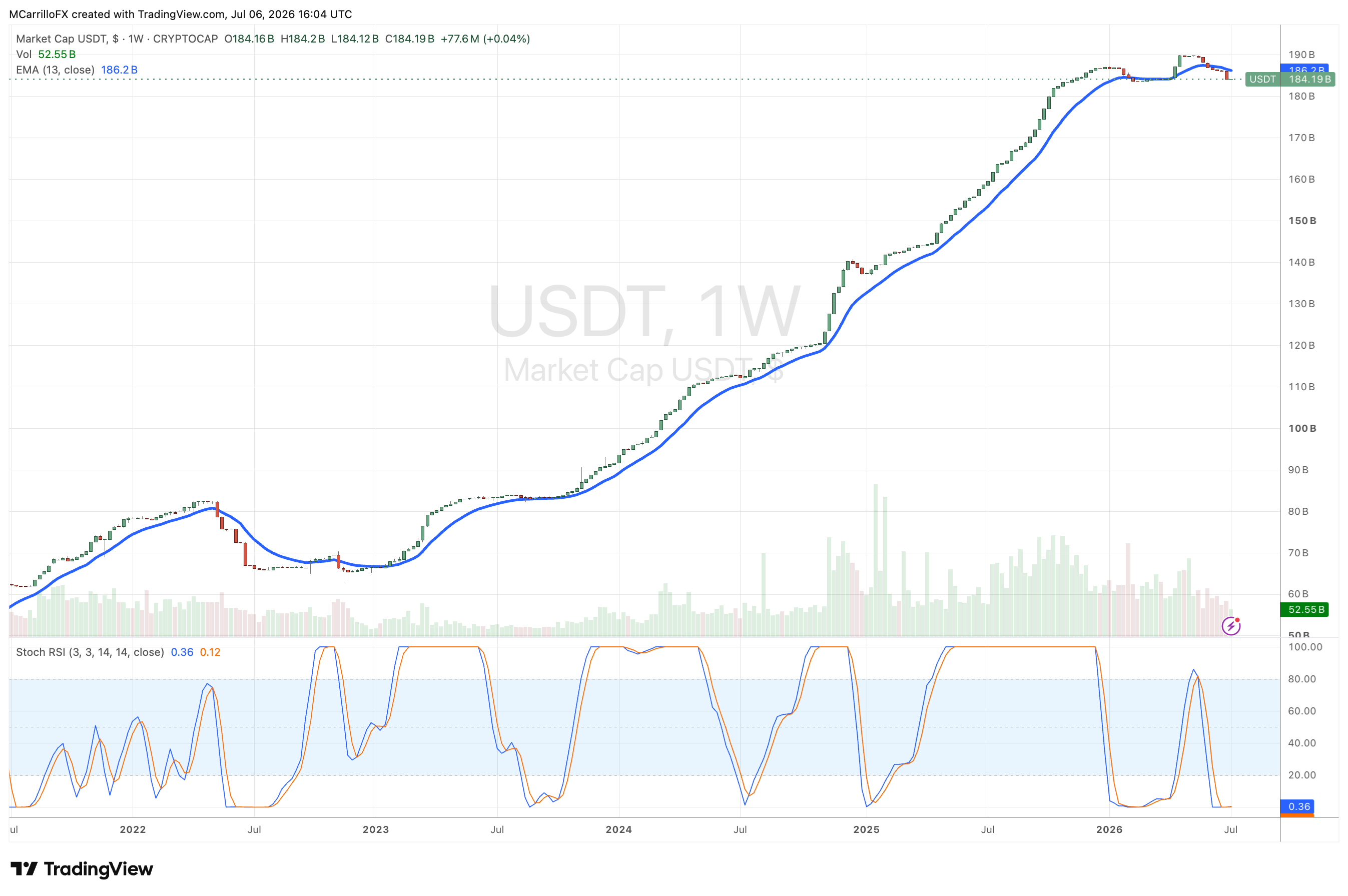
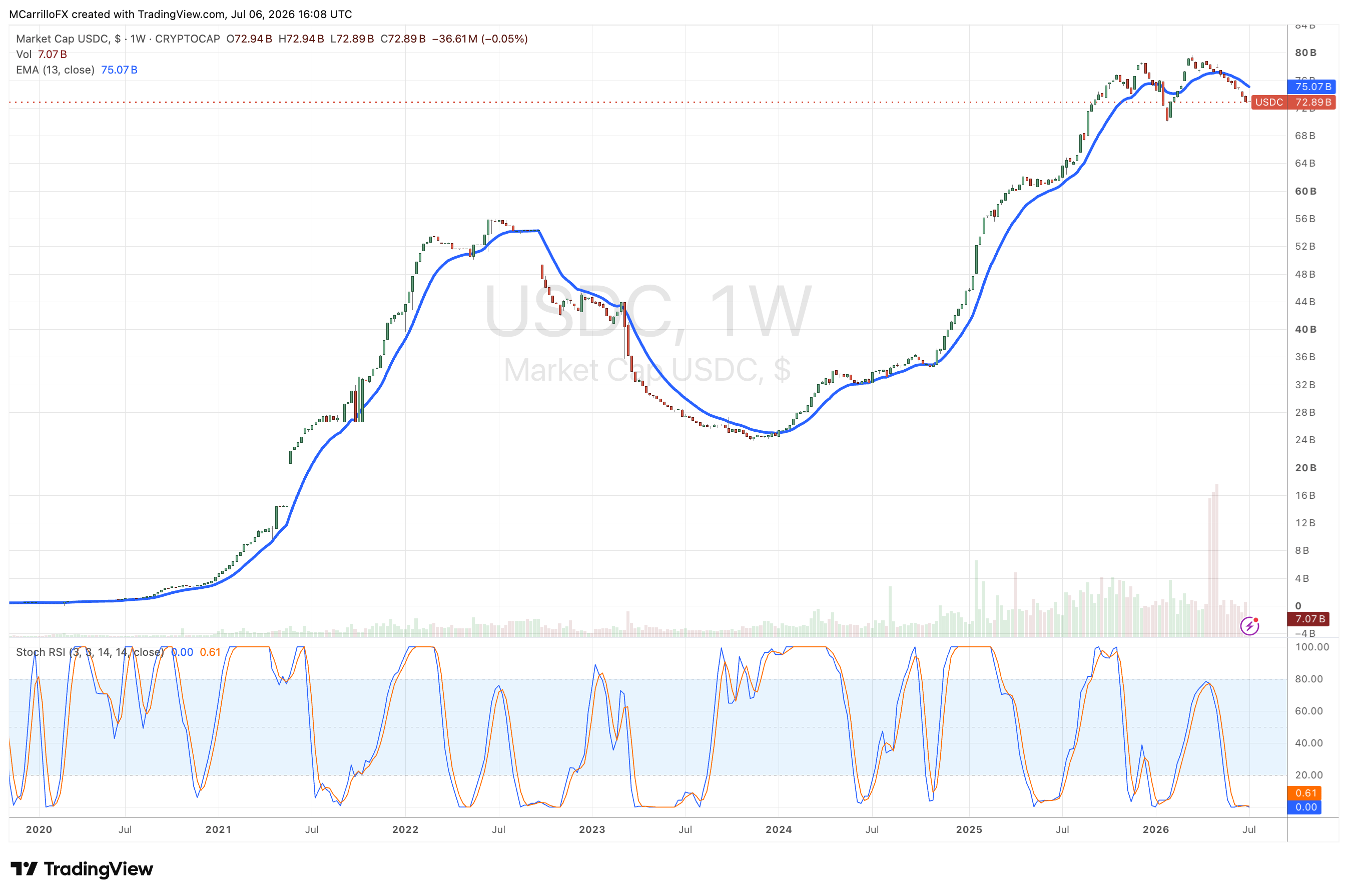
USDT sits near record supply, roughly $184 billion, barely flinching as Europe locks it out. USDC, the compliant winner, is around $73 billion and drifting slightly off its highs. The blessed coin softens; the exiled one doesn't move.
To be clear, this isn't a knock on MiCA. Cleaning the field from more than two thousand registered firms down to two hundred authorized ones is the market maturing, not failing. That's the point of a rulebook.
But regulation doesn't destroy liquidity. It relocates it. And if USDT can be shut out of an entire continent without losing supply, then that demand didn't disappear... it's simply somewhere else.
The question is where.
USDT has always been the dollar of the emerging world: Istanbul, Manila, Buenos Aires, Lagos, across Asia's trade corridors. USDC is the dollar of Western institutions.
So the divergence on these charts may be the small, visible edge of a much larger sorting: a regulated Western tier of digital dollars and a global tier responding to entirely different demand.
Europe drew a clean line around its own market. What the charts hint at is the flow on the other side of that line - moving east, moving south, toward the poles where the next chapter of money is being written. The dollar still rules.
The question worth watching is whose hands are holding the digital version, and where. And whether the new framework belongs to the old guard, or to a new order.
Author

Mauricio Carrillo
Witbrew
Mauricio Carrillo is a financial journalist, fintech executive, and inter-markets analyst with fifteen years of experience at the intersection of traditional finance and digital asset infrastructure.