First Mover Asia: Is binance becoming too dominant?

Binance pushes through around 53% of all crypto trades on spot and derivatives markets by trade count, and around 30% of the market’s value; Bitcoin remained comfortably above $19,000 in Monday trading.
Good morning. Here’s what’s happening:
Prices: Bitcoin continued its weeks-long stay above $19K; most other major cryptos were slightly in the red.
Insights: Has Binance grown too big and powerful?
Prices
Bitcoin Holds Over $19K – Yet Again
By James Rubin
The economic future had a slightly rosier hue, but not enough to stir bitcoin and other major cryptos from their weeks-long roosts.
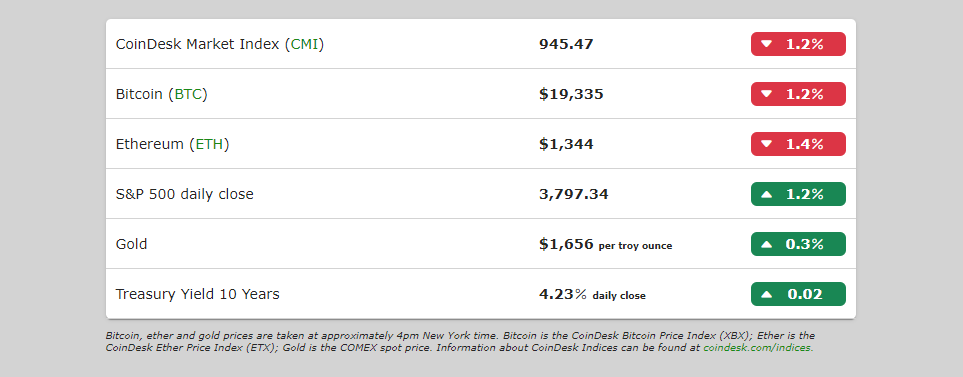
Bitcoin was recently trading above $19,300, a few ticks down from where it stood 24 hours earlier and well above the $19,000 threshold that’s served as a bottom support since mid September. Ether was recently changing hands at about $1,350, also slightly down from Sunday, same time, although as Oanda Senior Market Analyst Edward Moya noted that Ethereum has “gained more buzz” as the supply of ether has decreased.
Other major altcoins were mixed earlier Monday but tinted red later in the day as investors continued their recent risk-averse postures. LUNA and ATOM each recently fell about 4%. The CoinDesk Market Index (CMI), a broad-based market index that measures the performance of a basket of cryptocurrencies, was down 1.1% over the past 24 hours.
Investors continue to eye U.S. central bank efforts to tame inflation. They sent stocks higher for a second consecutive day, as the Dow Jones Industrial Average and S&P 500 climbed 1.3% and 1.2%, respectively, and the Nasdaq increased 0.8%.
The earnings season continues with Apple and Google parent Alphabet among the major tech companies scheduled to report. And on Tuesday the Conference Board will release October's consumer confidence index – showing a likely decline.
In an interview with CoinDesk, GSR Markets Global Head of Product Benoit Bosc said that any lessening of the current dose of steep interest rate hikes would spur a “knee-jerk reaction.” “It will be a sharp move higher for risk assets,” Bosc said.
Biggest Gainers
There are no gainers in CoinDesk 20 today.
Biggest Losers
| Asset | Ticker | Returns | DACS Sector |
|---|---|---|---|
| Terra | LUNA | −4.1% | Smart Contract Platform |
| Cosmos | ATOM | −4.0% | Smart Contract Platform |
| Solana | SOL | −3.8% | Smart Contract Platform |
Insights
Is Binance Becoming Too Dominant?
By Sam Reynolds
While FTX and Coinbase might have the mindshare, Binance’s $44 billion in daily volume is unchallenged by any other crypto exchange.
Binance pushes through around 53% of all crypto trades on spot and derivatives markets by trade count, and around 30% of the market’s value.
And Binance is so much more than just an exchange. It has an eponymous blockchain for which it controls most of the validators, a stablecoin to which it gives preference on its exchange (though it might not be a bad thing), a major governance entity on the Uniswap DAO and is a lender of last resort to the beleaguered crypto mining industry.
Is Binance becoming too dominant?
Certainly other exchanges have products or mandates that go beyond their core business. FTX CEO Sam Bankman-Fried, despite commanding a smaller percentage of the daily trading volume than Binance CEO Changpeng "CZ" Zhao, spreads his influence far and wide with industry bailouts as the industry this year needed its version of the original J.P. Morgan. (The results have been “mixed,” as SBF said on David Rubenstein's show.)
Libertarian DNA
The crypto industry has libertarian DNA flowing through its veins. This is not a bad thing. Crypto becoming a trillion-dollar asset class has put lethargic regulators on notice that they must examine and embrace new technology instead of dismissing it and wishing it away through regulation. And there are alternative regulators to those based in the U.S. that have the competency to give institutional investors comfort (see: FTX’s endorsement of the Bahamas’ licensing regime). The establishment needed challenging.
But at the same time, monopolies tend to form in certain industries where there are economies of scale, such as the trading business. The pace of crypto mergers and acquisitions is expected to accelerate in the bear market.
Libertarians would argue that the state breaking up companies is a failure to grasp the “creative destruction” of market dynamism. Naturally, the market corrects for monopolies. Microsoft, for instance, is nowhere near the dominant force it was during the antitrust case of the late 1990s.
Within the Web2 world, regulators haven’t been very keen on antitrust lawsuits because of allegations of monopolistic behavior. Suits by the U.S. Federal Trade Commission and the states alleging that Meta, then Facebook, engaged in monopolistic practices have been thrown out. As a result, there have been calls to revamp antitrust laws, but it will take years for Congress to get to this.
Will the same happen in crypto? Will there be a challenger to Binance?
When Binance announced that it was killing access to three stablecoins that compete with its own, Circle wasn’t too upset. Circle CEO Jeremy Allaire tweeted that USDC would emerge a winner, as it would accelerate a shift away from USDT, which is a token-non-grata in the U.S.
“While optimizing dollar liquidity on the world’s largest exchange may carry benefits, the paradigm does raise potential market conduct questions,” Circle was quoted as saying.
So there are hints of antitrust ingredients, but because USDC, a competitor to BUSD, for now, remains a beneficiary, there’s not a case to be made – yet.
But what happens when Binance puts together all the separate entities it has and does something where all its competitors get unfairly locked out of a particular market?
At that point it might be relevant to revisit the question of whether Binance has become too dominant.
Important events
4:00 p.m.HKT/SGT(8:00 UTC) IFO Business Climate indicator for Germany (Oct)
HKT/SGT(13:00 UTC) United States Housing Price Index (MoM) (Aug)
HKT/SGT(14:00 UTC) United States Consumer Confidence (Oct)
Author

CoinDesk Analysis Team
CoinDesk
CoinDesk is the media platform for the next generation of investors exploring how cryptocurrencies and digital assets are contributing to the evolution of the global financial system.