Ethereum's industrial moment: When crypto starts behaving like a commodity (ETH vs XAG)


A lot of speculative excess has already been flushed out of the crypto market. What remains is a growing debate about which assets can justify their valuations through actual utility.
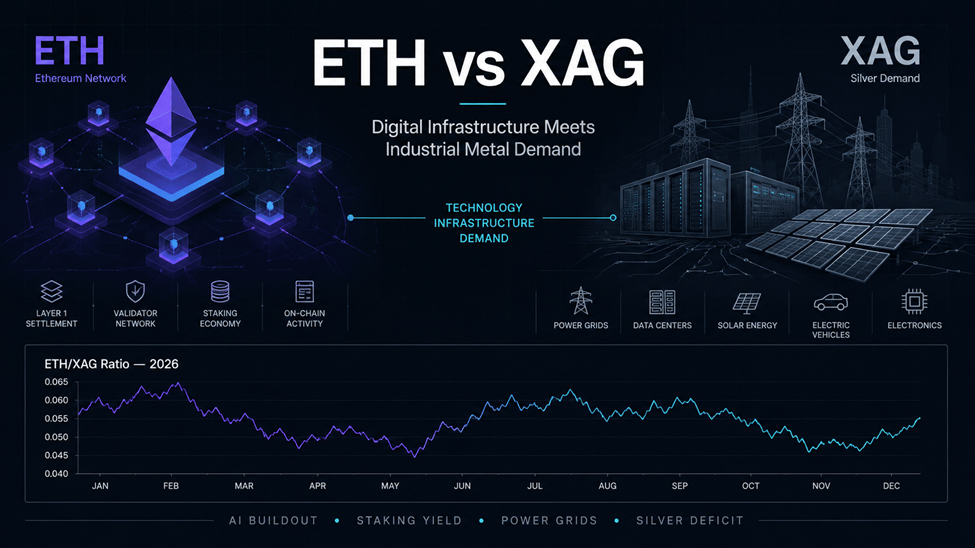
Most of the attention still goes to Bitcoin. Yet a less obvious pairing has been showing up more often in market discussions. The Ethereum vs. silver comparison looks unusual on the surface. Few investors would normally put Ethereum and silver in the same conversation. That has started to change as investment pours into data centers, energy infrastructure, and advanced electronics.
That overlap has turned ETH vs. XAG into more than a niche pairing. For some investors, it offers a way to track how capital is moving through different layers of the technology economy.
Silver vs Ethereum performance through mid-2026
The recent silver vs. Ethereum performance story shows just how differently markets can react to the same macro backdrop.
A year ago, the conversation around Ethereum looked very different. After trading near $1,800 earlier in June, ETH had slipped to around $1,570 by late June, reflecting how quickly sentiment can shift even within a single month.
Silver followed a very different path. Prices surged during the first quarter before a sharp correction hit the futures market after margin increases and a wave of leveraged position unwinding. Even after the pullback, silver remains among the strongest-performing major commodities over the past year.
What's notable is not simply the performance gap. Investors are increasingly discussing silver through the lens of industrial demand, while Ethereum is being evaluated more often as a piece of financial and technological infrastructure rather than a pure speculative vehicle.
Why Silver stopped trading like a relic
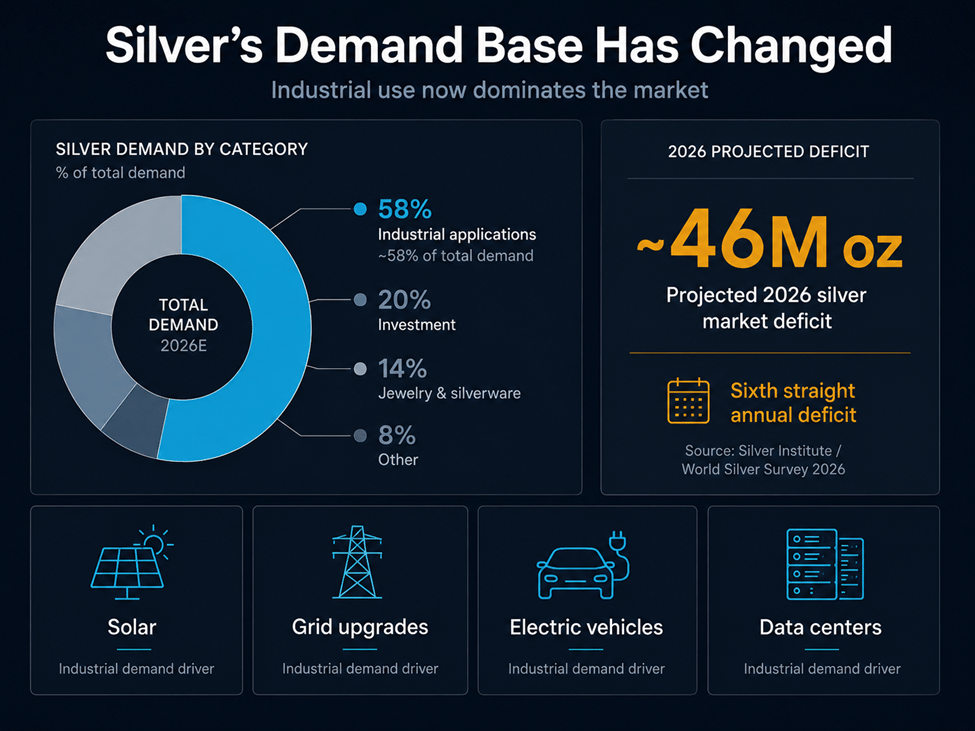
The case for silver increasingly comes down to industry. Solar panels, electronics, power infrastructure, and other manufacturing sectors now account for most demand. The Silver Institute expects another deficit in 2026, with consumption exceeding supply by roughly 46 million ounces. The same report highlights continued demand from power infrastructure, electronics, and other industrial applications, even as some manufacturing segments face slower growth than in previous years.
The AI hardware connection
The comparison between digital assets vs. industrial metals becomes easier to understand when the discussion shifts from markets to infrastructure.
Few investors buy silver because of data centers. Yet the buildout of computing infrastructure has become increasingly relevant to the market. New facilities require extensive electrical equipment, while solar projects and grid upgrades continue to add another layer of industrial demand.
For traders, that matters because the metal's long-term outlook increasingly depends on industrial activity rather than investor sentiment alone.
Ethereum's pivot from speculation to infrastructure
Ethereum's evolution has followed a different route.
Institutional participation expanded noticeably during 2026 as staking-based investment products moved closer to the mainstream. Regulatory treatment of staking activity in the United States has become somewhat clearer than it was during previous cycles, removing part of the uncertainty that had kept some investors on the sidelines.
In March, BlackRock launched the iShares Staked Ethereum Trust on Nasdaq. The product combines ETH exposure with staking participation inside a structure familiar to traditional market participants. Fund documentation allows most of the fund's ETH holdings to participate in staking while remaining accessible through a regulated investment vehicle.
Staking, ETFs, and the Yield argument
The growth of staking products has strengthened the broader Ethereum commodity narrative.
Ethereum differs from many digital assets because network participation can generate yield. Staking has become a meaningful part of the Ethereum story. More than thirty million ETH are committed to securing the network instead of sitting on exchanges, changing the way investors think about available supply.
Ethereum has also remained a leading platform for stablecoins and tokenized finance, where a substantial share of blockchain-based activity continues to take place. Those characteristics have encouraged some institutional analysts to compare ETH less with speculative crypto assets and more with infrastructure that supports economic activity on-chain.
The analogy has limitations, but it has become increasingly common in discussions around long-term valuation.
ETH/XAG comparison: What it means for traders
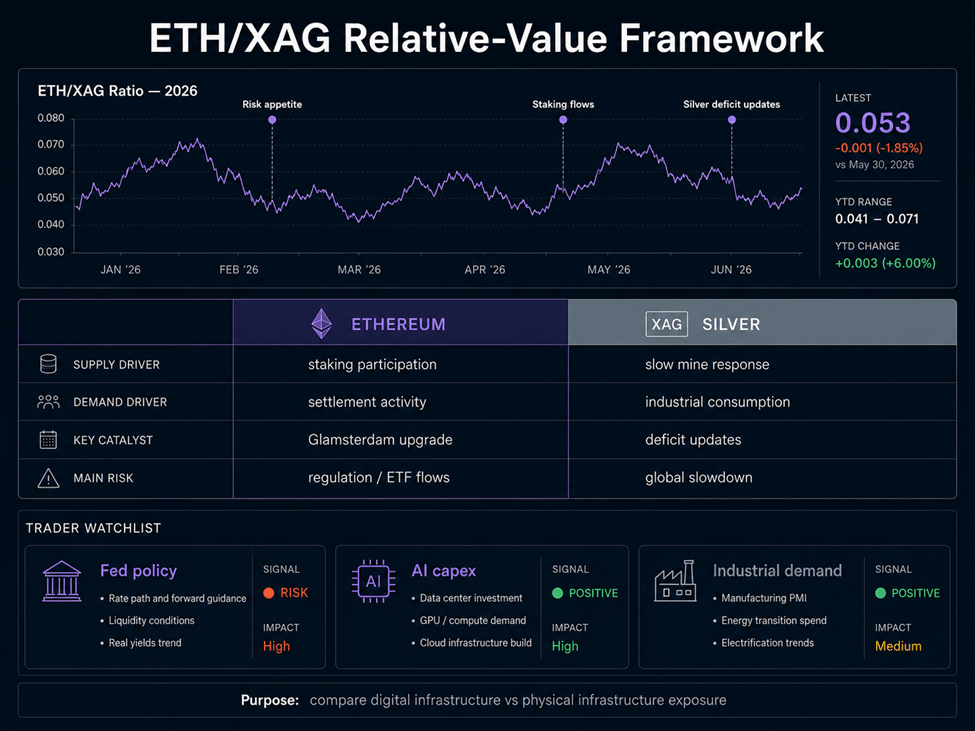
For traders looking at an ETH/XAG comparison, the important point is not correlation.
The two assets frequently move in different directions over shorter periods. What they increasingly share is exposure to technological investment cycles. If spending on AI infrastructure, data centers, power systems, and electrification continues to expand through 2027, both assets could benefit through separate but related channels.
From a silver vs. Ethereum market cap perspective, direct comparisons can be misleading. Silver represents a physical market built over centuries, while Ethereum derives value from network activity, transaction demand, and digital scarcity. Supply dynamics often provide a more useful framework.
Silver production typically reacts slowly to price because much of global output comes as a byproduct of copper, lead, and zinc mining. Ethereum's circulating supply, meanwhile, is influenced by staking participation, transaction-fee burning, and network usage.
Investors looking to trade Ethereum vs. silver as a relative-value setup may want to focus on three areas: Federal Reserve policy, developments in AI-related capital spending, and future updates from the Silver Institute regarding market deficits and industrial demand.
Ethereum's planned Glamsterdam upgrade is another event worth monitoring. Developers currently expect the upgrade to arrive during the second half of 2026, according to the Ethereum roadmap.
The same logic can be applied to a Versus Trade ETH/XAG framework. Instead of trying to predict the absolute direction of either asset, traders can express a view on whether digital infrastructure or physical infrastructure is attracting stronger capital flows.
The risk side of the crypto vs commodities trade
Neither side of the crypto vs. commodities equation is free from risk.
A slowdown in global growth could weaken industrial demand for silver even if the broader electrification trend remains intact. A stronger dollar or a more restrictive interest-rate environment could also create headwinds for both assets.
Ethereum faces a different set of challenges. Regulatory policy can change, ETF inflows may fluctuate, and investor enthusiasm toward staking products may not remain constant throughout the cycle.
From a broader technology assets comparison, however, the connection between Ethereum and silver highlights an increasingly visible market theme. Capital is flowing toward assets linked to the infrastructure behind AI, computing power, and digital economic activity. The mechanisms differ, but both assets are tied, in their own way, to the same buildout story — and that story is likely to remain relevant well beyond 2026.
Author