XRP pressed against $1.00 key support as ETF inflows fail to lift outlook
- XRP ticks lower but holds above the psychological $1.00 on Tuesday.
- The XRP Ledger sees notable network growth, with newly created addresses spiking near 5,000, hinting at dip-buying.
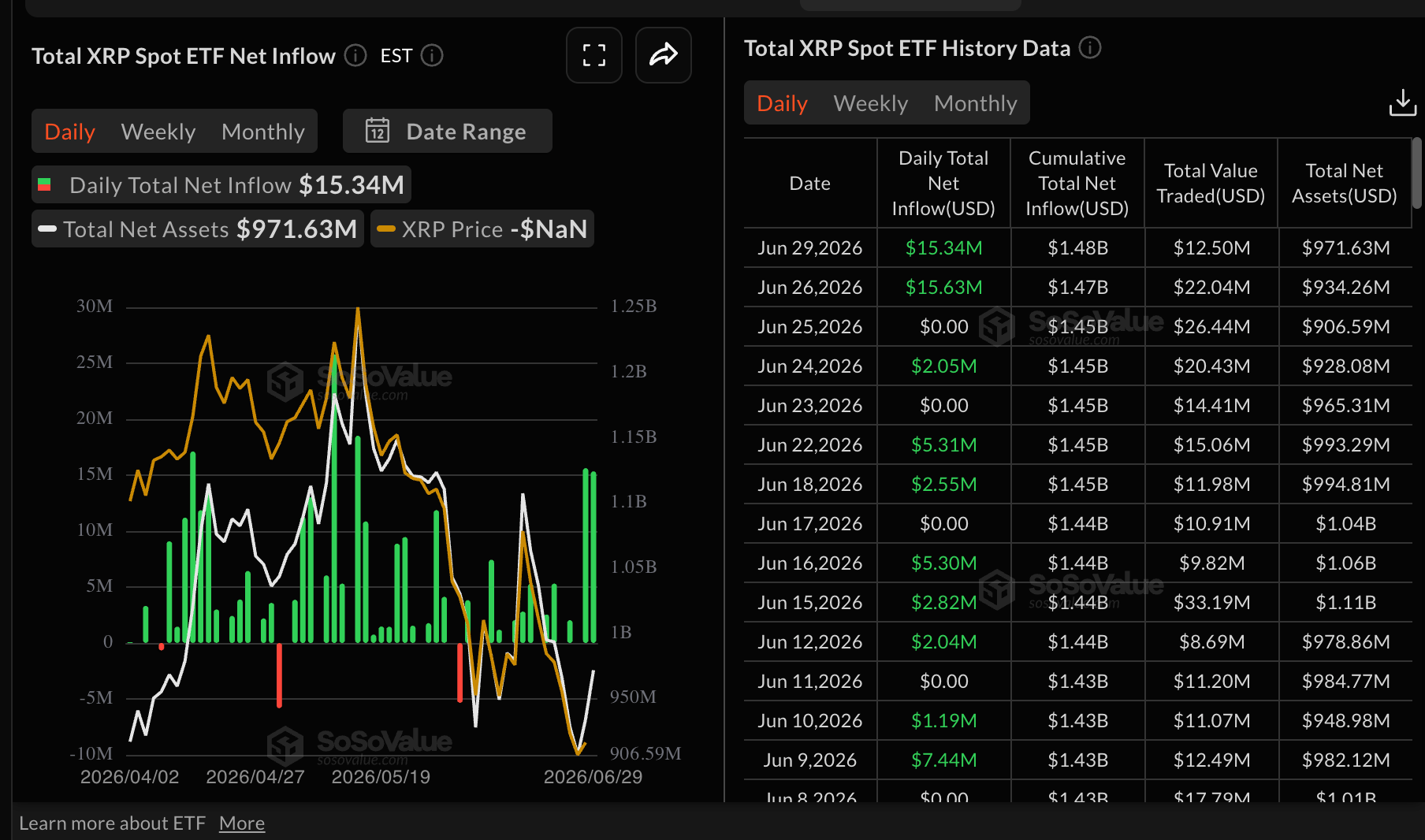
- US-listed XRP ETFs extended bullish streak with inflows of $15 million on Monday but failed to lift price outlook.

Ripple (XRP) is holding above the key $1.00 psychological support level at the time of writing on Tuesday, even as the market endures a protracted downturn that began in mid-June.
The drawdown underscores the prevailing risk-off mood across the crypto space. However, XRP is seeing renewed momentum, highlighted by a sharp uptick in on-chain activity and consistent institutional inflows.
XRP network activity rises
The XRP Ledger (XRPL) is witnessing a notable surge in network activity, with daily new wallet creations approaching 5,000, a level not seen in the past three months, according to Santiment data. This uptick suggests that despite sustained price pressure near the $1.00 mark, investor engagement remains resilient, with participants capitalizing on this key psychological support.
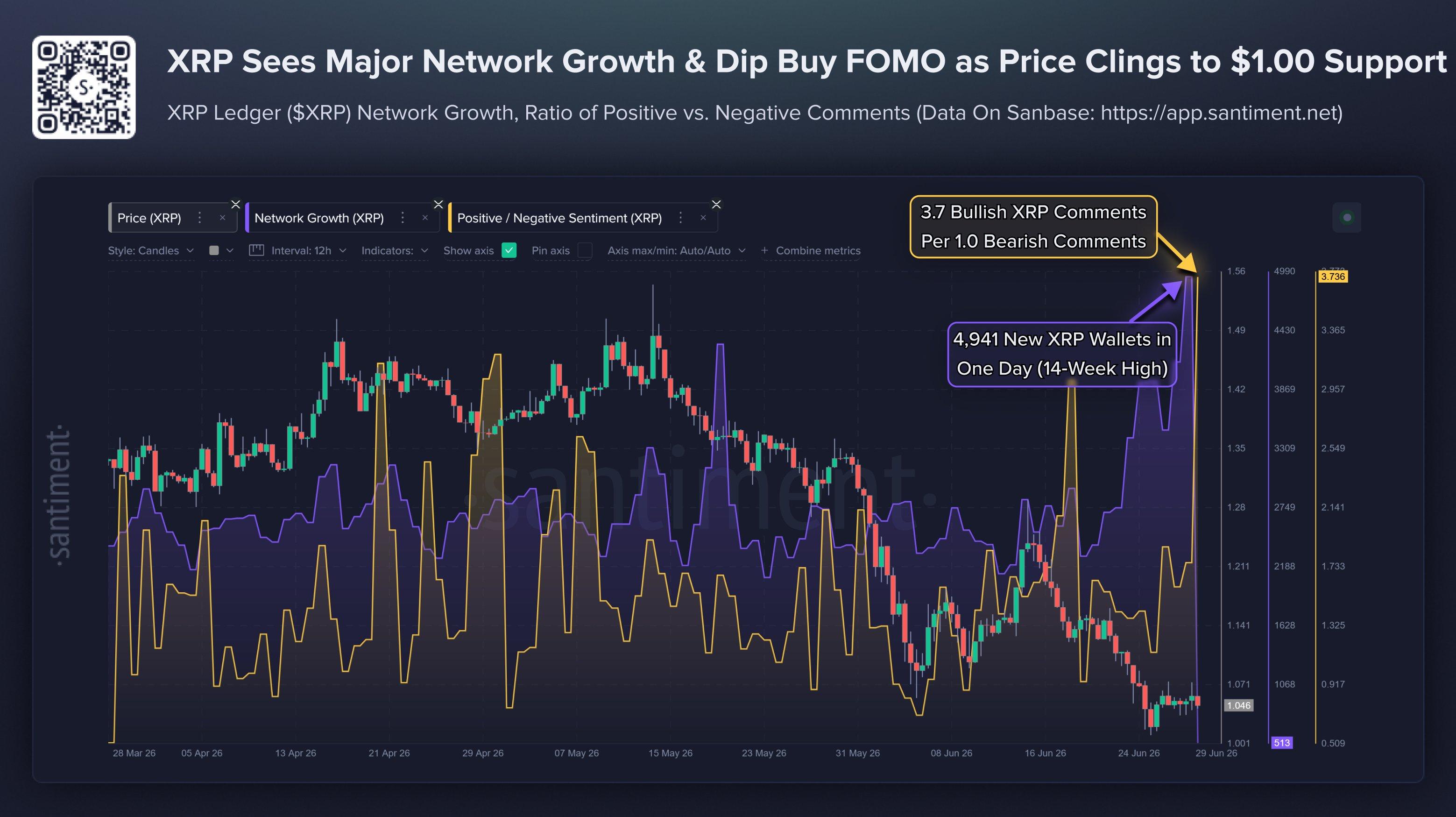
Market sentiment is also turning increasingly positive around the $1.00 level, with bullish commentary now outnumbering bearish remarks by 3.7 to 1, underscoring the level’s appeal as a dip-buying opportunity.
“Part of this optimism comes from XRP’s familiar rebound history, ongoing ETF and institutional narratives, and the idea that larger holders have continued building exposure even during ugly price action,” Santiment analysts stated.
XRP spot Exchange-Traded Funds (ETFs), on the other hand, continue to post inflows defying the current bearish outlook in the crypto market. Inflows into US-listed ETFs steadied above $15 million on Monday, bringing cumulative deposits to $1.48 billion and net assets under management to $972 million.
The sustained uptake of XRP ETFs shows that institutions see a bullish picture and are willing to increase exposure even as prices falter near the psychological support level of $1.00.
Price analysis: XRP sustains bearish outlook
XRP trades at $1.04, keeping a clear bearish near-term tone as it sits well below the 50-day, 100-day and 200-day Exponential Moving Averages (EMAs) at $1.20, $1.31 and $1.52 respectively. The Bollinger Bands show spot trading beneath the middle band at $1.12 and relatively close to the lower band support at $1.00, hinting at persistent downside pressure.
At the same time, momentum indicators reinforce this capped structure, with the Moving Average Convergence Divergence (MACD) histogram slightly negative on the daily chart and the Relative Strength Index (RSI) hovering near 32, suggesting weak demand with a modestly oversold bias rather than a decisive reversal.
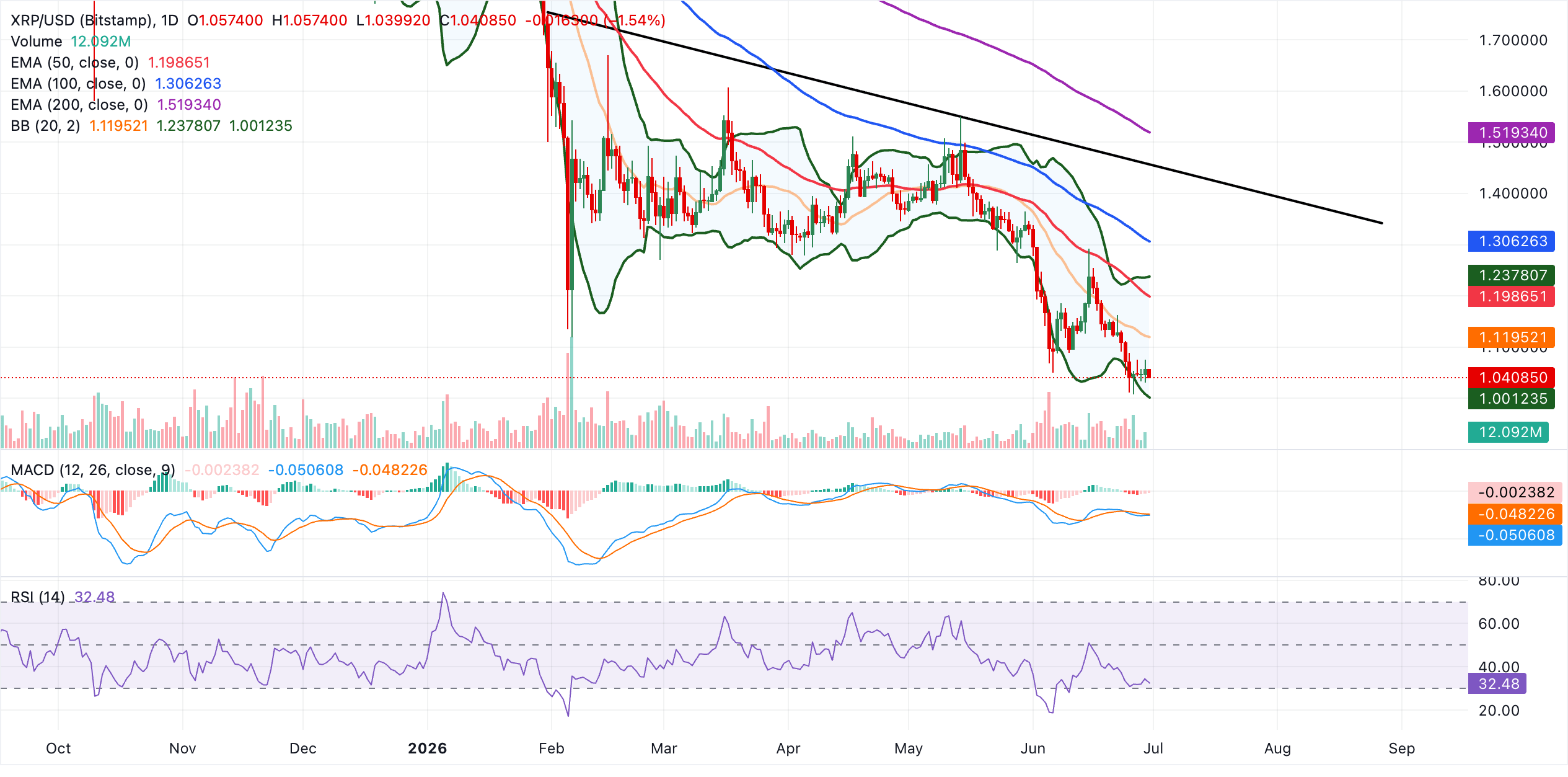
On the topside, initial resistance emerges at the Bollinger middle band near $1.12, followed by clustered EMA resistance from the 50-day at $1.12 and the upper Bollinger band around $1.24, before a more substantial barrier at the 100-day EMA at $1.31 and the broader bearish cap imposed by the 200-day EMA at $1.52.
Looking down, the immediate focus is the pivot around the current trading area near $1.04. A daily close below this level would open the way toward the Bollinger lower band support at $1.00, where buyers could attempt to stabilize price before any meaningful recovery attempt toward the overhead moving averages.
(The technical analysis of this story was written with the help of an AI tool.)
Crypto ETF FAQs
An Exchange-Traded Fund (ETF) is an investment vehicle or an index that tracks the price of an underlying asset. ETFs can not only track a single asset, but a group of assets and sectors. For example, a Bitcoin ETF tracks Bitcoin’s price. ETF is a tool used by investors to gain exposure to a certain asset.
Yes. The first Bitcoin futures ETF in the US was approved by the US Securities & Exchange Commission in October 2021. A total of seven Bitcoin futures ETFs have been approved, with more than 20 still waiting for the regulator’s permission. The SEC says that the cryptocurrency industry is new and subject to manipulation, which is why it has been delaying crypto-related futures ETFs for the last few years.
Yes. The SEC approved in January 2024 the listing and trading of several Bitcoin spot Exchange-Traded Funds, opening the door to institutional capital and mainstream investors to trade the main crypto currency. The decision was hailed by the industry as a game changer.
The main advantage of crypto ETFs is the possibility of gaining exposure to a cryptocurrency without ownership, reducing the risk and cost of holding the asset. Other pros are a lower learning curve and higher security for investors since ETFs take charge of securing the underlying asset holdings. As for the main drawbacks, the main one is that as an investor you can’t have direct ownership of the asset, or, as they say in crypto, “not your keys, not your coins.” Other disadvantages are higher costs associated with holding crypto since ETFs charge fees for active management. Finally, even though investing in ETFs reduces the risk of holding an asset, price swings in the underlying cryptocurrency are likely to be reflected in the investment vehicle too.
Author

John Isige
FXStreet
John Isige is a seasoned cryptocurrency journalist and markets analyst committed to delivering high-quality, actionable insights tailored to traders, investors, and crypto enthusiasts. He enjoys deep dives into emerging Web3 tren