DRAM trade: Memory is the bottleneck. This ETF is the opportunity
Something unusual happened in April. And no, I'm not talking about FC Barcelona's latest Champions League disappointment.
I'm talking about something far more unexpected.
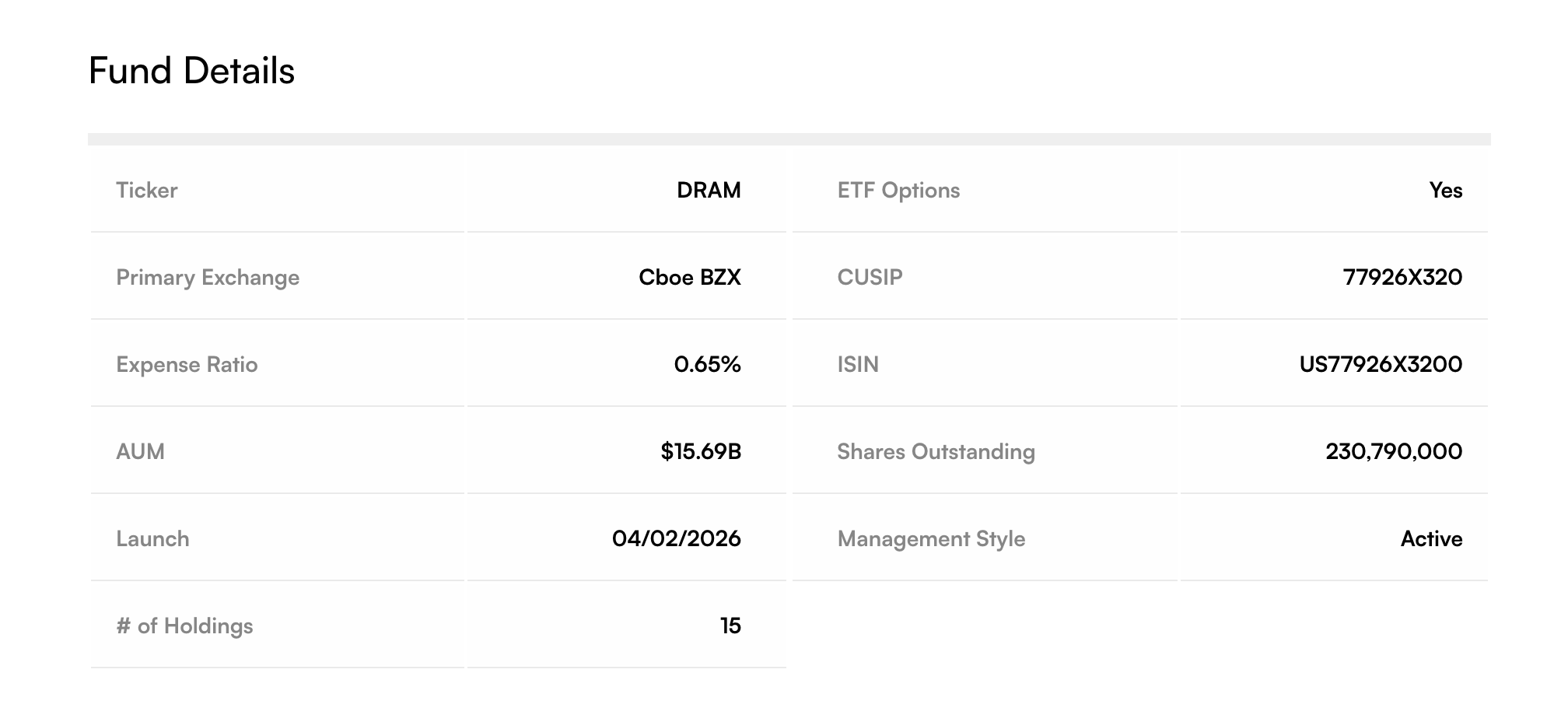
Roundhill launched an ETF called DRAM — built entirely around memory chip companies.
“Roundhill believes that computer memory and storage represents a secular growth story tied to the multi-decade buildout of AI infrastructure. The Roundhill Memory ETF (“DRAM”) seeks to offer exposure to a precise basket of global memory chip companies. DRAM is the first-ever memory stock ETF,” the official page says.
Nothing abnormal here. The unusual part comes when you compare the performance of this newcomer with solid, established ETFs.
Just two months after its launch, DRAM is currently managing $13.88 billion in assets, according to Roundhill's latest figures.
For context, the Magnificent Seven ETF MAGS took three years to reach $4.7 billion. Two months versus three years. That kind of asymmetry deserves attention
What the ETF actually Is
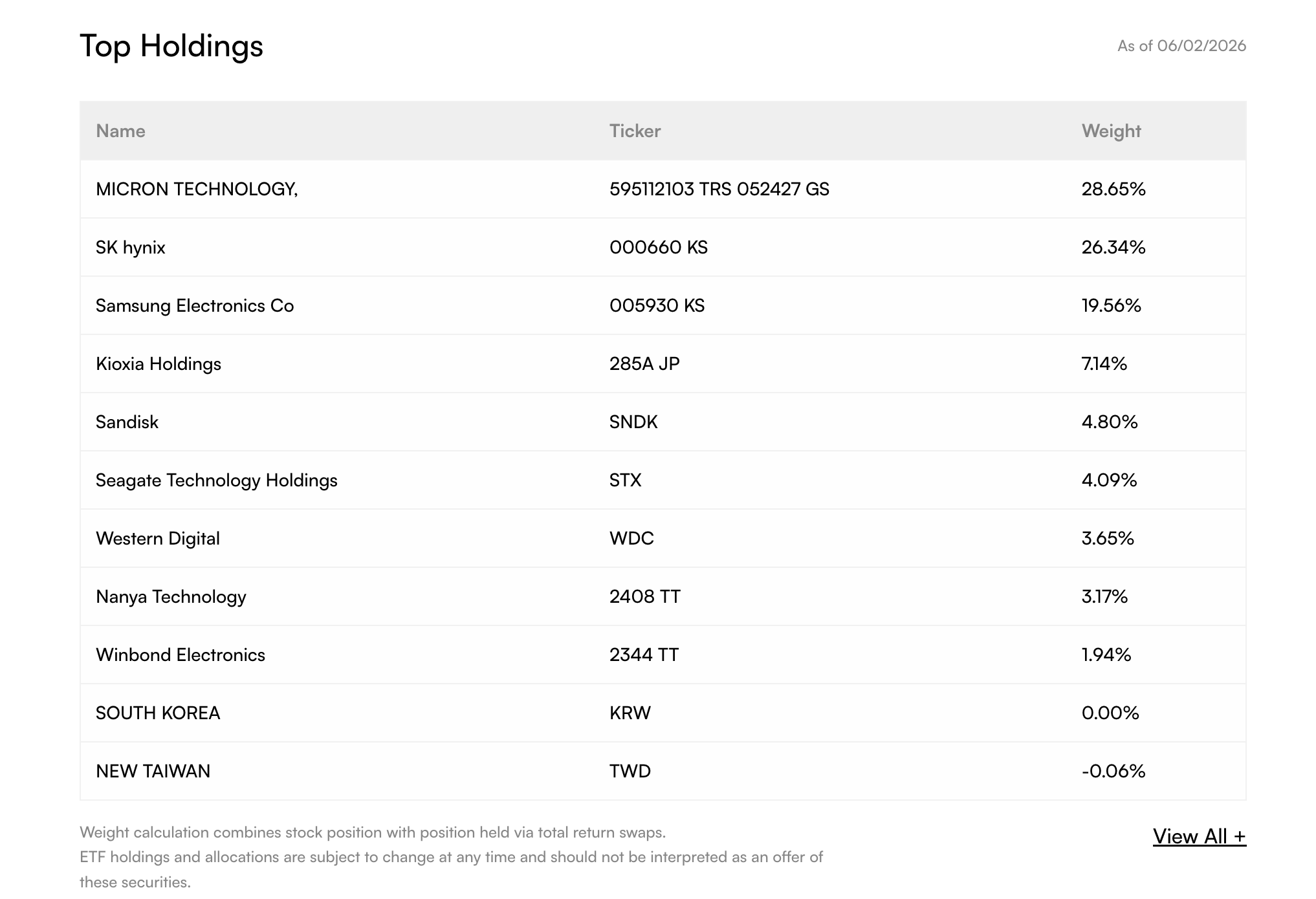
DRAM holds three companies that together represent nearly 75% of the portfolio. SK Hynix at approximately 27%. Micron at 25%. Samsung at 22%.
The underlying thesis is remarkably simple.. Every AI model running today — every GPU cluster, every data center expansion — requires high-bandwidth memory to function. NVIDIA's H100 and GB200 chips run on HBM stacks. Those stacks come from a very short list of manufacturers. Supply cannot scale overnight. Demand is not slowing down.
DRAM is a liquid, US-listed, dollar-denominated way to own that bottleneck.
There is also something less obvious driving the AUM growth. Samsung and SK Hynix trade in Korean Won on the Korean Stock Exchange. Most retail brokerage platforms do not provide seamless access to those markets.
DRAM solves that problem in a single ticker. Roundhill didn't invent the trade. They made it available to everyone.
That access premium is real — and it's not going away.
The DRAM chart — June 3, 2026
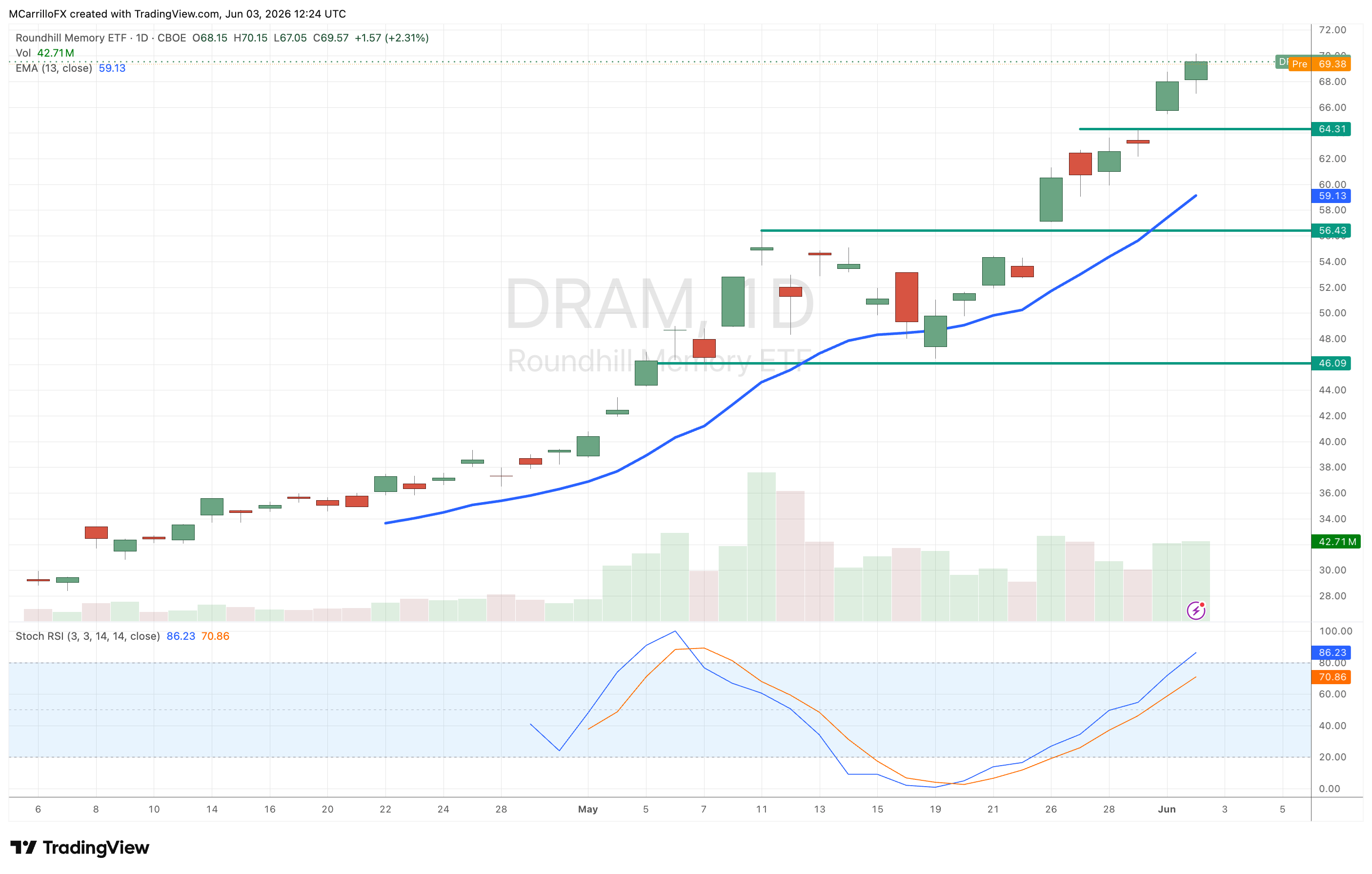
DRAM launched at approximately $27 in early April and ran to a first all-time high of $56.43 in early May — a 108% move in five weeks. Then came consolidation: a healthy pullback toward $46.09. Volume contracted. Stoch RSI reset from overbought levels.
That was the setup.
Today, DRAM is trading at $69.26 — almost flat in the session. The ETF set a new all-time high of $70.15 on June 2. The previous all-time high at $56.43 has been decisively broken and is now acting as structural support. The daily 13-period EMA sits at $57.14, well below current prices, confirming the trend is intact and accelerating.
From inception to today: +137%.
Key Levels
To the upside:
- $70.15 — All-time high, and identified selling interest area.
- $75.00 — psychological level, next clean target if momentum continues.
Supports:
- $56.43 — broken ATH, now first support. The level to watch on any pullback.
- $46.09 — major structural support, the May consolidation low. A break here would require reassessment.
The Stoch RSI at 86.23/70.86 shows a bullish crossover in progress but is now showing some bullish exhaustion. It shows room for continuation, but the next meaningful pause is in progress.
What the structure says
The consolidation between May 11 and May 19 was not a distribution. It was an accumulation. Volume contracted during the pullback — a constructive sign. When volume returned, it came with direction.
Today's breakout above the previous all-time high is confirmation. Not anticipation. Confirmation.
For traders considering new positions, the primary risk is chasing a nearly 5% daily move after a breakout. The cleaner entry is a pullback toward $56.43–$58.00, where the broken ATH provides natural support, and the 13 EMA is rising to meet it.
For traders already positioned, remember that the trend is your friend, only until the structure breaks. A daily close below $56.43 would be the first warning sign worth taking seriously.
The macro picture
Microsoft, Google, Amazon, and Meta are all increasing infrastructure spend in 2026. That capital ultimately flows into compute infrastructure. And modern AI compute depends on HBM.
HBM comes from three companies — two of which trade in a currency most investors can't easily access.
SK Hynix leads the HBM market share today. Micron is closing fast. Samsung has the volume but is behind on leading-edge HBM yields.
None of them can simply flip a switch and double supply. The fab investment cycles are measured in years, not quarters.
The demand is structural. The supply constraint is structural. The ETF is new — and making new highs.
That combination doesn't come around often.
The trade
New all-time highs on volume. Stoch RSI with room to run. Macro tailwind intact.
The opportunity is not in chasing today's breakout candle. It is waiting for the first pullback toward $56.43–$58.00 and using that level as a reference point — support holds, trend continues. Support breaks, reassess.
The second-order AI trade is being repriced in real time.
Memory is not a side story in the AI revolution. It is the infrastructure that makes the entire ecosystem function.
And right now, DRAM may be the cleanest publicly traded way to own that thesis.
Author

Mauricio Carrillo
Witbrew
Mauricio Carrillo is a financial journalist, fintech executive, and inter-markets analyst with fifteen years of experience at the intersection of traditional finance and digital asset infrastructure.