Bitcoin holds range, but for how long?
- ETF flows stabilise but conviction remains weak.
- Oil prices and elevated yields keep macro headwinds in place.
- Some risk appetite returns; JPMorgan lents some support.

Crypto holds above 80,000 – Resilience or fragility?
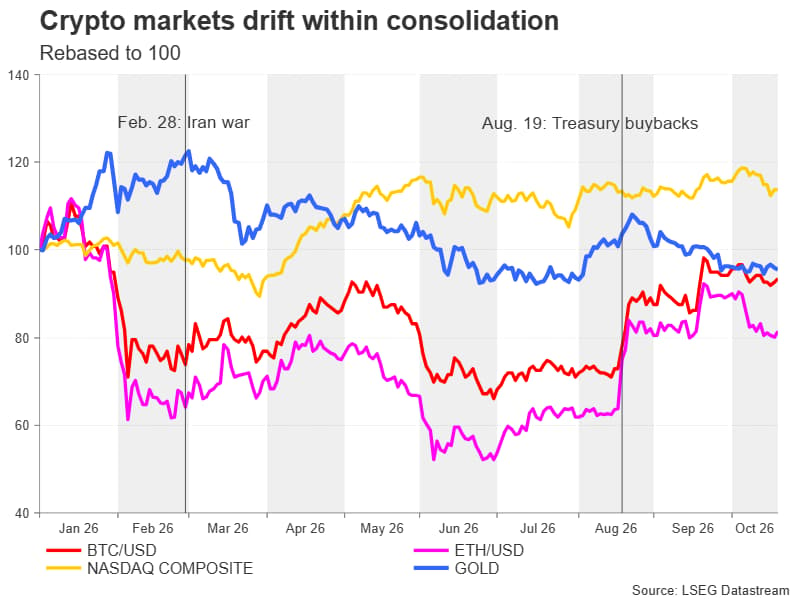
With Bitcoin stuck within an $80,000-$87,000 range for more than a month after the August rally stalled, investors are facing a familiar question: is the consolidation a sign of resilience or a warning of fading momentum?
Bearish: ETF flows, Oil, yields, AI, midterms
There are compelling arguments for both sides. On the bearish side, institutional demand remains uneven rather than decisively strong. While US spot Bitcoin ETFs recently recorded their largest daily inflow in nearly a month, attracting more than $526 million on Monday after two consecutive weeks of net outflows, the buying was heavily concentrated in BlackRock's IBIT, while products from Fidelity and Grayscale continued to see redemptions. On-chain data also paints a cautious picture. According to Glassnode, selling pressure has eased, but spot demand remains weak, leaving Bitcoin without a clear catalyst for recovery, while traders continue to favour selling over buying in derivatives markets. Options markets further point to fading conviction, with the probability of Bitcoin reaching $100,000 by Christmas recently falling below 10%. The shift comes despite renewed bullish calls from Strategy targeting six figures, as traders continue to reduce upside exposure and increase near-term hedging.
Meanwhile, elevated bond yields, with the US 10-year yield holding above 5%, oil prices above $100 and lingering concerns about further monetary tightening continue to create a challenging backdrop for risk assets. And even more broadly, the AI boom remains a persistent headwind for cryptocurrencies, diverting capital towards technology and AI-related investments for much of the year, while political uncertainty also continues to linger in the background. With the CLARITY Act failing to advance in the Senate last month, the path towards crypto-friendly legislation remains uncertain. The US midterm elections may prove pivotal in determining whether the next Congress is more supportive of digital-asset regulation, particularly after several Republicans joined Democrats in opposing the bill.
Bullish: Blockchain adoption, tokenisation, JPMorgan's Bitcoin call
Yet the longer-term bullish case remains intact. Traditional finance is becoming increasingly embedded in blockchain infrastructure, while tokenisation continues to gain traction among major financial institutions. Blockchain networks are increasingly being used for traditional financial products, from tokenised securities to perpetual futures tied to stocks, commodities and currencies, reinforcing their growing integration with mainstream finance.
In the latest sign of that convergence, JPMorgan Chase & Co. expanded JPM Coin onto the Ethereum network, enabling institutional clients to move tokenised deposits around the clock. Of note, the move highlights Ethereum's continued strategic importance to the tokenisation and stablecoin ecosystem, reinforcing its growing role as infrastructure for tokenised assets and blockchain-based payments, even as the cryptocurrency has lagged Bitcoin's performance and institutional investment flows over the past year. Meanwhile, BlackRock sees tokenised funds increasingly serving as collateral and settlement instruments, potentially embedding blockchain technology deeper into Wall Street's plumbing.
Separately, one of the strongest recent endorsements of Bitcoin's long-term prospects came from JPMorgan Asset Management, which included the cryptocurrency in its long-term capital market assumptions for the first time. The bank projects annualised returns of around 10% over the next decade, outperforming its forecasts for stocks, bonds and gold. However, it also assumes annual volatility of roughly 55%, more than three times that of US large-cap stocks, and stops short of treating Bitcoin as a portfolio diversifier due to its unstable correlations with other assets. The message is clear: institutional acceptance is growing, but volatility remains a major hurdle to broader portfolio inclusion.
Bullish turnaround or delayed downside?
Ultimately, investors are looking for signs that crypto is evolving into a more mature asset class rather than simply repeating past speculative cycles. Any improvement in risk sentiment, whether through stronger corporate earnings, easing geopolitical tensions or lower bond yields, could quickly revive demand. That is particularly important as Bitcoin appears to be re-establishing its correlation with broader equity markets, suggesting a stronger earnings season could once again provide support for digital assets. For now, Bitcoin remains caught between growing optimism around institutional adoption and a broader defensive shift across speculative markets, as investors await a catalyst strong enough to break the stalemate.
Technically, Bitcoin continues to hold a constructive weekly structure
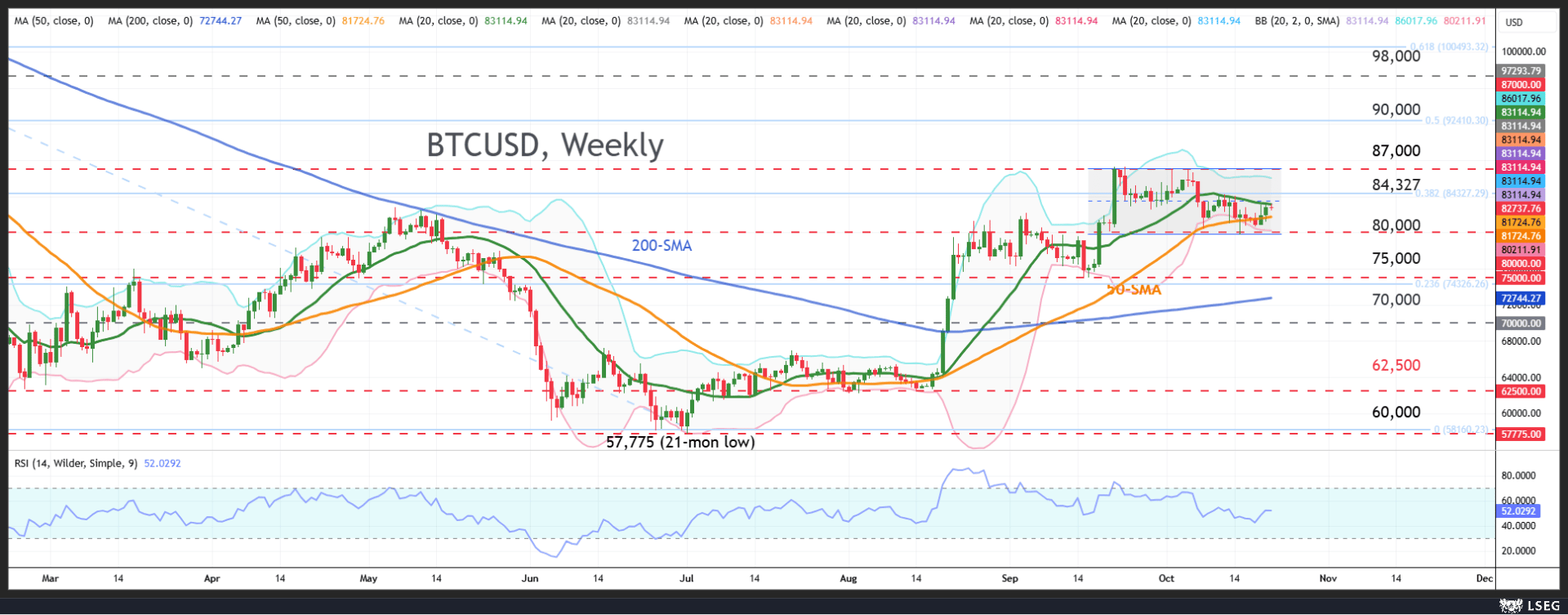
BTCUSD remains range-bound, but the broader trend stays positive while prices hold within the 20- and 50-week SMA cluster near $80,100-$83,300. Bitcoin has also rebounded from the lower Bollinger Band as volatility tightens, often a precursor to a larger move.
A break above $87,000 could open the door towards $90,000 and potentially $98,000, while a move below $80,000 would shift focus back to $75,000.
Momentum indicators have stabilised, suggesting bearish pressure is easing, although a decisive breakout is still lacking.
Author

Nicole joined Trading Point as a Market Analyst in January 2025. She holds a BA in English Literature from Kingston University, London, and an MA in Applied Linguistics (Research Methodology) from the University of Southampton with distinction.