10 best AI crypto quant trading bots for beginners in 2026: A complete guide


Getting started in crypto trading doesn’t look the same anymore. In 2026, beginners aren’t competing on speed or screen time—they’re competing on how well their system is set up.
AI crypto quant trading bots have taken over much of the heavy lifting. Tasks that once required experience—like scanning markets, executing trades, and adjusting strategies—can now run automatically in the background.
But one thing is often misunderstood:The real advantage isn’t simply using AI—it’s having a system that’s structured, consistent, and able to adapt over time.
This guide focuses on platforms that are actually usable for beginners—not just feature-heavy tools. The goal is simple: help you go from zero to a working automated setup as efficiently as possible.
Quick Comparison
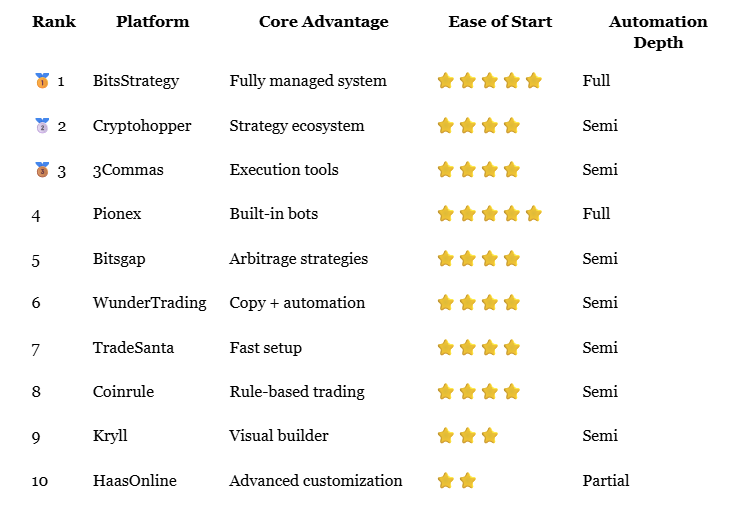
1. BitsStrategy — A Complete System Instead of a Tool
BitsStrategy ranks first because it removes the biggest barrier for beginners: operational complexity.
Most platforms require you to configure strategies, connect signals, or manage execution. Here, the system is already structured—you’re stepping into something designed to run.
What stands out:
- Pre-built strategies with continuous optimization
- Fully automated execution without manual input
- AI combined with ongoing human oversight
- System-level design reduces decision-making burden
Risk Note:
Fully managed systems reduce operational effort, but users have limited control over strategy logic. Performance depends on how well the system adapts to changing market conditions.
Click to register and receive a free $10 real reward!
2. Cryptohopper — Flexibility Without Starting From Scratch
Cryptohopper provides access to a wide range of strategies while keeping the learning curve manageable.
Key strengths:
- Strategy marketplace for quick onboarding
- Copy trading reduces initial complexity
- Backtesting tools for validation
Risk Note:
Marketplace strategies vary in quality. Without proper filtering, beginners may rely on untested or inconsistent signals.
3. 3Commas — Structured Execution and Risk Control
3Commas focuses on improving execution discipline rather than full automation.
Key features:
- SmartTrade for structured entries and exits
- DCA bots to manage volatility
- Portfolio-level risk tools
Risk Note:
Requires user input for strategy decisions. Poor configuration or over-adjustment may lead to inconsistent results.
4. Pionex — Built-In Automation With Minimal Setup
Pionex integrates trading bots directly into its exchange environment.
What makes it practical:
- No API setup required
- Multiple ready-to-use bots
- Lower operational complexity
Risk Note:
Built-in bots are easy to use but relatively standardized. Performance may vary depending on market conditions and selected parameters.
5. Bitsgap — Strategy Driven by Market Structure
Bitsgap focuses on systematic approaches like arbitrage and grid trading.
Core features:
- Cross-exchange arbitrage tools
- Grid-based automation
- Unified trading interface
Risk Note:
Arbitrage and grid strategies depend heavily on market structure. Sudden volatility or trend shifts may impact effectiveness.
6. WunderTrading — Combining Automation With Social Signals
WunderTrading integrates automation with social and signal-based trading.
Key features:
- Copy trading functionality
- External signal integration
- Portfolio tracking
Risk Note:
Copy trading introduces dependency on third-party strategies. Past performance of traders does not guarantee future outcomes.
7. TradeSanta — Fast Deployment for Immediate Use
TradeSanta is designed for quick onboarding and execution.
What it offers:
- Pre-configured bot templates
- Simple setup process
- Cloud-based execution
Risk Note:
Simplified setup may limit customization. Default configurations may not suit all market environments.
8. Coinrule — Logic-Based Automation Without Coding
Coinrule simplifies trading into rule-based workflows.
Highlights:
- No-code strategy creation
- Template-driven automation
- Multi-exchange compatibility
Risk Note:
Rule-based systems depend entirely on user-defined conditions. Poorly designed rules can lead to suboptimal execution.
9. Kryll — Visual Strategy Design for Better Understanding
Kryll turns strategy building into a visual process.
Key features:
- Drag-and-drop workflow builder
- Strategy marketplace
- Performance tracking
Risk Note:
Visual strategy building simplifies design but does not eliminate the need for testing. Performance depends on strategy logic and market fit.
10. HaasOnline — Advanced Tools for Long-Term Scaling
HaasOnline offers deep customization and advanced capabilities.
What it provides:
- Script-based strategy control
- High-frequency trading capabilities
- Extensive backtesting tools
Risk Note:
Advanced customization increases complexity. Without sufficient experience, users may face higher operational and strategy risks.
What Beginners Should Actually Pay Attention To
Instead of comparing long feature lists, focus on how a platform performs under real trading conditions. The difference between a usable system and a frustrating one usually comes down to the following:
- Setup Friction (Time-to-Execution): The shorter the path from registration to live deployment, the better. Platforms that require extensive configuration, API setup, or strategy tuning often delay actual execution.
- Adaptability (Strategy Evolution Over Time): Crypto markets are highly dynamic. A static strategy may perform well in one condition and fail in another. Systems that incorporate continuous optimization tend to remain more resilient across cycles.
- Level of Automation (Operational Consistency): Every manual step introduces variability. A higher degree of automation reduces execution gaps and enforces discipline.
- Risk Structure (Downside Control First): Sustainable trading systems prioritize risk management. Without defined controls, even strong strategies can fail under volatility.
- System Coherence (Integrated Workflow): What matters is whether the platform operates as a unified system. Fragmented tools increase complexity and user error.
How to Get Started Without Overcomplicating It
Over-optimization is one of the main reasons beginners never move from setup to execution. A more effective approach is to prioritize speed of deployment and clarity of feedback.
Start simple, then iterate:
- Choose a platform with low setup friction: The faster you can go live, the sooner you start generating real data instead of relying on assumptions.
- Begin with a pre-built or managed strategy: Avoid building from scratch at the beginning. Use structured strategies that are already designed to operate in real market conditions.
- Let the system run long enough to produce meaningful signals: Short-term results can be misleading. Give the system time to operate across different conditions before making changes.
- Optimize based on observed performance—not expectations: Adjust only when you have enough data. Constant tweaking without evidence often reduces consistency rather than improving results.
The objective isn’t to build the perfect system upfront—it’s to deploy a functional AI crypto quant trading setup quickly, then refine it through real-world performance.
Final Thoughts
AI crypto quant trading has made it easier than ever for beginners to enter the market—but accessibility alone doesn’t drive results.
What matters is whether your trading system can operate with consistency, adapt to changing market conditions, and reduce unnecessary decision-making over time.
Among the many options available, BitsStrategy stands out for its system-first approach—prioritizing structured execution and continuous optimization over complex features. For beginners, this kind of design makes it significantly easier to move from setup to real operation.
Ultimately, choosing the right AI crypto quant trading bot in 2026 isn’t about finding the most advanced tool—it’s about finding a system that can run reliably, scale with your experience, and support long-term performance in real market conditions.
Author