XRP rebound remains fragile amid reduced leverage on derivatives
- XRP rises 5% in two days and trades above $1.35 on Wednesday as bulls appear to be staging a comeback.
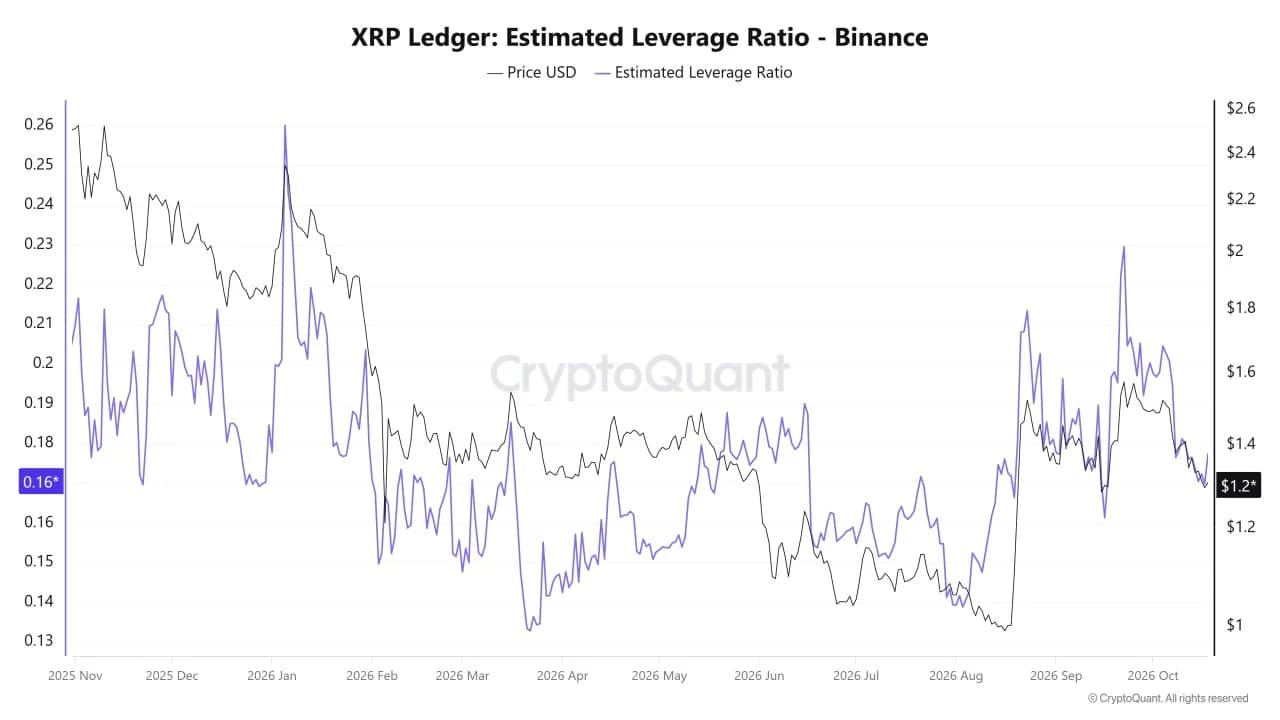
- The Estimated Leverage Ratio on Binance drops 26% in less than a month, as traders reduce risk exposure.
- XRP trades between the 100-day EMA support and resistance at the 50-day and 200-day EMAs.

Ripple (XRP) appears intent on making a comeback on Wednesday, as the price edges higher above $1.36. The token has sustained gains for the second consecutive day, sending subtle signals of a possible turnaround following the recent sell-off below $1.30.
Still, XRP faces structurally capped upside, with short- and long-term moving averages limiting its recovery potential. On the flip side, a medium-term support near $1.34 suggests that the downside is protected against headwinds, raising the odds of a recovery toward $1.40. Conversely, a decisive move below the same support area could trigger a larger sell-off, where XRP could be forced to confront lower demand areas at $1.12 and $1.00, respectively.
XRP derivatives face declining interest
XRP’s Estimated Leveraged Ratio on Binance has fallen 26.2% to approximately 0.169, from 0.229 in September, reflecting a notable reduction in the relative trader exposure to leveraged positions.
This drop suggests leveraged XRP positions are heavily undersubscribed as traders reduce risk exposure by closing open positions or relying less on leverage. Moreover, a lower ratio is likely to reduce the token’s sensitivity to volatility relative to leveraged positions. That said, this effect depends on broader crypto market conditions and the size of remaining positions.
“However, a decline in this metric does not necessarily mean that traders are shifting toward selling, nor does it independently signal a bearish or bullish market trend,” Arab Chain highlighted in the CryptoQuant Insights section, adding, “The decline may reflect a reduction in leveraged positioning, potentially mitigating the risks associated with liquidations.”
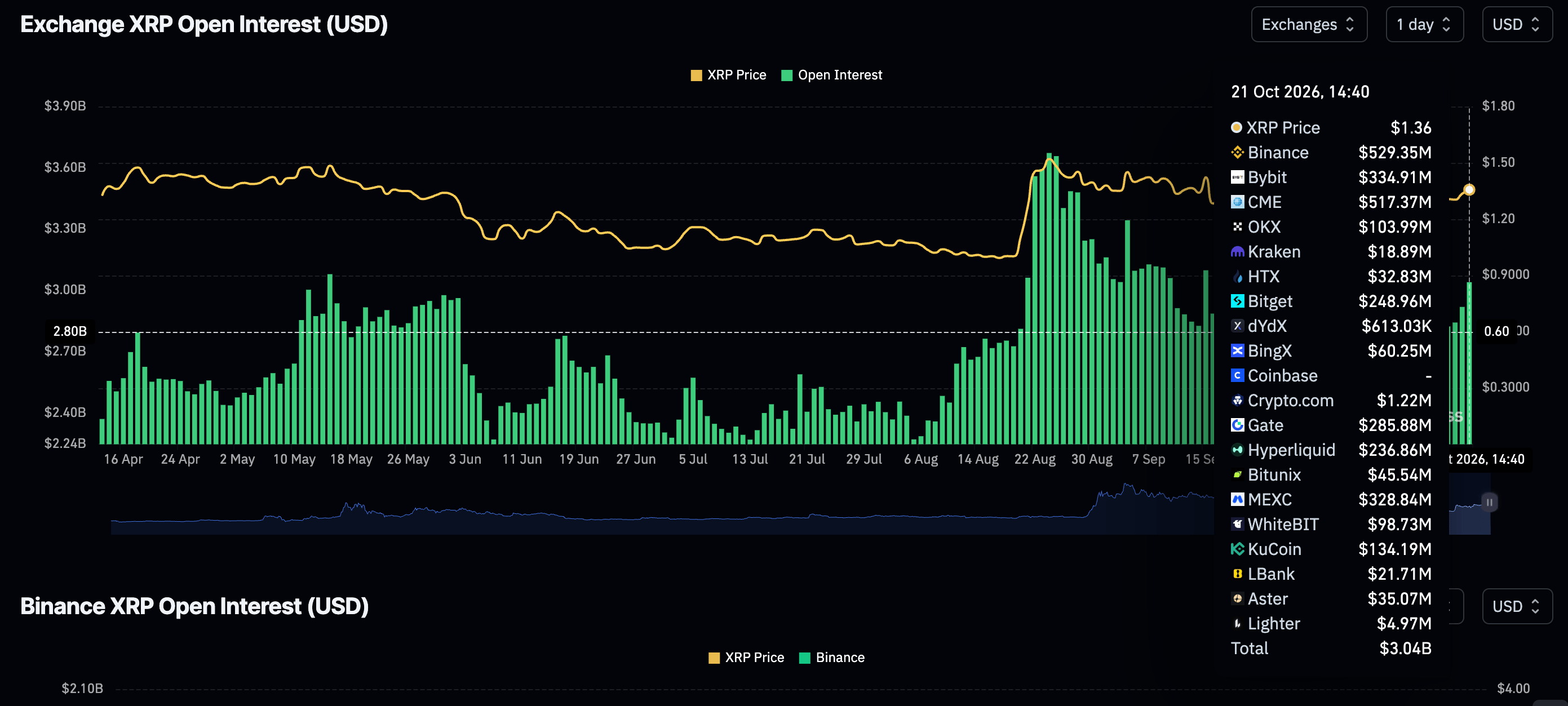
On perpetual futures Open Interest (OI), leveraged traders are signaling rising demand in the derivatives market, albeit slowly, with OI averaging 3.04 billion XRP on Wednesday, up from 2.84 billion XRP the day before. Overall, the figure falls well below the August and September peaks of 3.78 billion and 3.67 billion XRP. This outlook aligns with the Estimated Leveraged Ratio on Binance, suggesting that recovery could be an uphill battle if traders do not increase risk exposure by a significant margin.
Technical analysis: XRP ticks in a broader bearish structure
XRP trades above $1.36 as bulls push to reclaim control over the trend following the correction below $1.30 earlier this week. The remittance token holds below the 50-day and 200-day Exponential Moving Averages (EMAs) at $1.38 and $1.37, keeping the near-term bias bearish and suggesting rallies remain capped by overhead supply.
The SuperTrend line at $1.47 reinforces this ceiling, while the Moving Average Convergence Divergence (MACD) stays marginally below zero and the Relative Strength Index (RSI) hovers near 47, hinting at weak, directionless momentum rather than a decisive recovery.
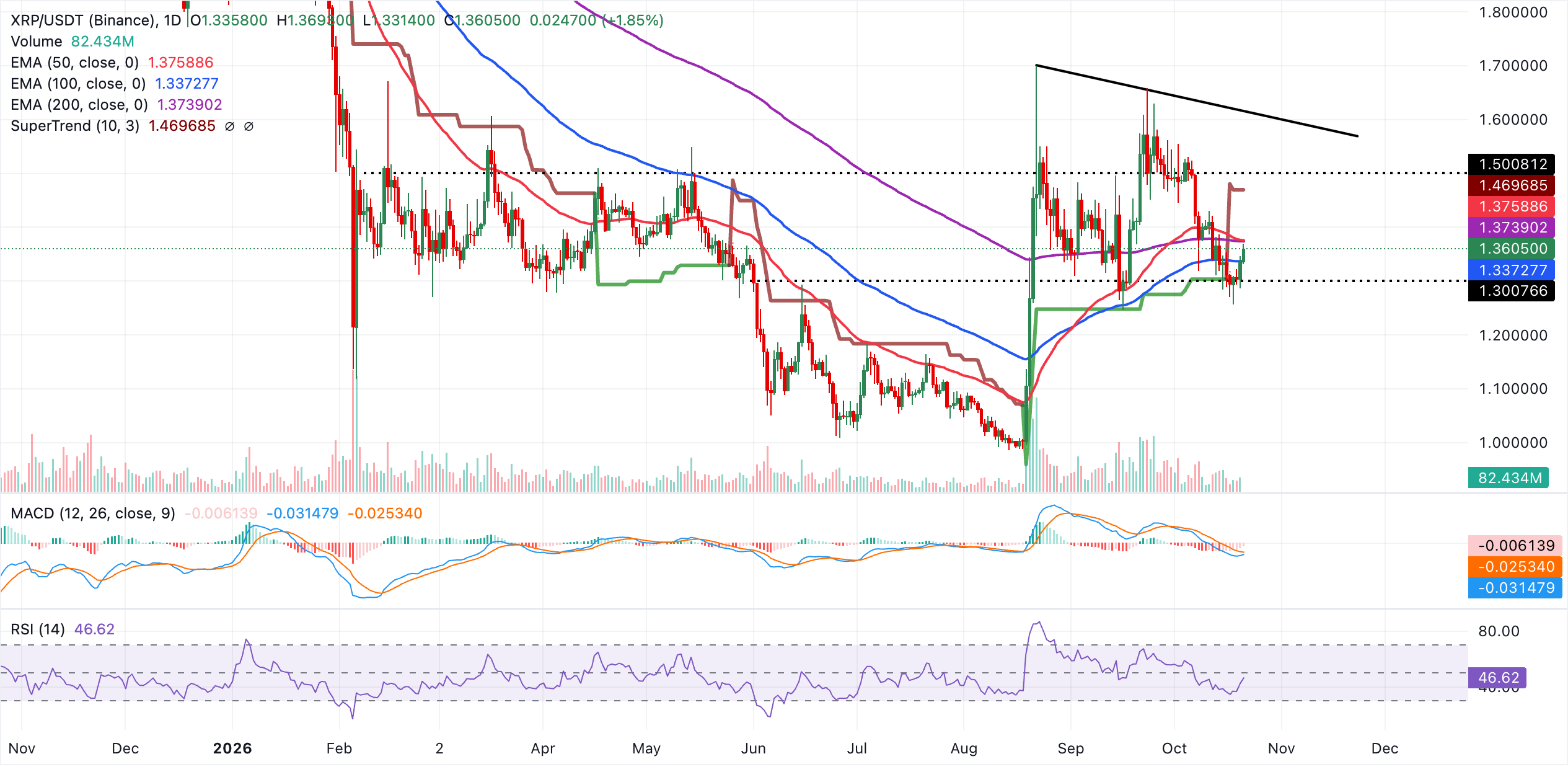
Initial resistance appears at the 200-day EMA at $1.38, followed closely by the 50-day EMA, creating a tight technical barrier before the SuperTrend level at $1.47 and the broader downtrend structure defined by $1.62 and $1.70. On the downside, immediate support is offered by the 100-day EMA at $1.34, and a clear break under this floor would likely open the way for a deeper bearish extension in the coming sessions.
(The technical analysis of this story was written with the help of an AI tool. Know more.)
Bitcoin, altcoins, stablecoins FAQs
Bitcoin is the largest cryptocurrency by market capitalization, a virtual currency designed to serve as money. This form of payment cannot be controlled by any one person, group, or entity, which eliminates the need for third-party participation during financial transactions.
Altcoins are any cryptocurrency apart from Bitcoin, but some also regard Ethereum as a non-altcoin because it is from these two cryptocurrencies that forking happens. If this is true, then Litecoin is the first altcoin, forked from the Bitcoin protocol and, therefore, an “improved” version of it.
Stablecoins are cryptocurrencies designed to have a stable price, with their value backed by a reserve of the asset it represents. To achieve this, the value of any one stablecoin is pegged to a commodity or financial instrument, such as the US Dollar (USD), with its supply regulated by an algorithm or demand. The main goal of stablecoins is to provide an on/off-ramp for investors willing to trade and invest in cryptocurrencies. Stablecoins also allow investors to store value since cryptocurrencies, in general, are subject to volatility.
Bitcoin dominance is the ratio of Bitcoin's market capitalization to the total market capitalization of all cryptocurrencies combined. It provides a clear picture of Bitcoin’s interest among investors. A high BTC dominance typically happens before and during a bull run, in which investors resort to investing in relatively stable and high market capitalization cryptocurrency like Bitcoin. A drop in BTC dominance usually means that investors are moving their capital and/or profits to altcoins in a quest for higher returns, which usually triggers an explosion of altcoin rallies.
Author

John Isige
FXStreet
John Isige is a seasoned cryptocurrency journalist and markets analyst committed to delivering high-quality, actionable insights tailored to traders, investors, and crypto enthusiasts. He enjoys deep dives into emerging Web3 tren