XRP recovers backed by steady ETF inflows
- XRP steadies its recovery, trading above $1.15 on Monday, aligning with a broadly rising crypto market.
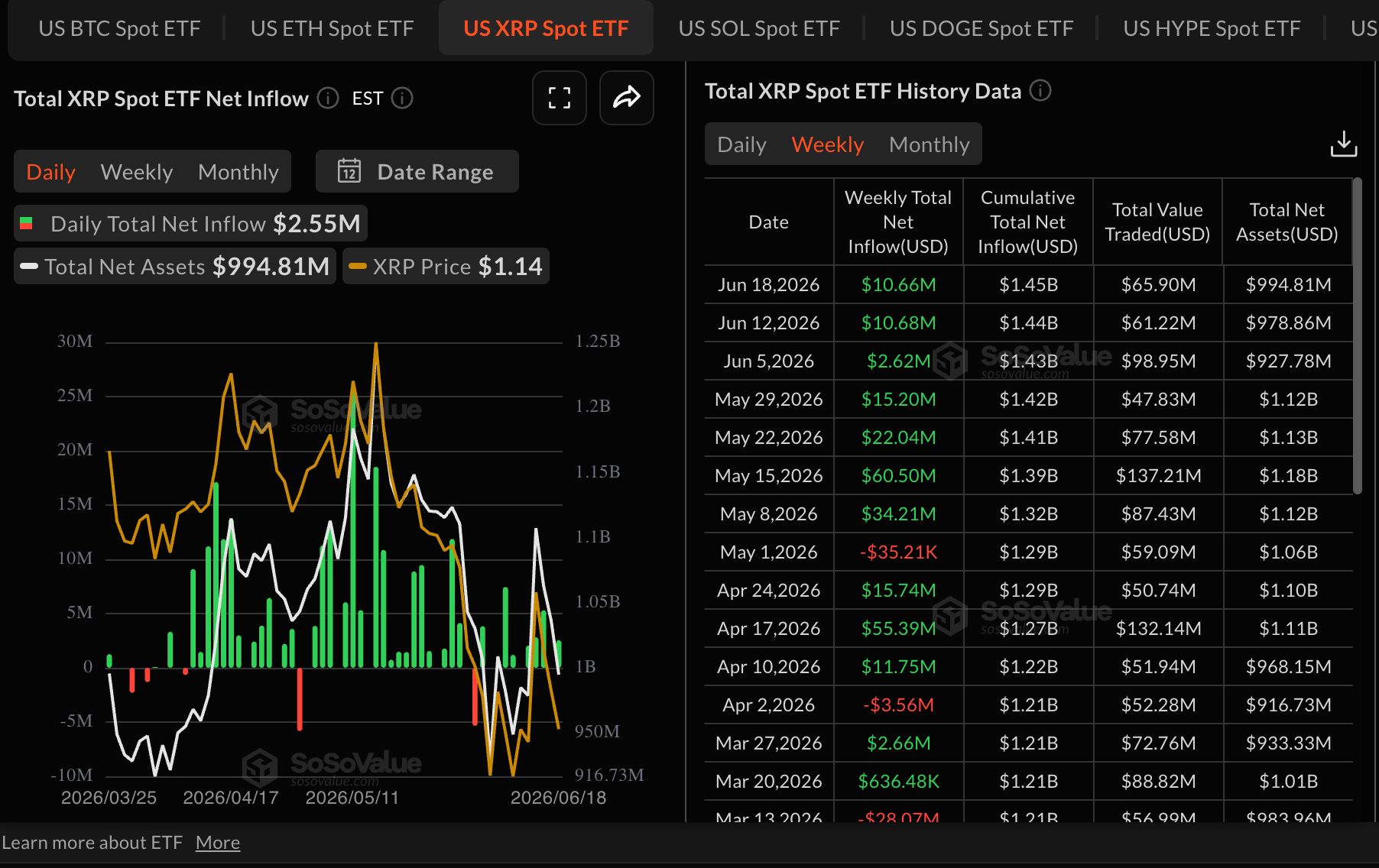
- XRP spot ETFs log seven consecutive weeks of inflows, suggesting steady institutional interest despite sticky risk-off sentiment.
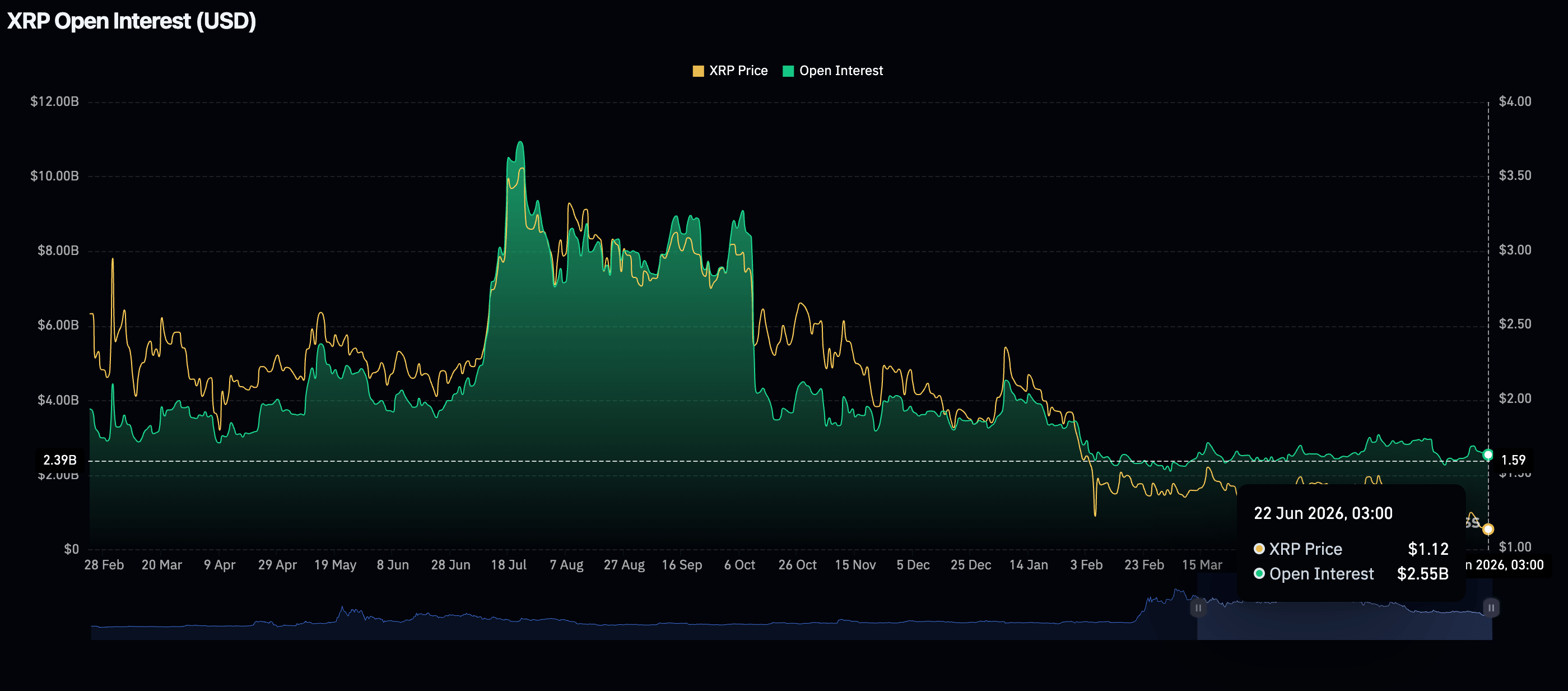
- Subdued retail demand, with futures Open Interest fading to $2.55 billion and a weak technical structure, could limit XRP’s recovery outlook.

Ripple (XRP) gains momentum on Monday, trading above $1.15 as the crypto market widely recovers. This recovery comes amid easing geopolitical tensions in the Middle East, following reports that the United States (US) and Iran made progress in the first round of talks aimed at achieving a lasting peace agreement.
Despite the two nations agreeing on an initial framework targeting a final agreement within 60 days, Israel’s attacks on Lebanon could complicate the existing ceasefire.
Meanwhile, US President Donald Trump has warned Iran to “stop their highly paid PROXIES in Lebanon from causing trouble.” Trump added that “if they don’t, we’ll hit Iran very hard again, just like we did last week, only harder!!!”
XRP attracts steady institutional interest
Institutional investors looking to gain exposure to cryptocurrencies through spot Exchange-Traded Funds (ETFs) have consistently increased their allocations to XRP in recent weeks. According to SoSoValue, XRP ETFs have now recorded seven straight weeks of net inflows.
Inflows amounted to $11 million last week. Cumulative inflows stand at $1.45 billion, while net assets under management average $995 million.
While inflows have been moderate, the persistent demand for US-listed XRP spot ETFs signals that institutional investors maintain a constructive outlook on XRP’s near to mid-term recovery potential.
“Focus remains on regulation, payments adoption, and broader altcoin sentiment. The Federal Reserve (Fed) is signalling higher interest rates for longer, which has larger implications for investor confidence,” said Anil Oncu, Bitpace CEO.
An expanded scope of the XRP derivatives market paints a grim picture, given futures Open Interest (OI) has faded to $2.55 billion on Monday, down from $2.63 billion the previous day. The subdued OI pales in comparison to the record $10.94 billion reached in July and undermines risk-on sentiment. Market participants remain hesitant to initiate new long positions.
Oncu adds that investors are finding it difficult to price risk assets confidently as “Liquidity stays tighter, and with uncertainty remaining around the future path of interest rates.”
Price analysis: XRP gains momentum as bulls tighten grip
XRP is maintaining a strong position above the recently recaptured $1.15 support level, signaling robust buy-the-dip activity among investors. Nevertheless, persistent bearish momentum prevails, with the spot price continuing to trade significantly below major moving averages. The nearest dynamic cap aligns with the 50-day Exponential Moving Average (EMA) around $1.25, while additional overhead layers sit at the 100-day EMA near $1.35 and the longer-term 200-day EMA close to $1.57.
A descending trendline resistance, projected from prior highs and intersecting ahead of $1.50, reinforces the broader downside bias, even as the Moving Average Convergence Divergence (MACD) histogram remains marginally positive on the daily chart. At the same time, the Relative Strength Index (RSI) improves toward the mid-40s on the same chart, hinting more at consolidation than at a decisive bullish reversal.
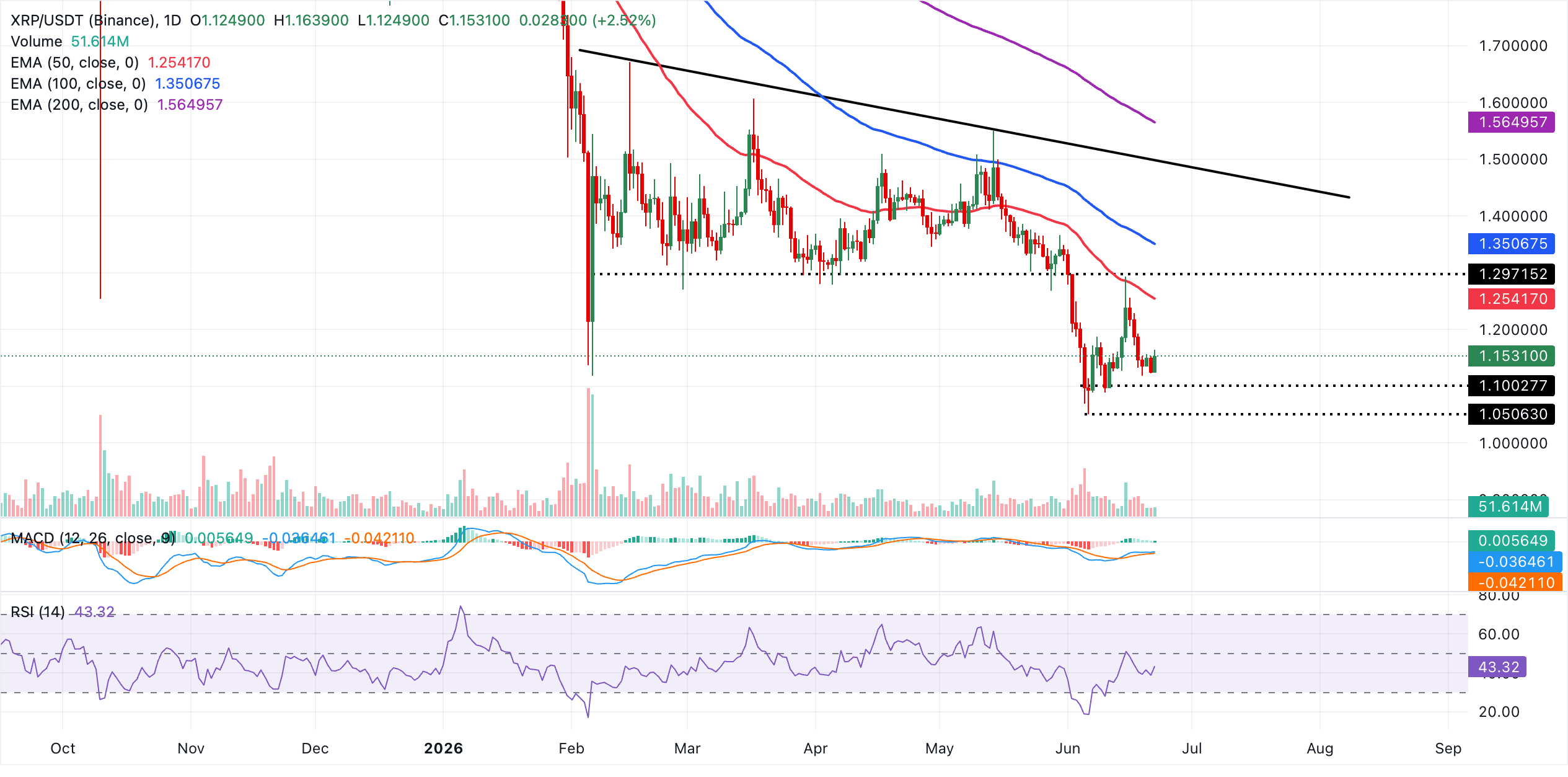
On the topside, bulls would first need to challenge the 50-day EMA at $1.25, with a daily close above that level opening the way toward the 100-day EMA at $1.35 and then the downtrend resistance zone around $1.50. A sustained break of that trendline would be required to expose the more distant 200-day EMA at $1.57 and shift the broader structure into a more constructive phase. Until then, rallies are likely to be treated as corrective within the prevailing bearish framework.
(The technical analysis of this story was written with the help of an AI tool.)
Bitcoin, altcoins, stablecoins FAQs
Bitcoin is the largest cryptocurrency by market capitalization, a virtual currency designed to serve as money. This form of payment cannot be controlled by any one person, group, or entity, which eliminates the need for third-party participation during financial transactions.
Altcoins are any cryptocurrency apart from Bitcoin, but some also regard Ethereum as a non-altcoin because it is from these two cryptocurrencies that forking happens. If this is true, then Litecoin is the first altcoin, forked from the Bitcoin protocol and, therefore, an “improved” version of it.
Stablecoins are cryptocurrencies designed to have a stable price, with their value backed by a reserve of the asset it represents. To achieve this, the value of any one stablecoin is pegged to a commodity or financial instrument, such as the US Dollar (USD), with its supply regulated by an algorithm or demand. The main goal of stablecoins is to provide an on/off-ramp for investors willing to trade and invest in cryptocurrencies. Stablecoins also allow investors to store value since cryptocurrencies, in general, are subject to volatility.
Bitcoin dominance is the ratio of Bitcoin's market capitalization to the total market capitalization of all cryptocurrencies combined. It provides a clear picture of Bitcoin’s interest among investors. A high BTC dominance typically happens before and during a bull run, in which investors resort to investing in relatively stable and high market capitalization cryptocurrency like Bitcoin. A drop in BTC dominance usually means that investors are moving their capital and/or profits to altcoins in a quest for higher returns, which usually triggers an explosion of altcoin rallies.
Author

John Isige
FXStreet
John Isige is a seasoned cryptocurrency journalist and markets analyst committed to delivering high-quality, actionable insights tailored to traders, investors, and crypto enthusiasts. He enjoys deep dives into emerging Web3 tren