|

XAU/USD Elliott Wave update: Gold in expanded flat correction [Video]

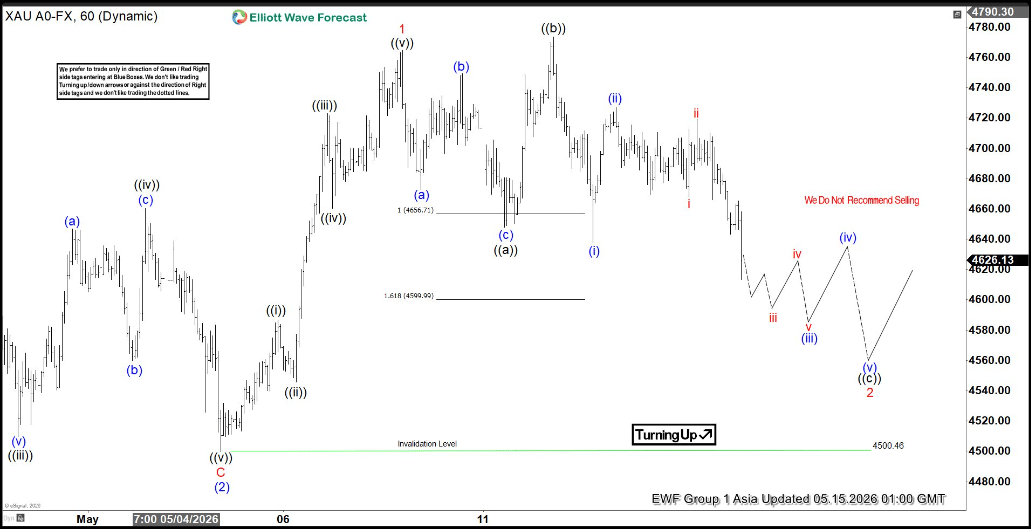
After completing the correction at $4098.74 on the March 23 low, Gold (XAUUSD) initiated a rally in a clear impulsive structure. From that level, wave (1) advanced and concluded at $4890.97. The subsequent pullback in wave (2) finished at $4500.46, as reflected in the one‑hour chart. Following this retracement, the metal resumed its upward movement in wave (3). However, confirmation of this view requires a decisive break above the prior wave (1) peak at $4890.97. From the wave (2) low, wave 1 advanced and ended at $4764.73.

At present, wave 2 is unfolding as a corrective phase to address the cycle that began on May 5, 2026. The internal structure of this wave is developing as an expanded flat formation within the Elliott Wave framework. Declining from wave 1, wave ((a)) terminated at $4647.71, while wave ((b)) completed at $4773.58. The ongoing wave ((c)) of 2 is progressing lower in impulsive fashion, with potential to retest the $4500.46 level before a renewed advance occurs. This decline is part of the corrective sequence rather than a reversal of the broader trend.

In the near term, the key pivot remains the $4500.46 low. As long as this level holds, the expectation favors a resumption of the upward cycle once the correction completes. The broader structure suggests that Gold is consolidating within a corrective pattern, yet the underlying impulsive bias remains intact. Traders should monitor the completion of wave ((c)) closely, as it will likely set the stage for the next bullish phase.

Gold Futures 60-minute Elliott Wave chart
Gold Elliott Wave [Video]
Youtube preview

Author

Elliott Wave Forecast Team

Elliott Wave Forecast Team

ElliottWave-Forecast.com

More from Elliott Wave Forecast Team
Share:

Editor's Picks

GBP/USD remains offered; bears target 1.3600

GBP/USD now leaves behind part of its recent recovery and revisits the low 1.3600s at the beginning of the week. Indeed, Cable trades with a mild downward bias amid decent gains in the Greenback as investors remain wary of upcoming US data releases and the Jackson Hole event.

EUR/USD remains sidelined above 1.1650

EUR/USD trades on the defensive following the closing bell on Wall Street on Monday, hovering around the 1.1660 region and adding to Friday’s small decline. The pair’s pullback comes in response to an acceptable rebound in the US Dollar in a context of generalised caution ahead of key US data releases and Chair Warsh’s speech in Jackson Hole.

Gold retreats from mid-May highs; fails ahead of $4,700 as Fed risks support USD

Gold touched a fresh high since May 14, during the Asian session on Tuesday, though it struggled to capitalize on the move and failed to break the $4,700 mark. The initial downward push on US bond yields due to the Treasury Department's expanded buyback strategy turned out to be short-lived amid concerns over the growing US national debt, which crossed $40 trillion.

Ripple and Stellar outlook: Key breakouts could fuel the next rally
Ripple (XRP) and Stellar (XLM) are showing signs of renewed strength after rallying over 53% and 27% in the previous week. Meanwhile, both altcoins are approaching key technical levels on Tuesday that could determine their next move. However, mixed on-chain signals with a slight bearish tilt suggest traders remain cautious amid the recent price gains.
Will Jackson Hole ignite Gold and Silver’s next explosive breakout?
The 2026 Jackson Hole Economic Policy Symposium arrives at a pivotal moment. The U.S economy faces record debt, elevated borrowing costs, a weaker dollar and renewed momentum across hard assets. For The Gold & Silver Club, the backdrop increasingly validates its early-year call: “2026 will be the Year of Hard Assets.”
$20 billion offered, $2 billion taken: Why Treasury doubled its buyback cap

The US Treasury moved off its own calendar on Wednesday, and that is the part worth sitting with. At 12:32 GMT, the department said it would at least double the size of liquidity support buyback operations in the 10-year to 20-year and 20-year to 30-year sectors, lifting the maximum from $2 billion per operation to at least $4 billion, effective September 9 and running to November 4.