|

WTI’s bullish count faces its first test

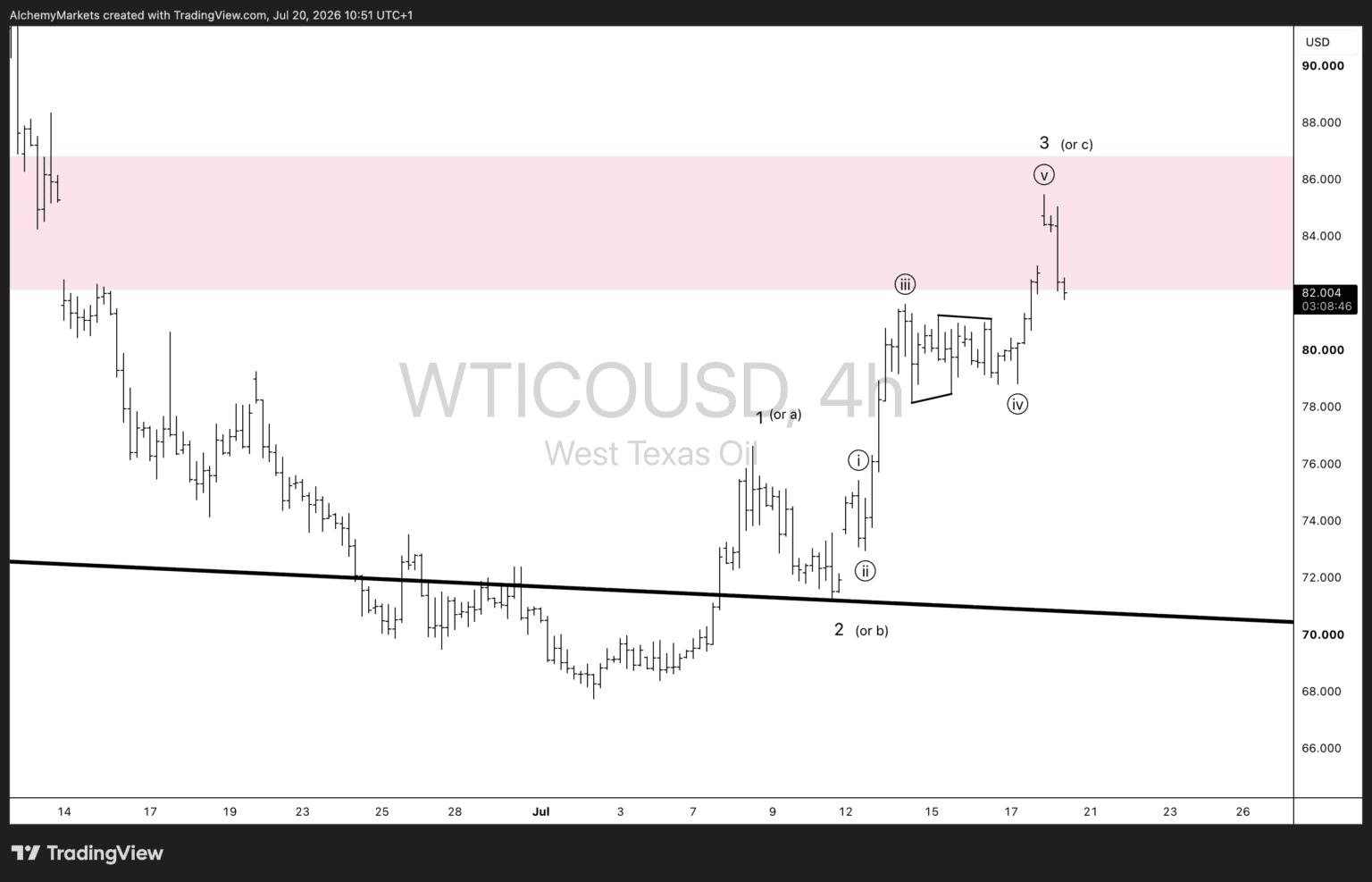
WTI has pulled back toward $82 after rallying from approximately $68 to $85. My bias remains slightly bullish, although the next move should determine whether this was the start of a larger advance or only a corrective rally.
WTI

The primary Elliott Wave count treats the rise to $76 as wave one, the decline to $71 as wave two, and the strong five-wave advance toward $85 as wave three. On this interpretation, the current weakness is a normal wave-four pullback before a potential fifth wave higher.

The first support is $81.50–82. A deeper retracement into the previous $79–80.50 consolidation would still fit the bullish count. If buyers defend this area, WTI could retest $85–86.50, with $88–90 possible following a confirmed breakout.

Fundamentals provide some support. US commercial crude inventories are around 3% below last year, gasoline stocks are nearly 10% lower, and refineries are operating above 96% utilisation. Global inventories are also expected to continue drawing during the third quarter, while uncertainty around Middle East supply and Strait of Hormuz traffic maintains a risk premium.

The alternative bearish count views the same move as an A–B–C correction: the rallies to $76 and $85 represent waves A and C, separated by wave B near $71. Under this interpretation, the recovery has finished and the larger downtrend is resuming.

A break below $81.50 would raise that risk, while losing $79 would provide stronger bearish confirmation. The bullish impulse is structurally invalidated below approximately $75.50–76.

The bearish case would also be supported by normalising Middle East exports, additional OPEC+ supply and weak US fuel demand.

For now, the five-wave advance keeps me slightly bullish. But buyers need to defend $79–82. Holding that zone favours another move through $85; losing it would shift the advantage toward the corrective bear count.

Author

Zorrays Junaid

Zorrays Junaid

Alchemy Markets

Zorrays Junaid has extensive combined experience in the financial markets as a portfolio manager and trading coach. More recently, he is an Analyst with Alchemy Markets, and has contributed to DailyFX and Elliott Wave Forecast in the past.


More from Zorrays Junaid
Share:

Editor's Picks

GBP/USD tumbles to three-day lows around 1.3420

GBP/USD comes under extra selling pressure and revisits the area of multi-day lows near 1.3420 in quite a bearish start to the week. Cable’s decline comes amid the firmer Greenback as investors continue to assess developments in the US-Iran conflict. Moving forward, attention will turn to the UK employment report on Tuesday.


EUR/USD declines to near 1.1400 as US launches fresh strikes on Iran

The EUR/USD pair posts modest losses around 1.1410 during the early Asian trading hours on Tuesday. Renewed tensions between the United States (US) and Iran continue to fuel risk-off sentiment, weighing on the Euro (EUR) against the US Dollar (USD). The ZEW surveys from Germany and the Eurozone are due later on Tuesday.  Also, the US ADP employment report will be released. 

Gold holds above $4,000 as inflation-driven Fed hike bets cap upside

Gold holds steady above $4,000 during the Asian session on Tuesday, though the upside potential seems limited. Inflation fears stemming from elevated oil prices reaffirm bets for higher US interest rates, which, along with an escalation in the Middle East war, continue to underpin the safe-haven US Dollar. This should act as a headwind for the non-yielding bullion, warranting caution for bullish traders before positioning for any meaningful gains.

Grayscale eyes Worldcoin ETF launch following S-1 filing

Grayscale filed an S-1 registration statement with the US Securities and Exchange Commission on Monday to launch a Grayscale Worldcoin ETF. The proposed fund, which would trade on Nasdaq under the ticker GWLD, is designed to give investors exposure to Worldcoin through a traditional brokerage account, eliminating the need to buy the token directly.

Here's where the Canadian Dollar is headed next: 4 bearish scenarios and a bullish one
The Canadian Dollar (CAD) has ridden a volatile first half of the year, with Oil prices surging and then falling as markets danced to the Middle East’s tune. Neither the Bank of Canada nor the Federal Reserve has changed rates so far this year, and the USD/CAD's next move may depend on which of the two banks fails to deliver what markets expect.
US Dollar mid-year outlook: Exceptional currency, exceptional risks?
The US Dollar enters the second half of 2026 in a markedly different position from a year ago. The King currency has recovered, reflecting persistent US inflation, changing expectations for Fed policy, geopolitical tensions and renewed demand for defensive assets.















