Why the Pound is starting to trade like an emerging-market currency

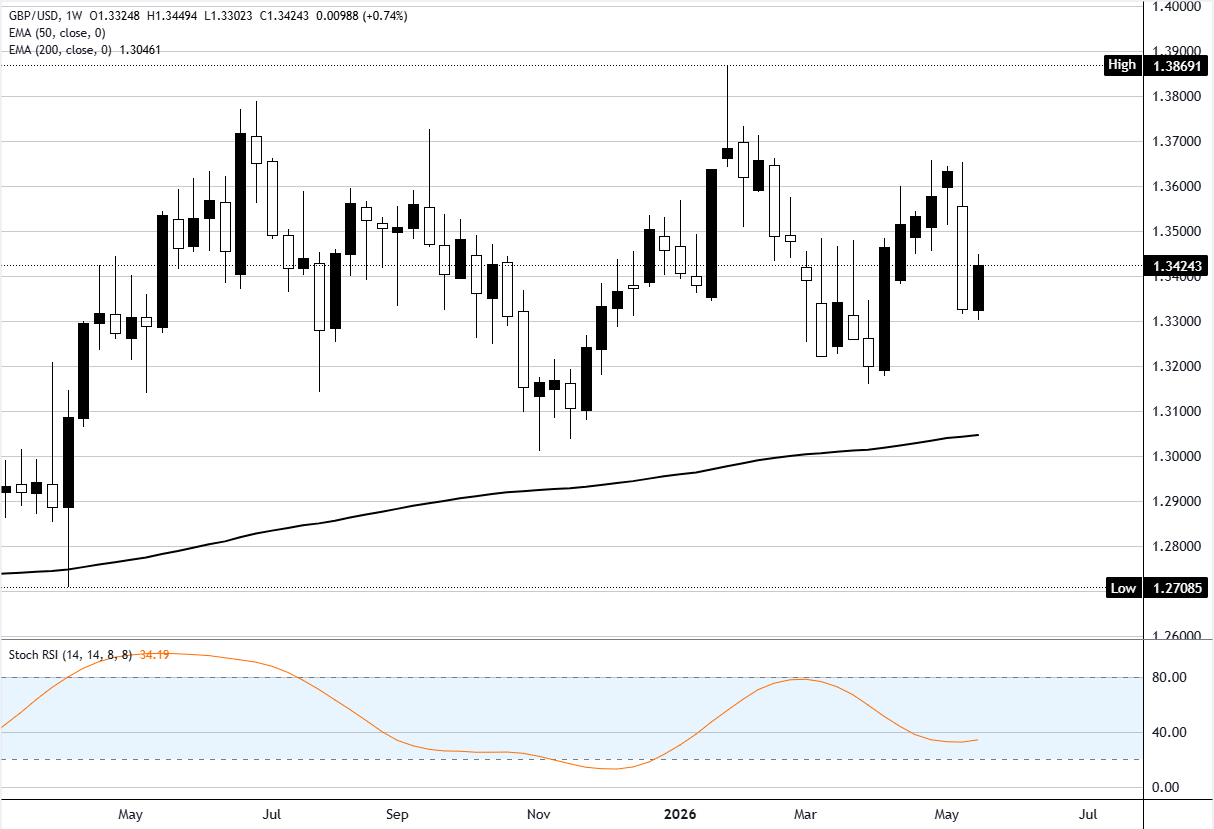
The Bank of England (BoE) is being priced to hike around 70 basis points before year-end. The 10-year gilt is near 5.2%, its highest since the 2008 financial crisis. The 30-year sits at levels last seen in 1998. None of it is helping the Pound. The Sterling is the second-weakest G10 currency against the US Dollar this year, and with GBP/USD cracking through 1.3400 to its lowest since early April, the textbook relationship between rising yields and currency strength has stopped working.
This piece walks through why it broke: an inflation-linker feedback loop connecting every Brent print directly to UK fiscal arithmetic, a BoE trapped in a box where hiking and holding both hurt the Pound, and the broader reframe traders need to make about Sterling, which has stopped behaving like a G10 currency and started behaving like emerging-market debt.
The textbook is broken
BoE Chief Economist Huw Pill voted for a rate increase at the last meeting and has continued to argue for more tightening to offset the energy shock. Under the standard G10 framework, that hawkish repricing should be lifting Cable bids. However, GBP continues to struggle against its major counterparts. Only the Kiwi has fared worse against the US Dollar this year.
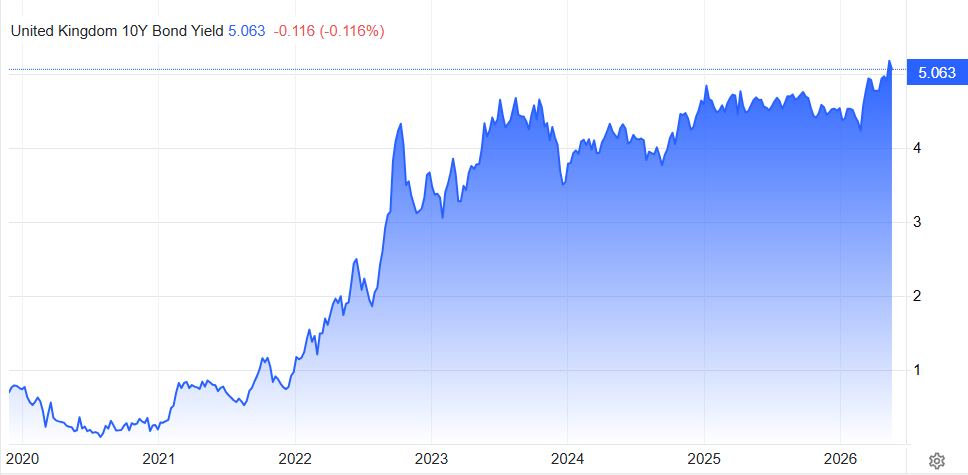
The 10-year gilt yield tells the other half of the story: Yields have climbed roughly 85 basis points since late February and now sit above 5%. The 30-year is at its highest since 1998. Some outlets have labeled the political risk component the "Burnham Premium in UK assets", a reference to Manchester mayor Andy Burnham's positioning to challenge Prime Minister Keir Starmer after Labour's local election collapse. The leadership question is real, but the structural problem runs deeper, and it explains why this gilt selloff is hitting Sterling instead of supporting it.
The linker loop nobody wants to price
The UK runs the highest share of inflation-linked debt in the G10. Roughly a quarter of the gilt stock is index-linked, several times the proportion carried by the US, Germany, or Japan. That creates a feedback loop uniquely brutal for British fiscal arithmetic.
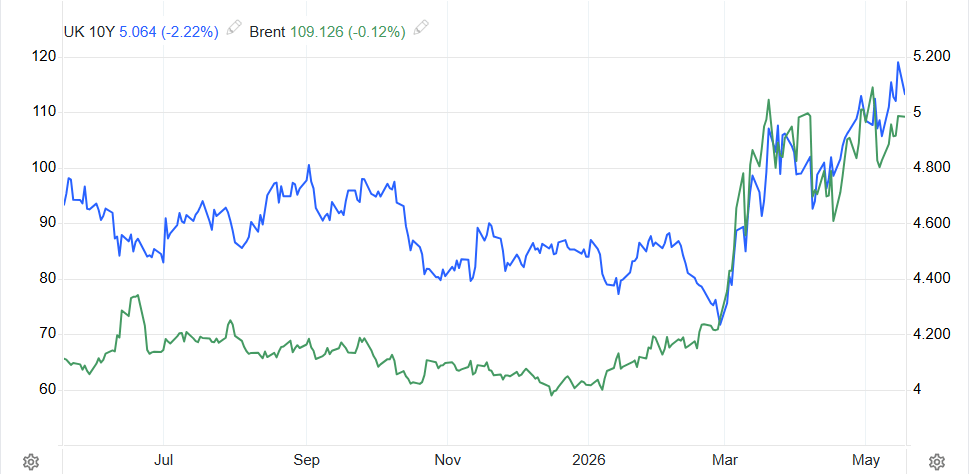
The chain works like this. Brent crude has been trading above $107 a barrel on stalled US-Iran negotiations over the Strait of Hormuz, with US President Donald Trump's recent comment about not needing the Strait open pushing prices higher. Higher Oil feeds directly into UK headline inflation, with March Consumer Price Index (CPI) already at 3.3% and services inflation at 4.5%. Higher inflation lifts UK breakevens, which raises the coupons on every inflation-linked gilt the Debt Management Office (DMO) has outstanding. That mechanically increases debt service, deteriorates the fiscal trajectory, raises term premium across the curve, and sells off the long end.
In G10 peers, the Crude Oil-to-debt-service transmission takes years to show up through refinancing cycles. In the UK, it shows up within months on linker resets. Goldman Sachs analysts recently dismissed the DMO's pivot toward more Treasury bill issuance as offering only "limited" fiscal improvement. The structural problem doesn't unwind through funding-mix tweaks. Brent above the $108 to $110 zone is essentially a direct short on Sterling, transmitted through a balance sheet that most G10 currency traders don't model.
The BoE's box
That brings us to monetary policy, where the trap closes. The BoE has two options, and both hurt Sterling.
Option one: Hike. Pill's faction wants it, and the swap curve is positioned for it. But every hike compounds debt service on conventional gilts, accelerates the fiscal deterioration already being priced, and validates the political case for fiscal loosening under a future Labour Party leadership. Hiking into fiscal stress isn't currency-positive when the stress was the original problem.
Option two: Hold or pivot dovish. That lets inflation expectations unanchor at a moment when Oil is still pushing through the system and the BoE is already widely viewed as too patient. The 30-year gilt at 1998 highs is partly a vote that the BoE has lost the inflation credibility battle. Sarah Breeden has pushed back, arguing the Middle East conflict is unlikely to drive an inflation surge on the scale of 2022, but the curve isn't buying it.
This is what fiscal dominance looks like in practice. The central bank can no longer set the price of money independently of the sovereign's funding constraints. Hawkish dissent that would normally be a currency tailwind has become a fiscal-deterioration accelerator. A dovish pivot that would normally cap currency upside has become an inflation-credibility risk. Either way, the Pound loses.
Cable has gone emerging market
Step back from the mechanics and the reframe writes itself. Currencies trading on fiscal credibility rather than rate differentials are emerging-market currencies. The playbook for trading Turkish Lira, Brazilian Real, or South African Rand is exactly this: watch the fiscal trajectory, the political risk premium, and the central bank's room to maneuver. Rate hikes are not currency-positive when they signal a sovereign losing control of its own balance sheet.
Kit Juckes at Societe Generale has captured the dynamic cleanly: A future Labour leadership almost guarantees higher spending, Chancellor Rachel Reeves is widely expected to raise taxes, including possible wealth and housing measures at the Autumn Budget, and 2026 Gross Domestic Product (GDP) forecasts have been cut from 1.1% to 0.8%, largely on the energy cost pass-through. That combination leaves Sterling with almost nothing to work with. Burnham's emergence after MP Josh Simons stepped aside has added a leadership-risk premium on top, with Wes Streeting and Angela Rayner also in the mix and Rayner carrying a similar bond-market risk profile to Burnham.
For traders running Cable on the old playbook, the past month has been a series of stop-outs. The new playbook treats Sterling closer to a high-yield credit than a developed-market currency.
Trading the regime
In application, Brent breakouts above the $108 to $110 zone are direct Sterling shorts. The transmission to UK fiscal arithmetic runs through linkers within the same monthly cycle, faster than in any other G10 economy.
Hawkish BoE surprises should be sold, not bought. The instinct to buy Sterling on a hawkish hold or a 25-basis-point hike is the dominant trap right now. Fade the spike: The curve is already priced for it and the fiscal damage outweighs the carry support.
UK 10-year breakevens are the cleanest Sterling sentiment proxy that almost no one is watching. They lead both the political risk premium and the Cable selloff. Build them into the dashboard.
GBP/EUR is the cleaner political-risk expression than Cable, stripping out the Federal Reserve (Fed) repricing story and isolating the UK fiscal and political premium.
The Autumn Budget is the binary unwind event: Until Reeves delivers credible tax measures or genuine consolidation, every gilt auction tail is a Sterling trade. After the Budget, the political risk premium could compress quickly if the numbers add up. That is the asymmetric setup into autumn.
The market's old assumption was that the BoE could rescue Sterling. The current assumption is that no one can.
Author

Joshua Gibson
FXStreet
Joshua joins the FXStreet team as an Economics and Finance double major from Vancouver Island University with twelve years' experience as an independent trader focusing on technical analysis.

















