|

US Oil breaks below bear flag as $80 comes into focus

US Oil breaks below bear flag as $80 comes into focus

US crude oil prices remain under pressure as improving Middle Eastern supply conditions and growing expectations of a global oil surplus continue to weigh on sentiment. West Texas Intermediate (WTI) has fallen sharply in recent sessions, with the market increasingly shifting its attention from geopolitical supply disruptions towards the possibility of excess supply.

The latest International Energy Agency (IEA) outlook has reinforced this bearish narrative, forecasting that global oil supply will exceed demand by approximately 1.7 million barrels per day during the fourth quarter. Recovering exports through the Strait of Hormuz have helped ease concerns over shortages, even as attacks on tankers continue to highlight lingering geopolitical risks.

The change in expectations is significant. Where investors previously priced oil around potential supply disruptions, attention is now turning towards whether recovering production and weaker demand could place further downward pressure on prices.

Technical outlook: Bear flag breakdown points towards $80
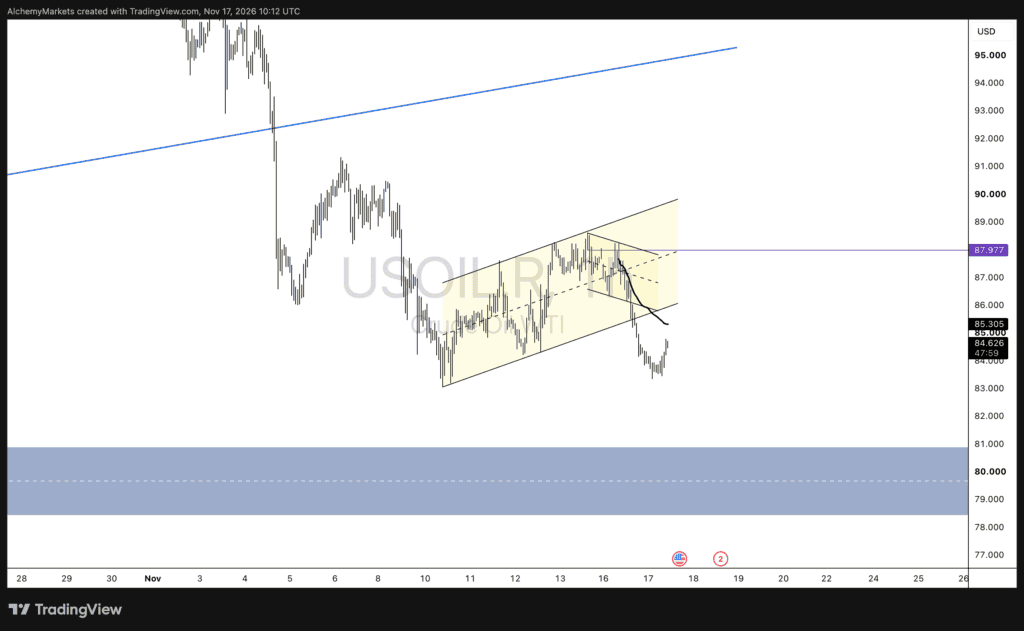
Oil

From a technical perspective, WTI has broken below a rising consolidation channel resembling a bear flag, following its earlier sharp decline. The breakdown suggests that the recent recovery may have been corrective rather than the beginning of a sustained bullish reversal.

Prices are now attempting a modest rebound, potentially setting up a retest of the broken channel boundary and the descending anchored VWAP area around $85–86.

Should sellers defend this region, the bearish structure would remain intact, increasing the likelihood of another downward move towards the $80 psychological level, our primary downside target.

A sustained recovery above $87.98, however, would challenge the immediate bearish outlook and suggest that buyers are regaining control of the short-term structure.

Market outlook

The combination of deteriorating technical momentum and improving supply expectations continues to favour the downside, although further disruptions to Middle Eastern exports remain an important risk to the bearish outlook.

For now, the potential retest of the broken bear flag and anchored VWAP could prove decisive. A rejection around $85–86 would reinforce the bearish continuation scenario, keeping $80 in focus as the primary target.

Author

Zorrays Junaid

Zorrays Junaid

Alchemy Markets

Zorrays Junaid has extensive combined experience in the financial markets as a portfolio manager and trading coach. More recently, he is an Analyst with Alchemy Markets, and has contributed to DailyFX and Elliott Wave Forecast in the past.


More from Zorrays Junaid
Share:

Editor's Picks

AUD/USD remains depressed below 0.6750 after RBA minutes

AUD/USD treads water below 0.6750 in Asia on Tuesday, struggling near ten-month lows. The pair fails to find any inspiration from RBA Governor Bullock’s hawkish remarks. Moreover, Minutes from the November RBA meeting also had little impact on the Australian Dollar amid a bullish US Dollar undertone, bolstered by firming Fed hike bets and geopolitical uncertainties.

USD/JPY holds steady around 156.50 as 'Yentervention' risks loom

USD/JPY is consolidating around mid-156.00s in the Asian session on Tuesday as traders stay on high alert amid speculation that authorities will step in to support the Japanese Yen. Meanwhile, the US Dollar holds its recent gains at a 19-month high, amid firming Fed rate-hike bets and geopolitical uncertainty. This, along with the wide US-Japan rate differential, acts as a tailwind for the pair.


Gold trims intraday recovery gains as Fed hike bets and Iran risks support USD

Gold struggles to capitalize on modest recovery gains and trades near the lowest level since October 2025, set the previous day, albeit retaining a mildly positive tone through the first half of the European session. The US Dollar pauses following the recent strong rally to a 19-month peak, offering some support to the commodity. However, firming US Federal Reserve rate-hike bets and geopolitical uncertainties limit USD losses, capping the non-yielding bullion.

Pi Network sinks to record low of $0.0551 as bears dominate

Pi Network extends its losing streak, hitting a new all-time low of $0.0551 on Tuesday as bearish pressure intensifies. Weakening derivatives metrics suggest bears remain in control. In addition, deteriorating technical indicators point to elevated downside risk, despite oversold conditions that could trigger a short-term relief bounce.

Make or break tonight: Nvidia reports Q3 earnings
The Nasdaq lost 2.5% yesterday following an interim final rule by the US Commerce Department on US export restrictions on AI chips (to China). The rule targets a loophole where Chinese firms rent computing power from data centers in unrestricted countries. Data center operators in Singapore, Malaysia, Thailand, Indonesia and Brazil must now request a US license to buy advanced AI chips.
Gold isn't being sold for thew reason most people think
Gold (XAU/USD) remains under heavy selling pressure on Monday, hitting its lowest level in 13 months. The precious metal is struggling to recover despite escalating geopolitical tensions in the Middle East, a backdrop that would normally encourage investors to seek protection in safe-haven assets. However, the main driver behind Gold's decline is not the geopolitical uncertainty itself.















