The New Zealand Dollar is now cheaper than it has been since the pandemic


NZD/USD trades lower on Wednesday, extending its decline toward levels last seen in March 2020, when the Covid-19 pandemic triggered a global financial market sell-off. The New Zealand Dollar (NZD) is struggling against the US Dollar (USD), caught between a weakening domestic economy and increasingly restrictive monetary policy expectations in the United States (US).
The currency pair is approaching a critical turning point. After several unsuccessful recovery attempts over recent years, the Kiwi is once again testing a historical support zone around 0.5500, which has repeatedly prevented a deeper depreciation. Unlike the extraordinary circumstances of 2020, however, the current weakness reflects a combination of domestic economic challenges and diverging monetary policy expectations.
Why is the New Zealand Dollar falling to pandemic-era lows?
The New Zealand Dollar's prolonged decline reflects deteriorating economic conditions and a monetary policy outlook that remains unfavorable for the currency. Recent economic indicators reinforce concerns about the strength of New Zealand's recovery. Statistics New Zealand reported on Wednesday that the Producer Price Index (PPI) for output rose 0.8% QoQ in the third quarter, slowing from 1.7% previously and missing expectations of 1.1%. Input producer prices also increased by just 0.7%, compared with 2.9% in the preceding quarter and forecasts of 1.5%.
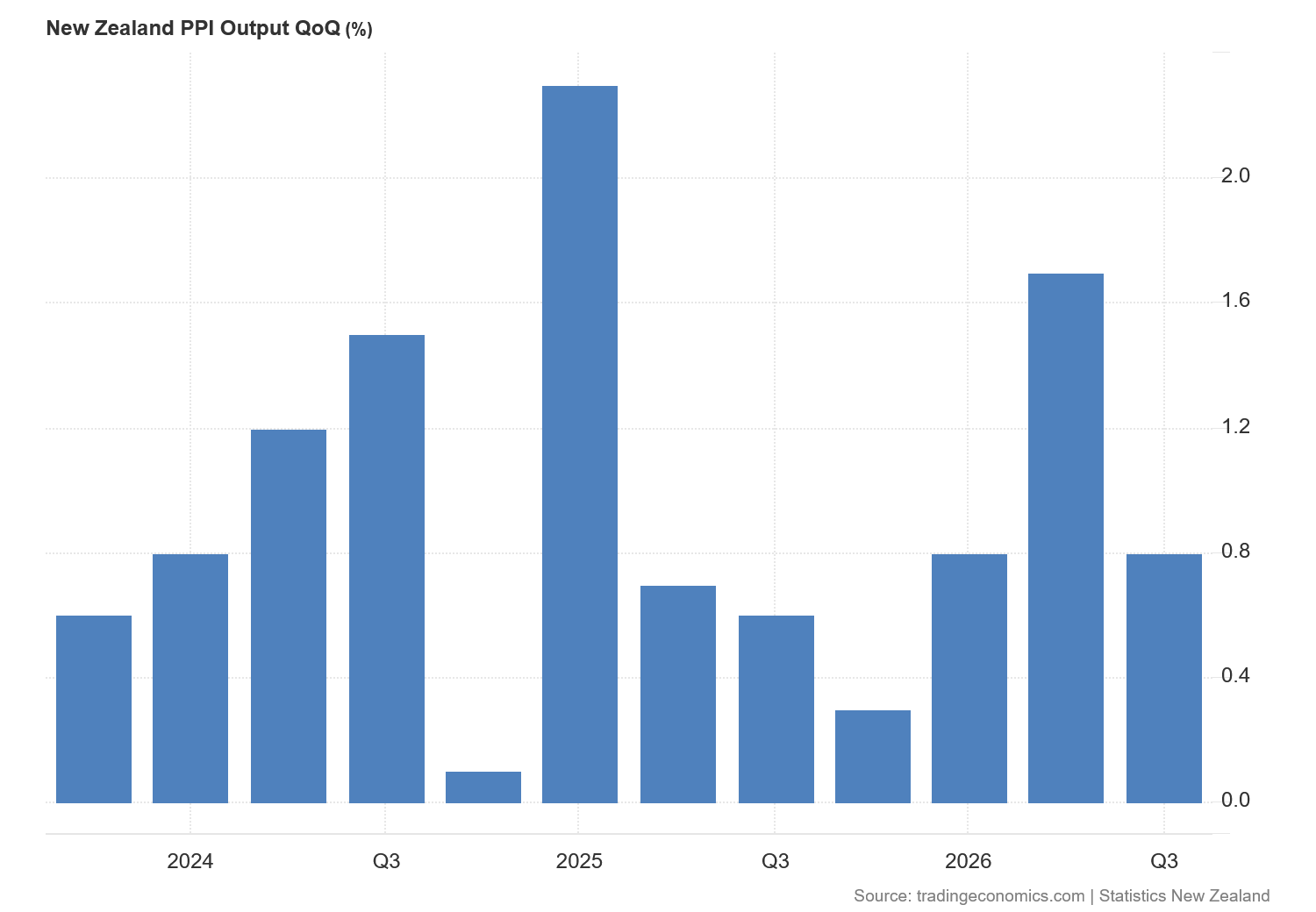
These figures suggest that price pressures at the production level are moderating, potentially giving the Reserve Bank of New Zealand (RBNZ) greater flexibility to maintain an accommodative monetary policy stance. The central bank's unexpectedly dovish shift in October has already weighed heavily on the Kiwi, as investors reassess the outlook for New Zealand interest rates.
Meanwhile, the RBNZ's fourth-quarter survey showed that two-year inflation expectations edged higher to 2.36%, compared with 2.34% in the previous quarter. One-year expectations stand at 2.92%, suggesting that inflation concerns have not entirely disappeared. This creates a challenging environment for policymakers: economic activity remains fragile, while inflation expectations limit the scope for aggressive monetary easing. New Zealand's Unemployment Rate of 5.7% adds another source of concern, highlighting persistent weakness in the labor market.
Political uncertainty could further complicate the outlook. Following the November 7 general election, preliminary results indicate that the National-led coalition holds a narrow one-seat majority, with official results expected on November 27. A potential Labour-led government could restore employment to the RBNZ's mandate, a development that markets may interpret as dovish given the current unemployment situation.
The Federal Reserve adds another layer of pressure
While New Zealand faces domestic economic challenges, developments in the United States are reinforcing the downward pressure on NZD/USD. The Federal Reserve (Fed) has adopted a more hawkish tone following stronger-than-expected US inflation figures, prompting investors to anticipate additional monetary tightening.
St. Louis Fed President Alberto Musalem recently warned about persistent inflation risks and signaled that several additional interest rate increases could be necessary in the coming months. Cleveland Fed President Beth Hammack also favors gradual monetary tightening, while acknowledging that larger adjustments may become necessary if inflation deteriorates.
According to the CME FedWatch tool, markets have fully priced in a 25-basis-point interest rate increase in December, while expectations of additional hikes in January and March continue to strengthen.
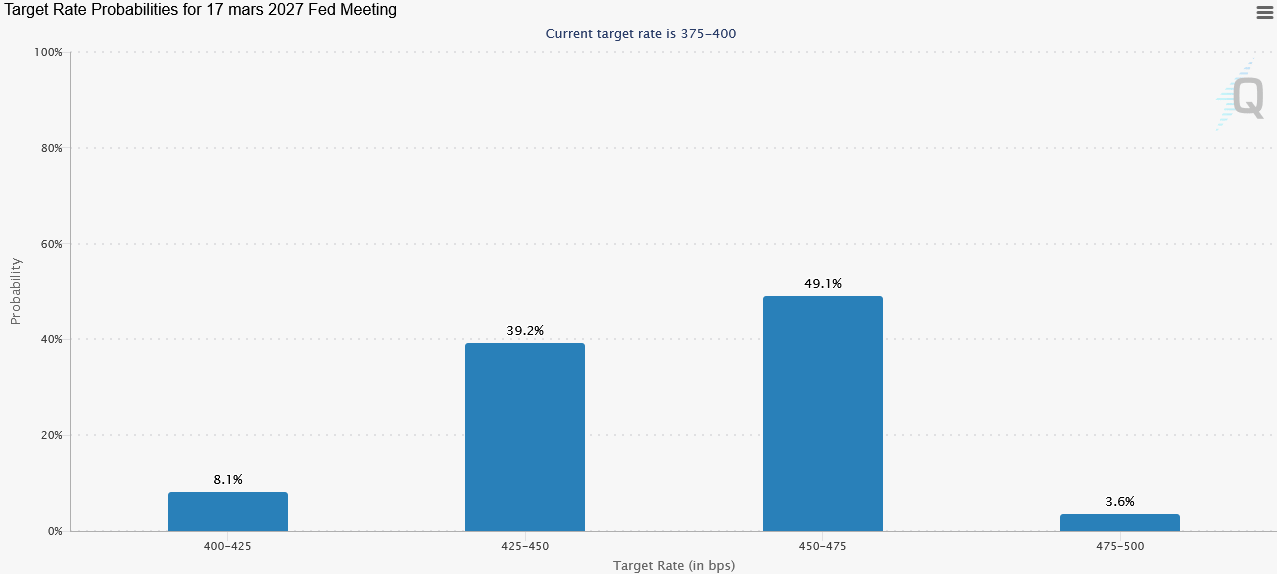
Strategists at Brown Brothers Harriman (BBH) acknowledge that “the USD rally may look stretched in the near-term as tightening by other major central banks limits policy divergence with the Fed.” Nevertheless, they highlight “robust US growth, favorable labor market conditions and sticky underlying inflation” as factors keeping the “USD bias tilted higher.”
For the New Zealand Dollar, this combination is particularly unfavorable. Higher US interest rates can increase the relative attractiveness of USD-denominated assets, while the RBNZ's softer stance limits the Kiwi's appeal.
Investors now await the minutes of the Fed's October monetary policy meeting for further indications of how aggressively policymakers intend to respond to persistent inflation.
A historical support zone stands between the Kiwi and a deeper decline
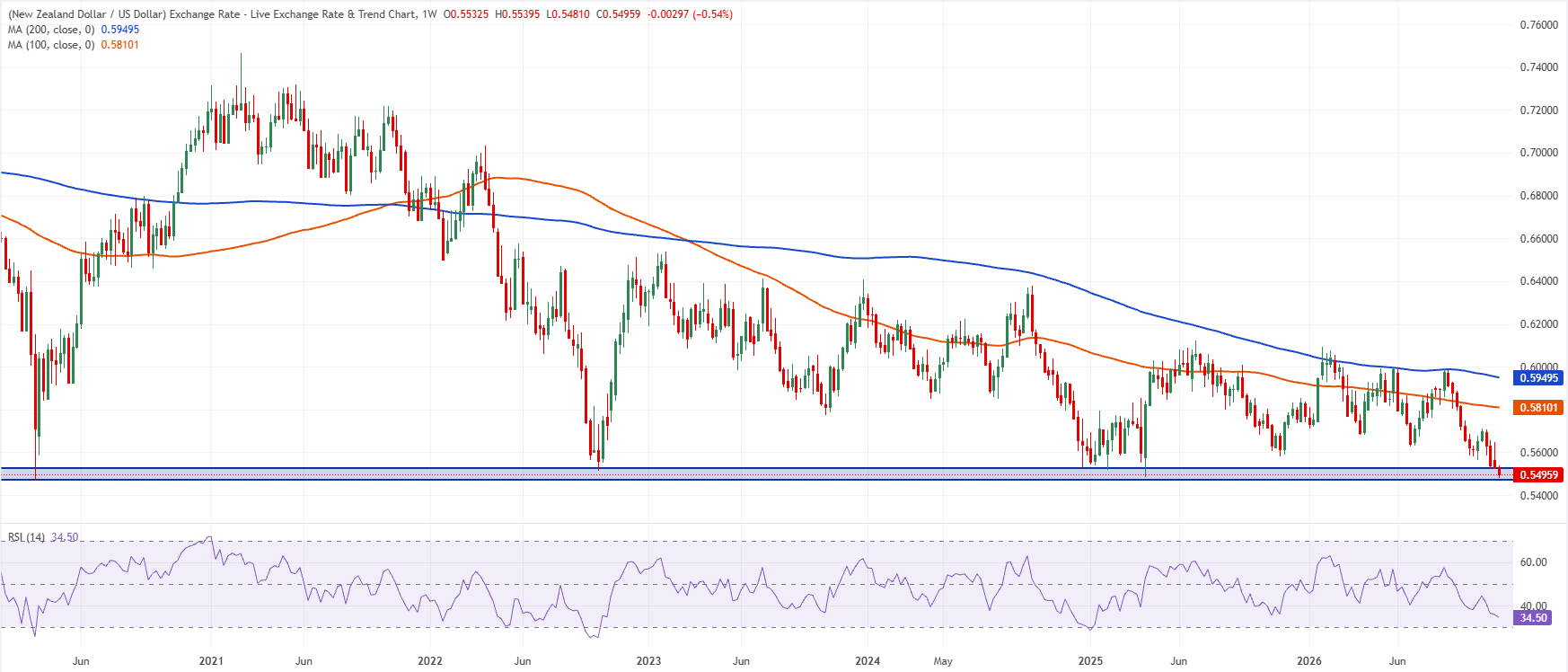
Beyond the macroeconomic pressures, the New Zealand Dollar is approaching an important technical crossroads. The weekly NZD/USD chart shows that the 0.5525-0.5470 region has acted as a major support area on several occasions since 2020. The pair has repeatedly rebounded from this region, including during periods of pronounced weakness in 2022 and early 2025.
However, the latest decline has pushed NZD/USD back into this support zone, with prices under the 0.5500 level. Although the lower boundary at 0.5470 has not yet given way, repeated tests suggest that buying interest is struggling to absorb persistent selling pressure. A sustained break below 0.5470 would therefore represent a significant deterioration in the longer-term outlook, exposing the Kiwi to levels not seen in nearly 18 years.
Conversely, a successful defense of this area could encourage a recovery, although the broader fundamental environment remains challenging. The coming days could prove decisive. Without an improvement in New Zealand's economic outlook or a meaningful shift in Federal Reserve expectations, the New Zealand Dollar risks losing a support zone that has held for several years.
The question is no longer simply whether the Kiwi is historically cheap, but whether current economic conditions provide enough justification for investors to start buying it again.
Author
Ghiles Guezout
FXStreet
Ghiles Guezout is a Market Analyst with a strong background in stock market investments, trading, and cryptocurrencies. He combines fundamental and technical analysis skills to identify market opportunities.