Betting no JAN hike


Tactics vs strategy
I have fallen into the “too much is priced in” trap. I do not believe the Fed will hike 50bps in December and I do not believe they will hike at all in January. But I have been caught offside because I am trying to take the other side too early. I got bullish EURUSD at 1.1087 and while I dodged the bullet in gold by cutting at flat before the collapse, I am now also short USDMXN.
The goal in trading and investing is to envision a future different from the one that has been priced in by the market, but that requires excellent timing because the process of pricing in new information is not instantaneous. The market has spent the last few weeks pricing in higher U.S. yields and today’s comments from Waller continue to push that narrative.
There is a tension between sticking to the view and getting caught in the woodchipper before the view can come to fruition. Still, I have not changed my mind. There are two reasons I do not think the Fed will hike in January. First, they seem weirdly anchored on spot CPI as an indicator, and headline CPI will likely print zero or negative in November.
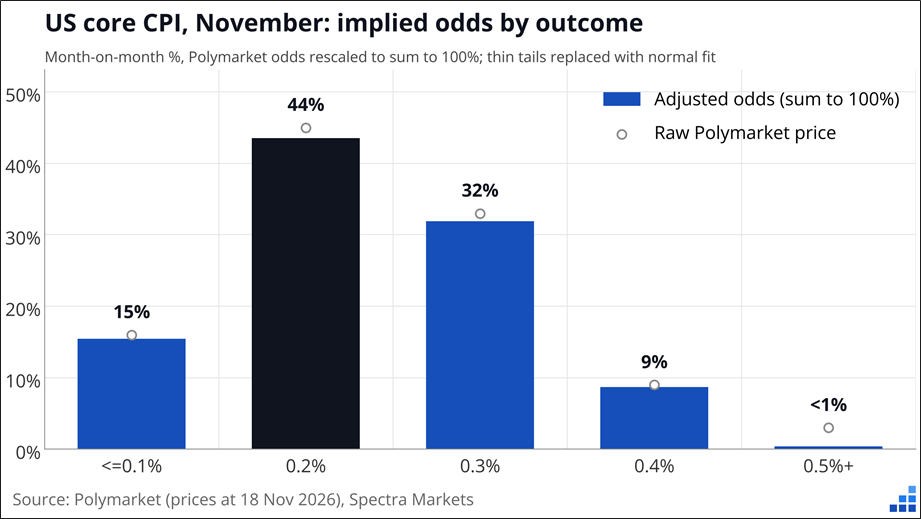
This is known to the market, but the Fed seems to wait for the CPI release, instead of using real-time information that is widely available. They are eschewing a real-time or forecasting approach and choosing instead to anchor policy on lagging official release data. When November CPI comes out negative headline and 0.2 core, I envision a rapid walkback of the extreme hawkish message and a revision to something more like: “November CPI provides some reassurance on inflation and we can proceed to hike at a measured pace.”
The goal now is to survive what I think will be the hawkish apex as it lands right around now.
The chart at right shows you current betting odds for headline CPI in NOV.
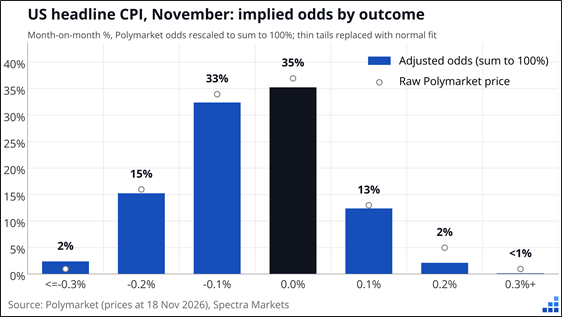
There is an 84% chance that the figure comes out flat or negative. The awkward thing is that CPI comes out on December 10, the day after the FOMC meeting.
Here is the expectation for November Core CPI, released 10DEC.
To me, this means that the following scenarios are most likely:
- Fed hikes 25 in December, sounds hawkish, CPI comes in negative and that’s the peak of hawkishness.
- Fed hikes 50 (very unlikely, but possible) and doesn’t need to hike in January.
There is an NFP in there, too, but I have no strong view on that. The other reason I think a January hike is unlikely is that the Fed has only ever hiked in January or February one time since they moved to the SEP in October 2007. See chart. They are a conservative organization with dovish DNA that likes to talk tough on inflation but act meek most of the time.
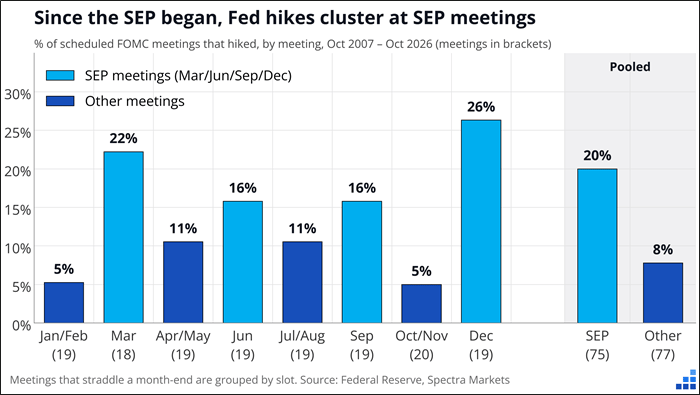
For them to be hawkish like they were in 2022 requires an emergency. There will be no such emergency visible in January as inflation will have cooled substantially due to tightening financial conditions and substantially lower commodity prices. The big supply shock from tariffs, the war, and AI capex is cooling off for a variety of reasons.
To give you a sense of what’s going on with commodities, here are some charts.
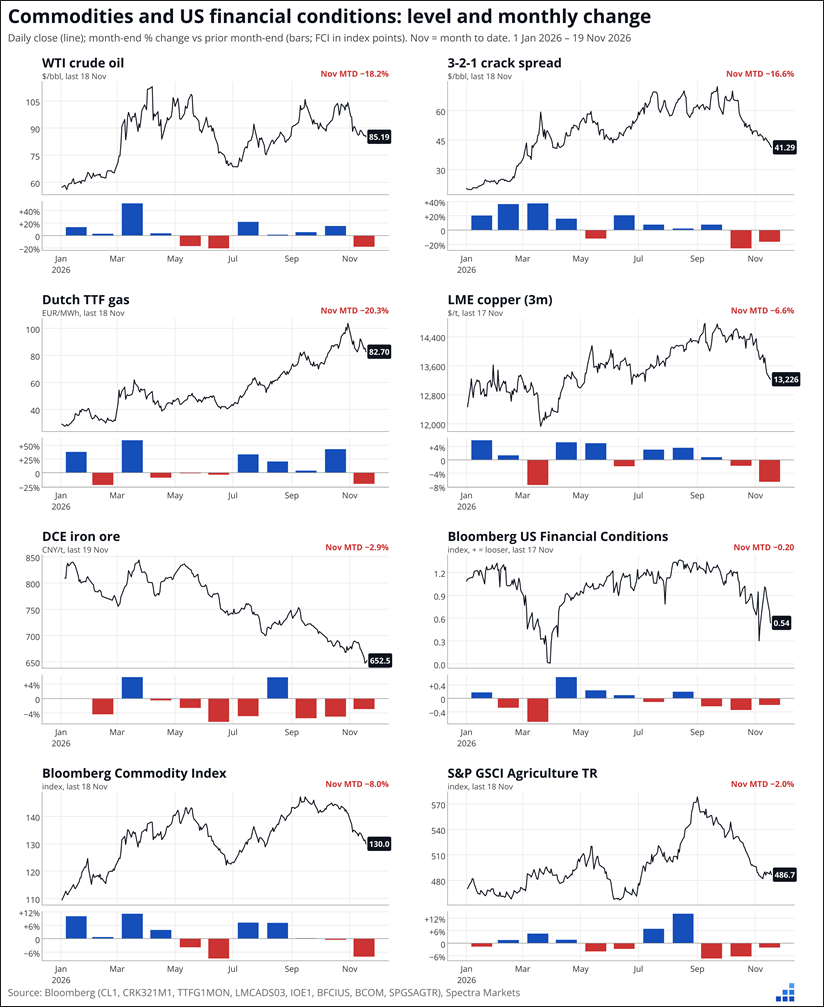
I mean, you probably know all this. I think this will all matter by January. The simple trade is to receive January FOMC in a way that you make money even if they hike in December. OIS and Polymarket are simplest but you can do it in Fed Funds, too. Polymarket has no JAN hike around 64% and WIRP has it around 70%. I am putting this as a trade idea in the sidebar because I really like it a lot. Not investment advice, just my view, which is always subject to change. This trade has staying power because you don’t need to stop out and the risk/reward is excellent.
Turnaround Tuesday did not work, but I am sticking with equity longs (I have NVDA, DRAM, and RSP right now) and will try to buy ANT below $90 on the open tomorrow. This is not a core view, just a tactical update.
Author
Brent Donnelly
Spectra Markets
Brent Donnelly is the President of Spectra Markets. He has been trading currencies since 1995 and writing about macro since 2004. Brent is the author of “Alpha Trader” (2021) and “The Art of Currency Trading” (Wiley, 2019).