The Dollar refuses to fall: What it means for Gold

Gold and the miners are doing little this morning, and the technical picture I described yesterday and in my gold price forecast for October 2026, has not changed. The one market that is doing something is the USD Index, which refuses to give back this week's breakout. So today I am focusing on the dollar and the fundamentals behind it, with brief notes on the rest.
The Dollar refuses to fall
Yesterday, I wrote: "From the medium-term point of view, this rally is still tiny. It has a lot of room to run."
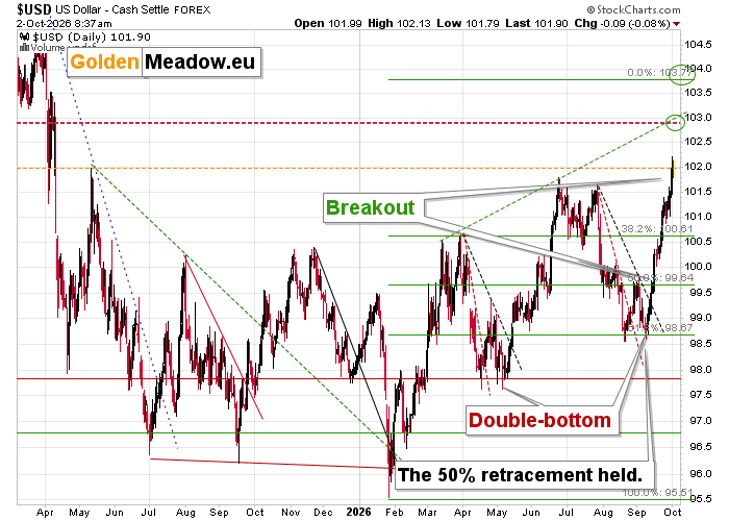
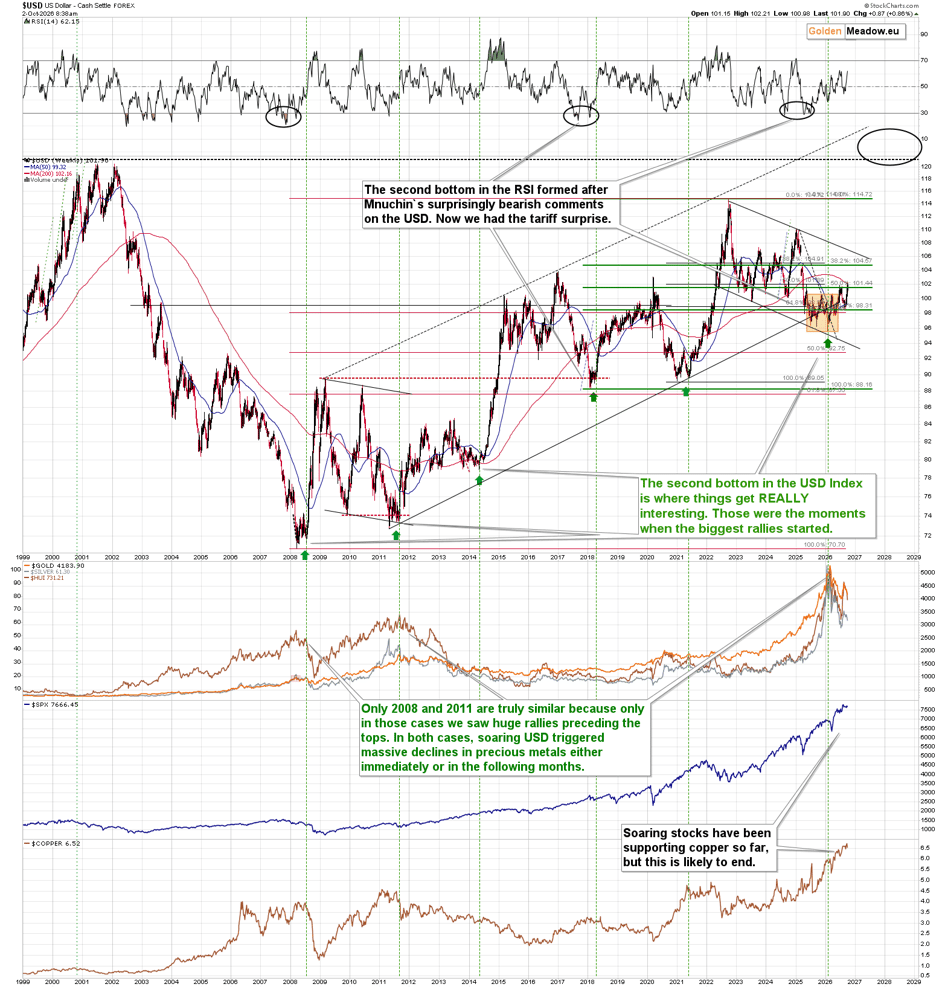
The index rose for a fourth straight day on Thursday and closed near 102.1, its highest since April 2025, after touching 102.20. It is only slightly lower this morning, even with oil down and yields off their highs. That is the refusal: the dollar rose every day this week while the odds of an October Fed hike roughly halved, and the soft inflation data that should have pushed it lower did not.
Part of the strength comes from Europe. The euro fell below 1.13 for the first time since May 2025 on dearer oil and French budget worries, and the euro is the largest part of the index. The rest comes from the bond market, and that is the mechanism worth understanding this week.
Technically, the USD Index moved lower after moving to the May 2025 top (just slightly above it), but it remains above the previous 2026 highs. This is the key part – in my view, it is this breakout that is being verified right now. This is already bullish, and it will become very bullish with a weekly close at new 2026 highs and without an invalidation on Monday. And if you've been following my analyses for some time, you're not surprised by the current strength in the USD Index at all.
Why yields rise when the Fed looks softer
The 2-year Treasury yield is mostly a bet on what the Fed will do over the next two years. The 10- and 30-year yields add something else: compensation for the risk that inflation runs hotter than expected over a decade or three, and for the amount of debt the Treasury has to sell. Economists call that extra compensation the term premium, and it does not take orders from the Fed.
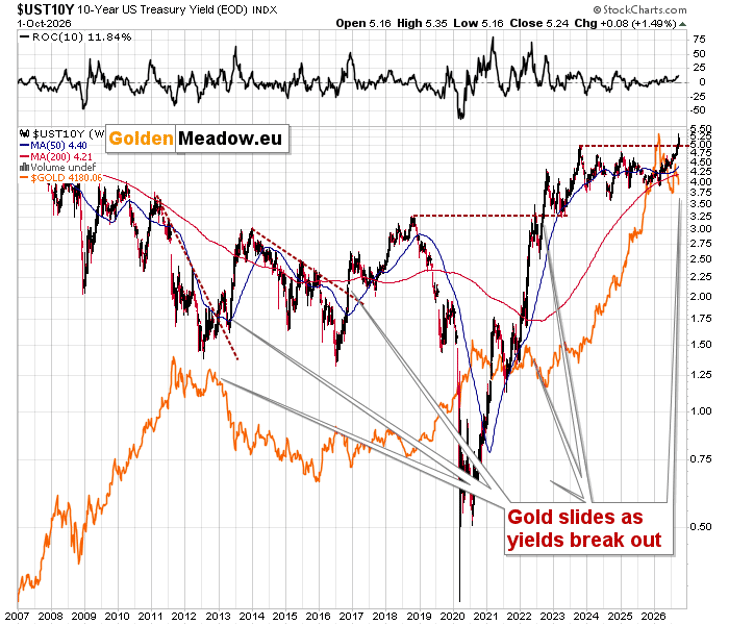
This week showed the difference. On Wednesday, softer core PCE cut the odds of an October hike from about 70 percent to about 37, and the front end relaxed. The long end did not: the 10-year touched 5.30 percent, its 2007 peak, and on Thursday it reached 5.344 percent before closing at 5.248. The 30-year traded above 5.66 percent, a 24-year high. The bond market has finished its worst quarter this century, with the 10-year up 87 basis points in three months, and it is on track for an eighth straight weekly gain. The Treasury's attempt to cap the long end did not change that: the enlarged buyback filled only $5.19 billion of its $6 billion in September, and the 30-year rose the same day.
Here is why it matters for gold. Gold pays no interest, so its competition is the yield an investor gives up by holding it, and for a long-term holder that is the 10- or 30-year yield, not the Fed's overnight rate. A softer Fed helps gold only if the long end follows. This week it did not, which is why soft inflation data and halved hike odds produced a spike to $4,251 that was sold within hours. The same long yields support the dollar, because they raise what foreign investors earn by holding dollar assets.
The takeaway is practical: when the headlines say the Fed is turning less hawkish, check the 10- and 30-year yields before drawing conclusions for gold. If the long end keeps rising, a softer Fed will most likely not lift the metal.
Inflation and the Fed
The inflation data still points up. The ISM's prices-paid index jumped to 77.9 from 71.1 on Thursday, diesel is above $6, and one analyst attributed part of Wednesday's drop in core PCE to methodological changes. The Fed's projections show at least one more hike this year, and the September CPI arrives in mid-October, two weeks before the October 27-28 meeting.
The September jobs report comes out today at 8:30 a.m. Eastern, with the consensus at about 90,000 jobs, unemployment at 4.1 percent, and wages up 0.3 percent on the month. A hot report is hawkish for gold, and a weak one should help it. If a weak report fails to lift gold, it will be the second failure on bullish news in three sessions.
Geopolitics
The Pentagon is sending the USS Theodore Roosevelt and 10,000 sailors and Marines to the Gulf, which would put three carrier groups in the region for the first time since April, and Secretary Rubio expelled Iran's UN delegation after the talks stalled. China suspended exports of fuel products. Brent jumped 4.4 percent to $102.31 on Thursday and is lower this morning. Each escalation feeds the same chain: oil, then inflation, then the long end of the bond market, then the dollar.
Gold, Silver, and miners
Thursday's data was hawkish, and the dollar hit an 18-month high, so gold should have fallen. It rose $15.60 to $4,202.30, following the 10-year's afternoon reversal. The internals were the warning: silver rose 1.01 percent, almost three times gold's 0.37 percent, while the senior miners (GDX) fell 1.21 percent. On September 3, I wrote that "miners weaker than gold and silver stronger than gold has 'watch out, it's a fake rally' written all over it."
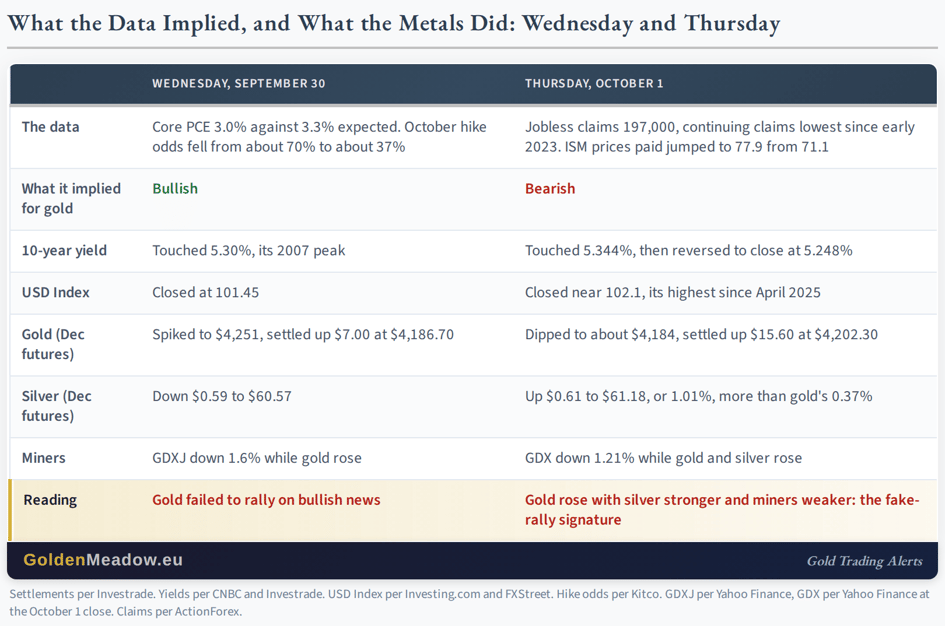
Gold is near $4,214 this morning, below Wednesday's $4,251 high. Yesterday I wrote that the verification had already happened, and the next stage of the October sequence is the move toward the first target near $3,920.
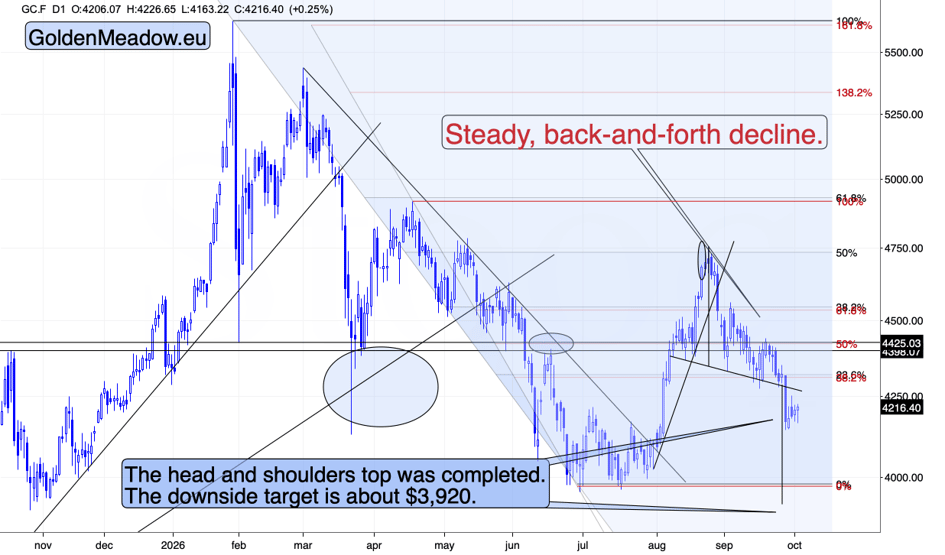
Gold continues to verify the breakdown below its head-and-shoulders pattern, but with over three closes below the neckline, this technical formation is already complete. The bearish implications are fully intact, active, and in tune with what I had been writing for weeks.
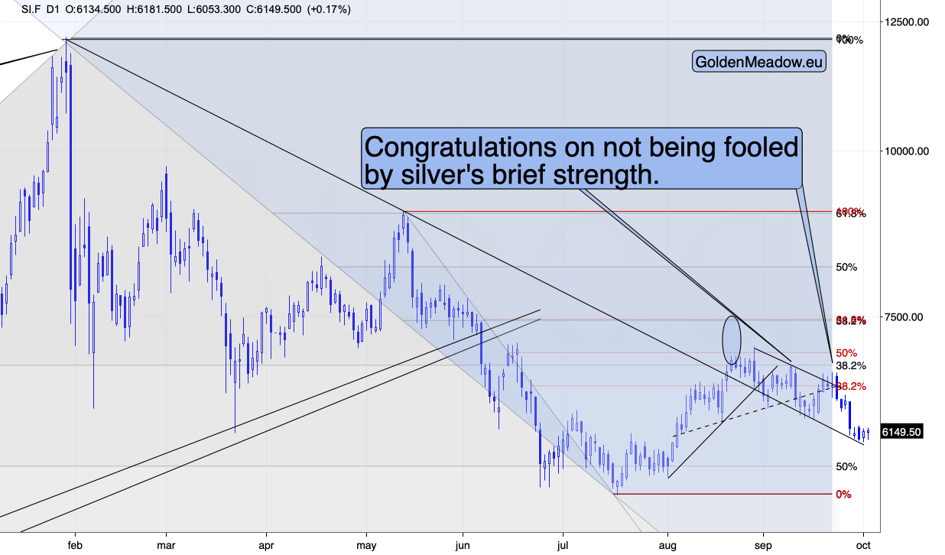
Silver is doing nothing – ready to slide when gold, USD, or stocks give it a push.
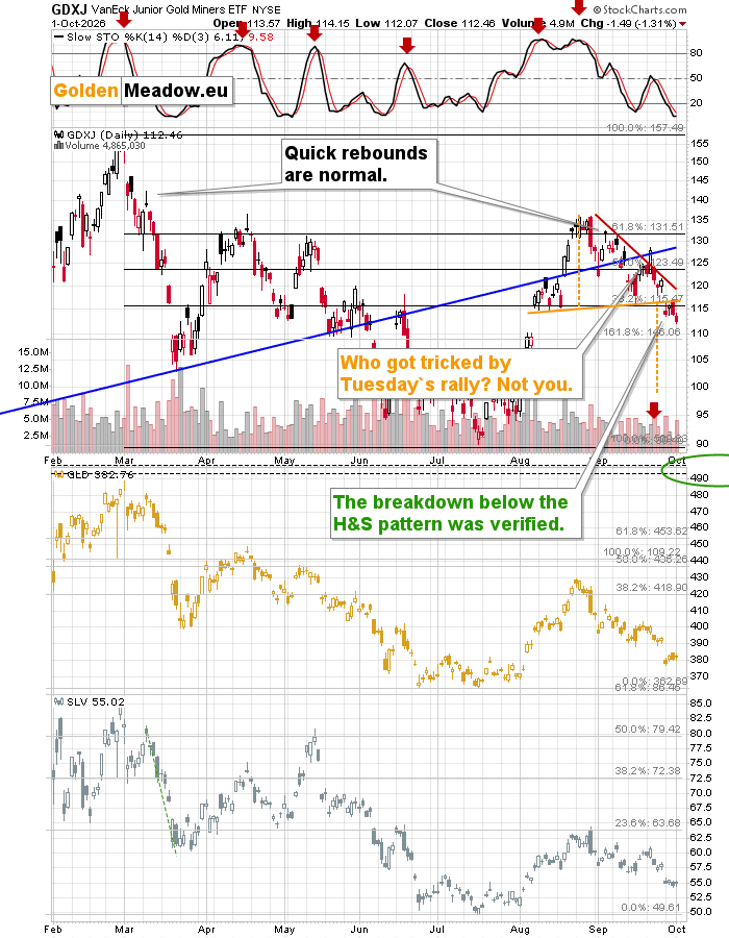
Meanwhile, the GDXJ declined yesterday, and the weak miners-to-gold link serves as a bearish confirmation for the short term. The H&S pattern was fully verified – just like I had written it would.
It’s time to buckle up. In other words, in my opinion, the current setup offers a favorable risk-to-reward point for entering or adding to short positions if one is not happy with the size of thereof (be sure not to overdo it, though).
The Calendar
The jobs report arrives today at 8:30 a.m. Eastern, ISM services on Monday, the EIA's oil outlook on Tuesday, the September CPI in mid-October, the FOMC on October 27 and 28, and the midterms on November 3.
Where this leaves us
My outlook and positions are unchanged, and the profit-take levels remain in place. I might need to adjust them soon given gold’s recent volatility, though.
The dollar rose through a week in which the Fed looked softer, because the long end of the bond market kept rising and Europe's problems weighed on the euro. Gold failed to hold a rally on soft inflation data and rose on hawkish data with the internals of a top.
The Fed looked softer this week. The bond market did not agree, and the dollar sided with the bond market.
Want free follow-ups to the above article and details not available to 99%+ investors? Sign up to our free newsletter today!
Author

Przemyslaw Radomski, CFA
Gold Price Forecast
Przemyslaw Radomski, CFA (PR) is a precious metals investor and analyst who takes advantage of the emotionality on the markets, and invites you to do the same. His company, Sunshine Profits, publishes analytical software that any

















