The Canadian Dollar's 1.4250 break is back — and crude is the reason

USD/CAD trades above 1.4250 on Thursday, after reaching a four-week high. The pair is supported by a combination of factors weighing on the Canadian Dollar (CAD): plunging Oil prices, a stronger US Dollar (USD), and growing monetary policy divergence between the United States (US) and Canada.
The break above the 1.4250 level comes as Oil markets experience a dramatic reversal. Brent crude has lost more than 22% since its October 30 peak, depriving the Canadian currency of one of its main sources of support.
Brent plunges 22%: A major blow to the Canadian Dollar
Brent crude fell from $113.73 on October 30 to $88.24 on November 10, marking a 22.4% decline in just eight trading days. Despite an attempted stabilization, Oil currently trades below $93 per barrel.
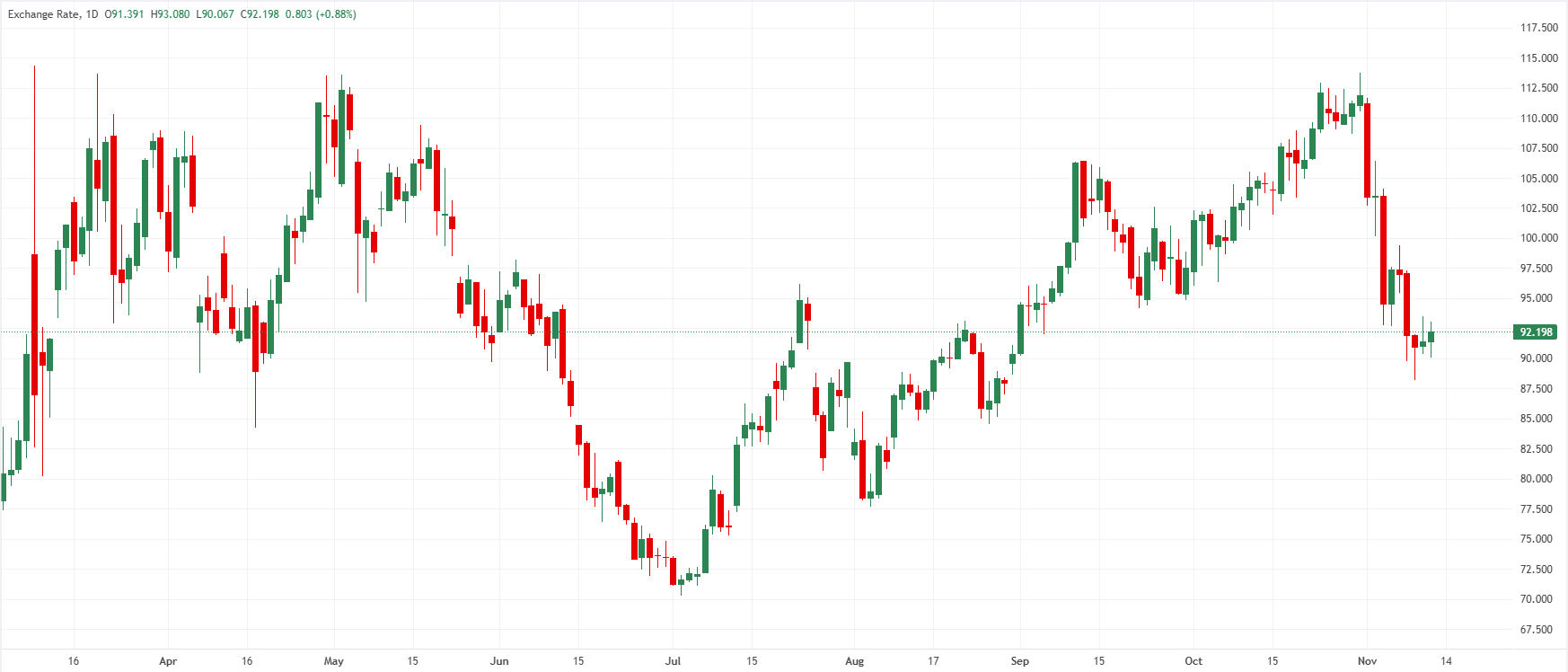
The sharp correction mainly reflects a decline in the geopolitical risk premium associated with the conflict between the United States and Iran. Comments from US President Donald Trump, who now considers renewed strikes against Tehran unlikely if a diplomatic agreement is reached, reinforce expectations of de-escalation.
Meanwhile, rising supply adds further downward pressure. According to the latest report from the Organization of the Petroleum Exporting Countries and its allies (OPEC+), the group's production increased by approximately 2.04 million barrels per day in October, reaching 41.23 million barrels per day, primarily driven by Saudi Arabia.
For Canada, a major Oil exporter to the United States, this price decline represents a significant headwind. Persistently lower energy prices could reduce export revenues and weigh on economic growth prospects, undermining the Canadian Dollar. However, geopolitical risks remain. Shipping disruptions in the Strait of Hormuz and the absence of a definitive agreement with Iran could limit further losses in Brent or even trigger a rebound.
As PVM Associates Analyst Tamas Varga told Reuters: “Market players are vacillating between tentative truces in Ukraine and the Middle East and the ongoing atrocities against energy infrastructure and ships.”
The Fed changes the equation as markets price in multiple rate hikes
Beyond Oil, the USD/CAD rally benefits from a rapid reassessment of US monetary policy expectations. The latest Consumer Price Index (CPI) report showed headline inflation rising 0.4% MoM in October, exceeding the 0.3% forecast. Core inflation also increased by 0.3%, beating expectations of 0.2%. These figures reinforce the hawkish stance of the Federal Reserve (Fed), particularly after Governor Christopher Waller raised the possibility of a 50-basis-point interest rate hike in December if inflationary pressures persist.
According to the CME FedWatch Tool, investors now assign a 90% chance to a 25-basis-point rate hike in December, compared with a 10% chance of a larger 50-basis-point increase. More importantly, expectations extend beyond December. Markets assign nearly a 62% chance to another 25-basis-point increase in January, while the possibility of a third consecutive hike in March gains traction, with approximately a 41% chance.
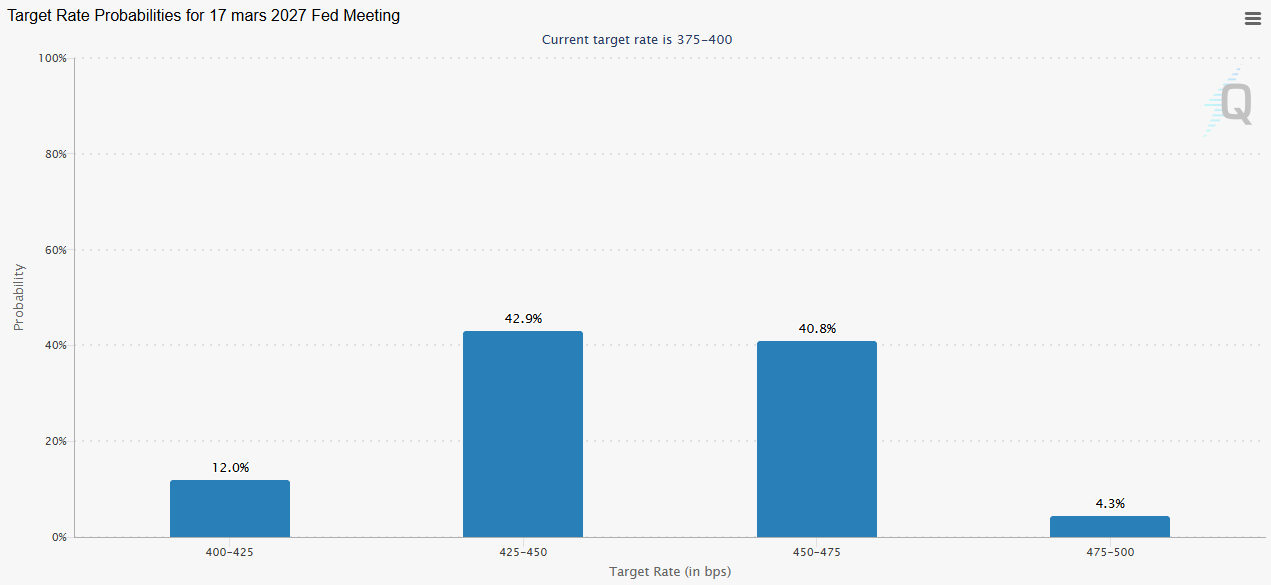
The prospect of a prolonged tightening cycle supports US Treasury yields and strengthens the appeal of USD-denominated assets.
Bank of Canada faces a weakening labor market
In contrast, Canada's monetary policy outlook remains less supportive. The Canadian economy lost 4.7K jobs in October, against expectations of 13.6K new positions. This contraction follows the loss of 68.3K jobs in September. Meanwhile, the Unemployment Rate rose to 6.7%, its highest level since April. These figures complicate the outlook for the Bank of Canada (BoC), despite annual inflation accelerating to 3.1% in September from 3% in August.
TD Securities argues that “diverging employment data releases will likely keep USD/CAD supported above 1.40,” highlighting how Canada's deteriorating labor market weakens the case for tighter monetary policy. The bank also notes that this divergence “reduces the market pricing of a December BoC rate hike relative to the Fed”.
The combination of a more hawkish Fed and a Bank of Canada facing weakening employment conditions creates a favorable environment for USD/CAD.
USD/CAD: The 1.4300 level emerges as the next bullish target
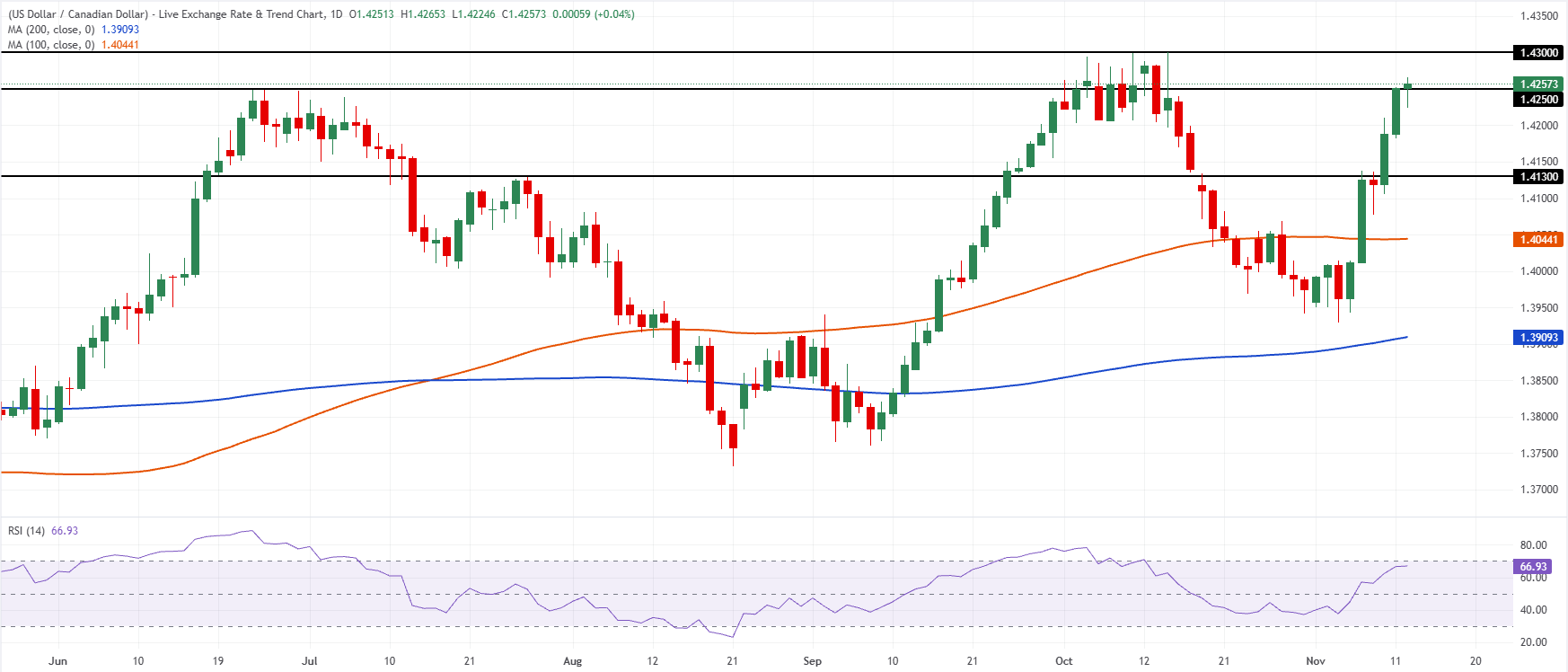
On the daily chart, USD/CAD accelerates its recovery after rebounding from the 1.3950 area in early November. The pair breaks successively above the 100-day Simple Moving Average (SMA), currently at 1.4040, and the 1.4130 resistance level, before returning to the 1.4250 area.
The Relative Strength Index (RSI) stands at 67, confirming strengthening bullish momentum without yet entering overbought territory.
A daily close above 1.4250 could open the door to another test of 1.4300, a level that capped gains in October. Conversely, rejection below 1.4250 could trigger consolidation toward 1.4130. Further down, the 100-day SMA, around 1.4040, provides additional support.
The continuation of the rally will largely depend on two factors: Oil's ability to stabilize sustainably and the evolution of US interest rate expectations. As long as Oil remains depressed and markets anticipate further Fed rate hikes, the Canadian Dollar is likely to remain under pressure.
Author

Ghiles Guezout
FXStreet
Ghiles Guezout is a Market Analyst with a strong background in stock market investments, trading, and cryptocurrencies. He combines fundamental and technical analysis skills to identify market opportunities.