Silver reclaims $40 within a day of its first break since August 2025

Silver (XAG/USD) extends its recovery on Thursday, reclaiming the psychological $40 level after breaking below it for the first time since August 2025 on Wednesday, when prices fell to a low of $38.20.
Falling United States (US) Treasury yields and a retreat in the US Dollar (USD) from its recent highs are providing some relief to Silver. However, expectations of further monetary tightening and uncertainty surrounding global equity markets continue to limit the prospects of a sustained recovery.
Falling US Treasury yields offer Silver some breathing room
Silver’s rebound comes as the benchmark 10-year US Treasury yield fell toward 4.80%, its lowest level in nearly three months, despite Wednesday’s stronger-than-expected US economic data. Renewed concerns over elevated Artificial Intelligence (AI) valuations have encouraged investors to seek safety in US government bonds, pushing yields lower even as expectations of further interest rate hikes remain firmly in place. Lower bond yields reduce the opportunity cost of holding non-yielding assets such as Silver, improving the relative attractiveness of the precious metal.
Meanwhile, the US Dollar Index (DXY), which measures the Greenback’s performance against a basket of six major currencies, stabilizes around 103.75 on Thursday after retreating from a 20-month high of 104.59 reached on Monday.
The combination of lower Treasury yields and a softer US Dollar creates a more favorable short-term environment for Silver, allowing the metal to recover some of its recent losses without a significant shift in the broader monetary policy outlook.
Fed tightening expectations remain firmly in place despite Silver’s rebound
The latest US inflation figures continue to support expectations of further interest rate hikes by the Federal Reserve (Fed). The core Personal Consumption Expenditures (PCE) Price Index accelerated to 3.3% YoY in October, up from 3.1% in September and above market expectations of 3.2%. Meanwhile, annualized third-quarter Gross Domestic Product (GDP) growth was revised upward to 4.3% from an initial estimate of 3.4%. However, the stronger-than-expected inflation reading has failed to trigger a significant repricing of monetary policy expectations.
According to the CME FedWatch tool, markets price in a 97.5% chance of a 25-basis-point (bps) interest rate hike in December. The odds of another increase in January stand at around 60%. Although expectations of monetary tightening in early 2027 have moderated somewhat over the past week, the prospect of higher US interest rates remains a significant headwind for Silver.
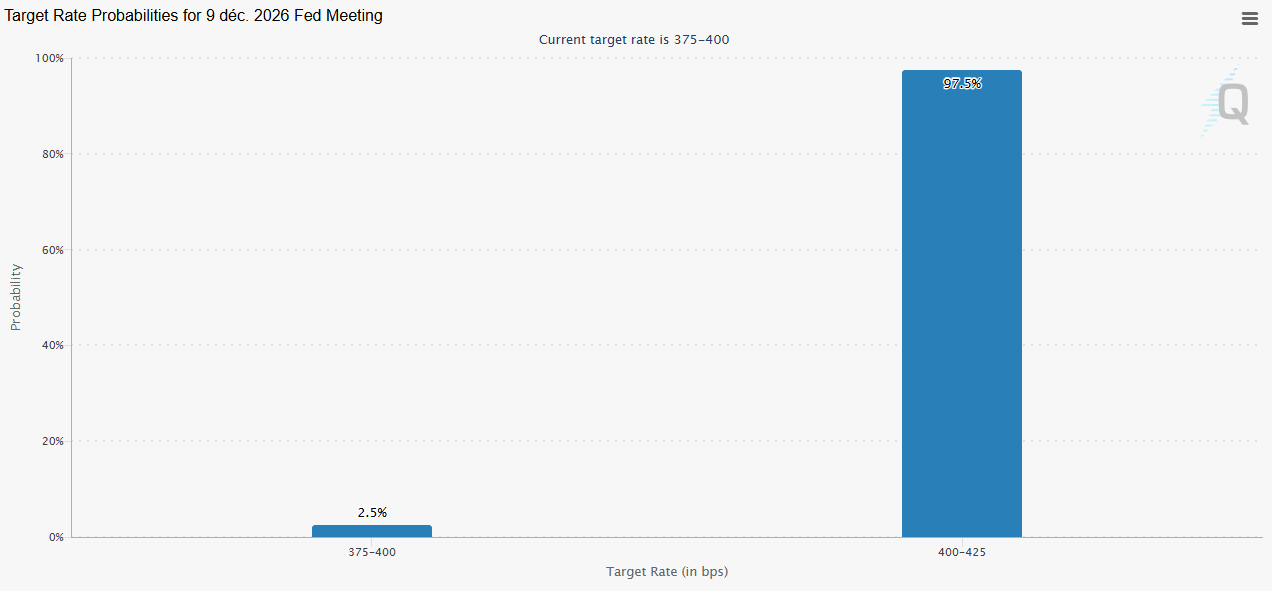
The divergence between falling Treasury yields and persistent rate hike expectations suggests that the current recovery is benefiting more from defensive flows into the bond market than from a fundamental shift in the Fed’s expected policy trajectory.
Silver’s dual role leaves it vulnerable to equity market volatility
Unlike assets whose demand is primarily driven by investment flows, Silver is particularly sensitive to changes in both monetary conditions and expectations for industrial activity. Its widespread use in electronics, solar energy and other industrial applications means that resilient economic growth can support its longer-term demand outlook. However, this relationship becomes more complex when strong economic activity is accompanied by persistent inflation and expectations of higher borrowing costs.
Renewed concerns over technology sector valuations and the announcement of proposed US tariffs targeting 14 trading partners also add uncertainty to the industrial demand outlook. Furthermore, sharp declines in equity markets can encourage investors to reduce their exposure to precious metals to raise cash and meet margin calls, potentially amplifying Silver’s volatility.
Wednesday’s partial recovery in US equities may have helped alleviate some of this liquidation pressure. Nevertheless, renewed weakness in stock markets could leave Silver vulnerable to another wave of selling. With US markets observing the Thanksgiving holiday, thinner liquidity could also exaggerate price movements, making the sustainability of the current rebound more difficult to assess.
Silver reclaims $40, but the broader downtrend remains intact
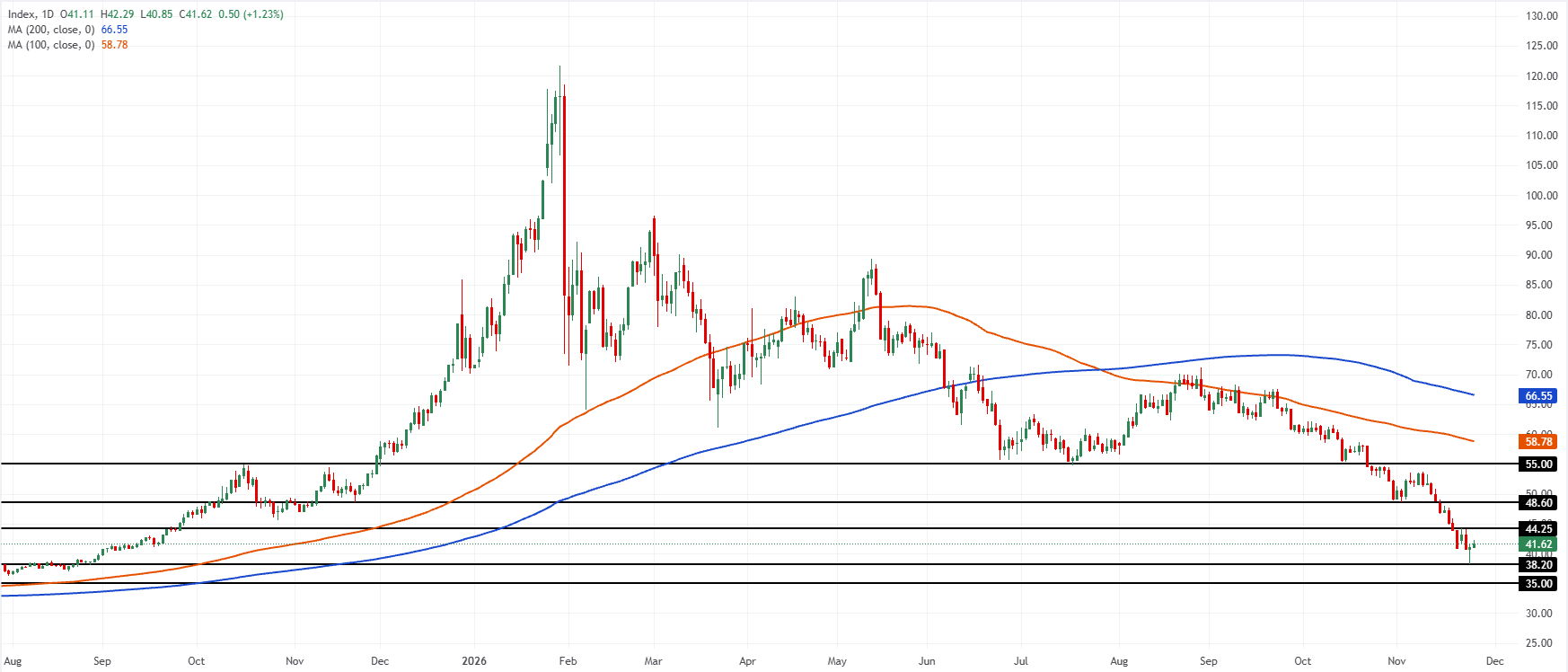
Silver has recovered nearly 9% from Wednesday’s low of $38.20, but the technical outlook on the daily chart remains predominantly bearish. The white metal trades approximately 66% below its January record high near $122, having successively broken below key horizontal support levels at $55.00, $48.60 and $44.25. XAG/USD also remains well below its 100-day and 200-day Simple Moving Averages (SMAs), currently located at $58.78 and $66.55, respectively. Both moving averages are trending lower, reinforcing the broader bearish bias.
On the upside, the former support at $44.25 represents the first significant resistance to Silver’s recovery. A sustained break above this level could allow the white metal to extend its rebound toward $48.60, followed by the $55.00 area.
On the downside, a renewed break below the psychological $40.00 level would undermine the current recovery and expose Wednesday’s low at $38.20. A breach of this support could trigger a fresh bearish acceleration toward the $35.00 level.
While the sharp rebound suggests that immediate selling pressure is easing, Silver has yet to invalidate the succession of lower highs and lower lows that has characterized its broader decline. A sustained recovery above $44.25 would provide an initial indication that the bearish momentum is losing traction.
Author
Ghiles Guezout
FXStreet
Ghiles Guezout is a Market Analyst with a strong background in stock market investments, trading, and cryptocurrencies. He combines fundamental and technical analysis skills to identify market opportunities.