Our forex playbook for the trading community

The US dollar initially fell against the Japanese yen during Friday’s trading session, but later recovered and showed renewed strength. Overall, the pair remains uncertain as US yields decline, yet they are still far above Japanese yields, making a meaningful shift difficult to envision.
The 162.8 yen level above remains a key area many traders will watch closely. A break above it could open the door for the US dollar to move much higher, potentially toward 165 yen. Short-term pullbacks are likely to keep attracting buyers, especially as the pair appears to be forming an ascending triangle, a typically bullish pattern. Below current levels, 161 yen should offer support, with the 50-day EMA nearby. Overall, this market continues to favor traders who buy dips in the US dollar. I view the pair the same way over the longer term and have no interest in fighting the current momentum.
Among short term market participants, there appears little reason to consider shorting this pair over the longer term unless it breaks below the 200-day EMA. In generally long positions are outnumbering the short interest in this market for some time, as traders accumulate small amounts on dips to gradually build a longer-term “investor style” position.
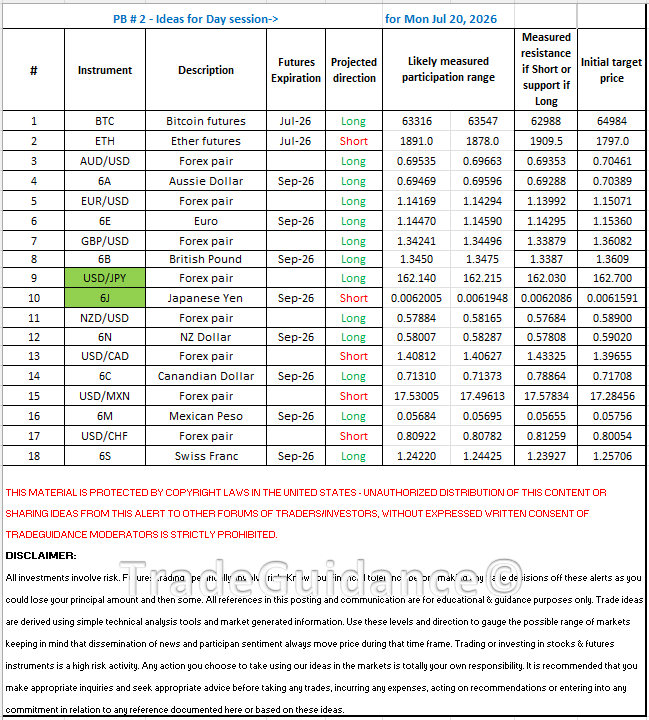
Here is our playbook for intraday forex and currency futures market participants [Highlighted green indicative of setups which attained targets from the most recent measurements]
Meanwhile, China’s yuan edged higher on Monday against a directionless dollar, pressured by the global energy shock but supported by cooling domestic inflation. Analysts expect USD/CNY to stay range-bound, with strong exports supporting the yuan while weak domestic consumption limits its appeal. The currency is likely to move closely with the dollar index and remain within a narrow trading range. China’s economy grew at its slowest pace in more than three years in the second quarter as domestic demand weakened. Following the softer-than-expected GDP data, policymakers are expected to emphasize easing and speed up already planned demand-support measures at this month’s Politburo meeting. Additional stimulus could help revive growth and make yuan-denominated assets more attractive. On Monday, China also left benchmark lending rates unchanged for a 14th straight month.
Author

Murali Sarma
Trade Guidance, LLC
Murali Sarma is a private investor and trader, dealing in currencies, commodities (grains, energies, metals, bonds, indices) and stocks.

















