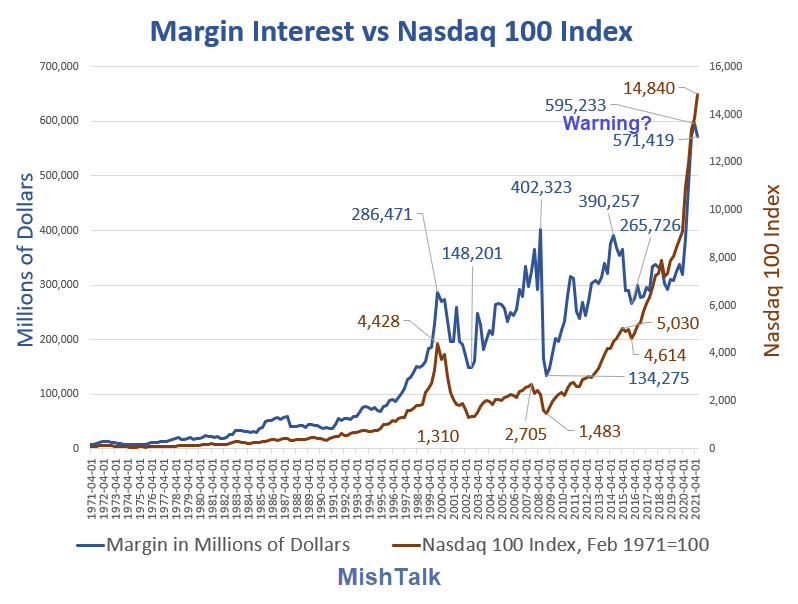
Margin interest hit a massive $595 billion, what's it mean?


In the third quarter margin interest declined to $571.419 billion.
Are stocks or margin debt leading
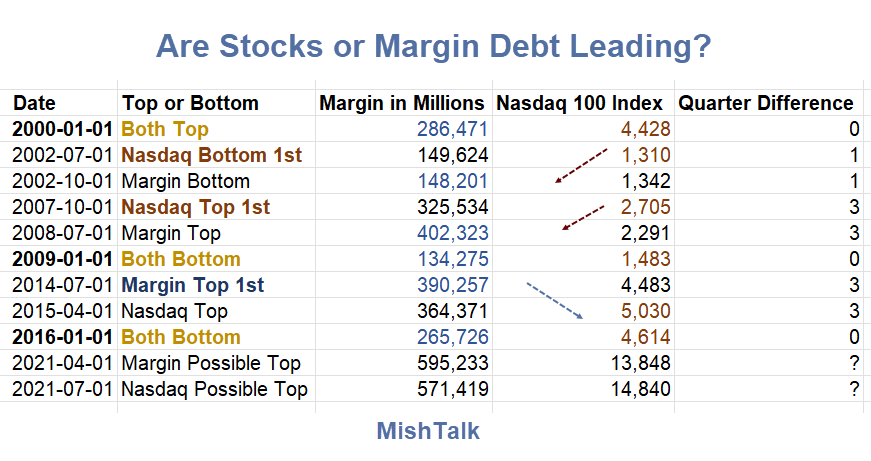
Coincident indicator analysis
-
Both topped at the same time once.
-
Both bottomed at the same time twice.
-
The Nasdaq bottomed once first.
-
The Nasdaq topped once first.
-
Margin topped one first.
Close scrutiny says neither stocks nor margin is leading the way. They are coincident indicators of the same thing. Guess what that thing is. I give the answer below.
First let's discuss widespread nonsense about the stock market being an economic leading indicator.
Economic leading indicators
Many people believe the stock market is a leading economic indicator. The idea is easily disproved nonsense.
If the stock market is a leading indicator, what exactly was it leading in November of 2007 or March of 2000?
The stock market is not a leading indicator of the economy, corporate profits or anything else.
Sentiment!
The stock market is a coincident indicator of sentiment towards stocks.
Margin is the same.
Thus, it is should not be surprising to discover that stocks and margin tend to move in sync.
Warning signal?
Is the decline in margin now a warning signal?
Perhaps, but perhaps it's noise.
Stocks will turn and so will margin, at approximately the same time.
When is that?
I don't know, nor does anyone else. But both will change when sentiment towards stocks changes and buy the dippers stop dipping.
What's the Catalyst?
Think back to June 2006. People went from standing in line around the corner for the right to enter a lottery to buy a Florida condo. A week later, there were no lines at all.
Q: What changed?
A: Sentiment towards buying houses changed and changed hard.
Stocks kept rising for another year.
Q: Why?
A: Sentiment towards buying stocks still had not changed, then it did, in a hurry.
Recession of choice
Flashback March 21, 2008: Was this a Recession of Choice?
That's what the ECRI said. This was my response.
Things the Fed Had No Choice About
Home prices collapsing
People waking away
A key change in auto lending psychology
World trade
Rising unemployment
A collapse in commercial real estate
Rising default rates on corporate bonds
The idea that this recession could have or even should have been prevented is pure lunacy. Consumers were tapped out, job creation slowed, there was an enormous inventory of unsold houses, and overcapacity was rampant everywhere.
The Fed could have slashed interest rates to zero and it would not have stopped this recession. In fact, had the Fed acted earlier than they did, yields on the high end of the curve may have spiked hastening the beginning of the recession.
“This is a recession of choice,” said Lakshman Achuthan, ECRI managing director. “The business cycle does not sit around and wait.”
Here is the reality: The best way to smooth the business cycle is to eliminate the Fed.
More amusing flashback anecdotes
-
January 2, 2008: Mighty Mouse Bernanke Fails To Save The Day.
-
January 8, 2008: Recession is a Reality This was obvious but not called for months.
-
January 10, 2008: Read Between Bernanke’s Lines: Things Are Going To Get Worse.
-
January 12, 2008: Bernanke Reaches Point of Recognition.
-
January 15, 2008: Leading Economic Indicators A look at the stock market as a LEI.
-
January 20, 2008: Time To Short Treasuries? Kass said short treasuries, I said don't.
-
January 22, 2008: Bernanke Blinks Huge rate cut by the Fed.
-
February 27, 2008: Old Maid: Bill Gross Has Right Game, Wrong Solution.
Another major recession coming
There will be another recession. And it will coincide with a decline in the stock market, a decline in housing prices, and a rise in the unemployment rate.
Q: When will that be?
A: When sentiment towards stocks and spending money peaks.
The stock market is now the economy. It's supporting consumption and speculative home buying. Thank the Fed for that.
Tell me when the buy the dippers stop dipping and I will tell you when the recession is likely to start.
A change in sentiment will lead the way. And it may come with no warning or apparent catalyst at all.
Author
Mike “Mish” Shedlock's
Sitka Pacific Capital Management,Llc
Mike “Mish” Shedlock is a registered investment advisor for SitkaPacific Capital Management.