Interest rates unchanged after Fed family fight
It appears a Kevin Warsh-led Federal Reserve will at least provide a bit of drama.
The Fed family fought, but it amounted to a lot of yelling and no punches thrown.
In what was anything but a foregone conclusion, the Fed elected to hold the federal funds rate steady at between 3.5 and 3.75 percent. However, the decision wasn’t unanimous. In what Warsh described as “a good family fight,” three committee members split from the 9-person majority to push for a quarter-point rate hike.
In summary, the Federal Reserve is talking a lot about fighting inflation, but it isn't doing a lot to fight inflation.
Less guidance, more guessing
Warsh has indicated he will provide much less “forward guidance” than Jerome Powell. In other words, he doesn’t want the central bank to signal its intentions. So far, he has stuck to that commitment. There was genuine uncertainty in the market as to what the Fed would do. Some analysts even forecast a rate hike.
Cleveland Fed President Beth Hammack, Minneapolis Fed President Neel Kashkari and Dallas Fed head Lorie Logan all voted for a rate hike.
“I asked for a good family fight, and I got one,” Warsh said in his post-meeting press conference.
“Most of our discussion was on the big questions that matter to the conduct of monetary policy. We didn’t sort of hide from them. We weren’t scared of them. There was a lot more interaction between and among my colleagues. It was a real family fight.”
The official FOMC statement did little to signal how the Fed plans to move forward. The first statement issued by the Warsh-led committee dropped from more than 300 words under Powell to just 130. At the time, Warsh said forward guidance was “not well suited for the current policy conjuncture.”
“It’s a bit shorter, a bit simpler and it dispenses with some older language,” Warsh said of the first statement of his regime. “That statement just gives you the facts, as best we can judge it.”
Other than information about the vote, the July FOMC statement was identical to June’s.
“As before, the policy statement conveys just the facts. It’s steering clear of forecasting, a choice we consider especially prudent at these uncertain times,” Warsh said. “Uncertainty, however, does not mean a lack of clarity.”
This new lack of transparency has already frustrated some Fed observers. Capital Economics analysts criticized Warsh’s “vague” responses, saying they “make forecasting the Fed’s next move even trickier than it already was.’'
Warsh doesn’t seem to care.
“I understand the desire for rolling forecasts and commentary from this committee, but for our part, we need to observe market reaction to developments direct and unfiltered. I want to stress, of course, that decisions by this committee matter a great deal, and where necessary and appropriate, we will not hesitate to act.”
Still talking tough on inflation
While the Fed didn’t deliver any policy changes, Warsh continued to insist the Federal Reserve is committed to returning inflation to the mythical "2 percent target."
“You’ve heard this before, but we will deliver price stability.”
He emphasized that it won’t be a quick or easy fix.
“We have no magic wand. This isn’t something we’re going to be able to carry out in days or weeks.”
Warsh bristled at calling the Fed’s decision to hold rates steady “a pause.”
“I would characterize what we did as a review of the big hard questions, and I’d characterize it as a view of what our own homework is to try to resolve those questions in the period ahead.”
He went on to say that this is just the “beginning of the story,” not the end.
“We have begun a new chapter, and we understand that the five-plus years of inflation above target cannot be cured in nine weeks, or by a single month of modest price decreases. This Fed will not waver. Our credibility rests on performing our duties and delivering on our responsibilities.”
The markets have their doubts
The markets don’t seem to put much faith in Warsh’s rhetoric. They are looking for action. Having gotten none, interest rates on the long end of the Treasury yield spiked yet again after the policy announcement.
The rate on the 10-year Treasury yield rose 5 basis points to 4.657 percent. Meanwhile, the 30-year Treasury bond yield surged 9 basis points to 5.193 percent.
This indicates that investors have little faith in the central bank’s willingness or ability to anchor price inflation at 2 percent. As a CNBC report put it, “We think you’re going to keep short-term policy rates in check, and it’s going to create a ton of inflation later.”
Some analysts believe we are in the early stages of a secular bear market in bonds with higher yields on the long end of the curve no matter what the central bankers at the Fed do.
Over the last several weeks, Warsh has repeatedly said that “inflation is a choice.” FWDBOND chief economist Chris Rupkey said it appears to him the central bank is choosing inflation.
“If inflation is a choice, the Federal Reserve meeting today shows no sign of taking steps to bring it under control with its primary monetary tool, which is interest rates.”
This is indicative of rhetoric running face-first into reality. Warsh would undoubtedly love to drive price inflation back to 2 percent. But he must reckon with a massive Debt Black Hole dominating the global economy. High levels of debt don’t play nicely with higher interest rates. The central bankers at the Fed are in a Catch-22, and it isn’t going to resolve any time soon.
Ultimately, the Fed will have to choose. It can tackle inflation and risk popping the debt bubble and toppling the economy, or it can try to keep the economy limping along by looser monetary policy.
It can’t do both.
Historically, when push comes to shove, central bankers pick inflation when the rubber meets the road.
The Federal Reserve is still running quantitative easing
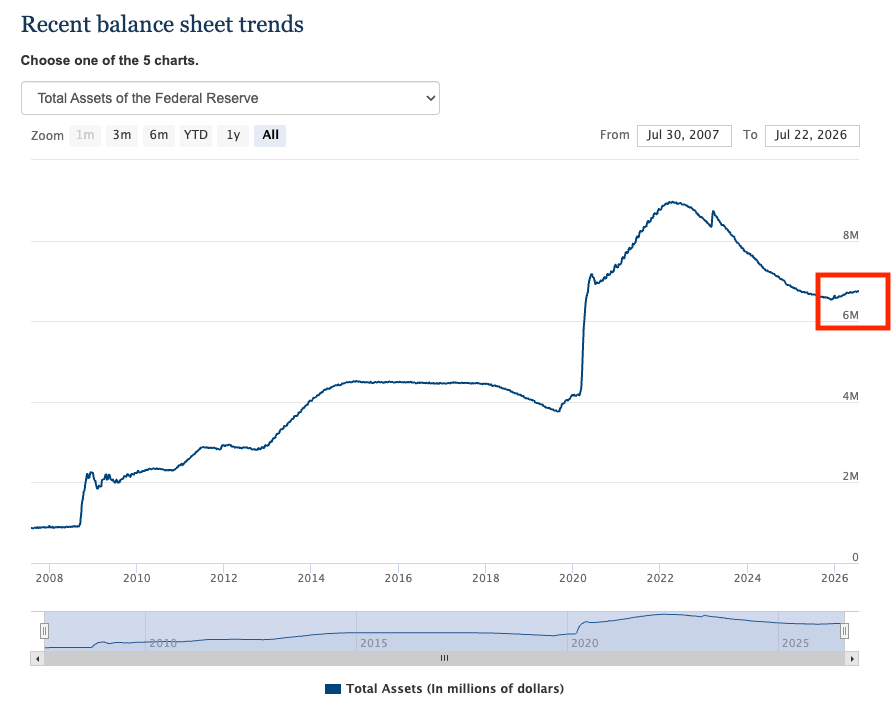
Underscoring the difficulties facing Warsh and Company, even as he talks tough about slaying inflation, his central bank continues to run modest quantitative easing operations (QE). This is indicated by the balance sheet, which is once again creeping upward.
When the Fed started hiking rates in 2023, it also began quantitative tightening (balance sheet reduction). The balance sheet hit its low at $6.54 trillion on December 1, 2025.
At the October 2025 meeting, the Fed announced it would end balance sheet reduction effective December 1. At the time, I wondered out loud if the central bankers were about to restart QE.
Sure enough, they did.
At the December meeting, the FOMC announced it would purchase $40 million in Treasury Bills on Friday (Bills are short-term Treasuries that mature in one year or less). From that point, purchases will “remain elevated for a few months” before they are “significantly reduced.”
Since then, the balance sheet has grown to $6.75 trillion.
Of course, you will not hear any central banker or mainstream pundit utter the words "quantitative easing."
In fact, if pushed, they’ll almost certainly deny that they’re doing it. They’ll call it “reserve management,” or tell you they’re engaged in “technical operations” to keep the financial system’s plumbing moving.
However, an expansion of reserves is an expansion of reserves. You can call it QE. You can call it reserve management. You can call it tap dancing with unicorns.
In practice, the Fed is purchasing Treasury bills with money created out of thin air. This increases the money supply and puts downward pressure on Treasury rates. The balance sheet is growing; liquidity is increasing; risk asset bubbles are getting more air. This is exactly what QE does. So, call it what you want. If it walks like a duck...
By the way, it is also inflation – by definition.
So much for that commitment to fight inflation. Based on the central bank's actions, it appears Warsh & Company are more committed to keeping the debt bubble inflated and the economy limping along.
To receive free commentary and analysis on the gold and silver markets, click here to be added to the Money Metals news service.
Author

Mike Maharrey
Money Metals Exchange
Mike Maharrey is a journalist and market analyst for MoneyMetals.com with over a decade of experience in precious metals. He holds a BS in accounting from the University of Kentucky and a BA in journalism from the University of South Florida.