How does the surge in sugar futures affect Coca-Cola’s profit?


Sugar is used in food, beverage, and in biofuel production, and its importance in global trade gives it a strong position in the commodity futures market. The price of sugar has surged 17% since the beginning of January 2021.
Reduced Brazil production
Sugar prices have recently been affected by production levels in Brazil, a key sugarcane producer and exporter. In May, Brazilian mills reportedly had to cancel sugar export contracts as they shifted to ethanol production, seeking to capitalize on high energy prices.
Brazil supplies half of the world’s sugar, producing 654.8 million tonnes of sugarcane, 41.25 million tonnes of processed sugar and 29.7 billion liters of ethanol annually.
As the Ukraine crisis triggered a global energy crisis, Brazilian farmers shifted to ethanol production. However, the US Department of Agriculture estimates that sugarcane crop in Brazil will recover 6% year over year to 613 million metric tons in the 2022-2023 marketing year.
Strong output in India and Thailand
Still, India and Thailand, which also export substantial volumes of sugar, are making up for the reduced output in Brazil. Last month, a trade group in India said the country could produce a record 36 million tonnes of sugar in 2021/22, up 3% from early estimates.
The record output in India and improving production levels in Thailand could bring global sugar prices down. But concerns that the Indian government could curb exports recently pushed the prices of sugar futures higher.
Sugar users bear brunt
While concerns of lower sugar production can be a win for sugar futures traders, users of the commodity are bearing the costs of low sugar supplies and higher inflation.
Coca-Cola (NYSE:KO), known for its namesake sugary drink, is considering additional price hikes as record-high inflation is eating away companies’ profit margins.
Last year, Coca-Cola raised the prices of its products to counter higher commodity costs, joining other consumer brands like PepsiCo (NASDAQ:PEP) and J.M. Smucker (NYSE:SJM).
The price hike helped the soda manufacturer grow its full-year revenue in 2021 by 17% year over year to $38.7 billion. Household brands like Coca-Cola, which continues to dominate the global market for soft drinks, have strong pricing power, allowing them to pass on higher input costs to customers.
Thus, Coca-Cola’s stock price has risen in line with the price of sugar since the beginning of 2021, up by ~20%.
However, Coca-Cola and rival PepsiCo recently suffered from lower margins despite strong revenues. The companies warned in February that rising costs are weighing on their profit margins, prompting them to lower their sales expectations.
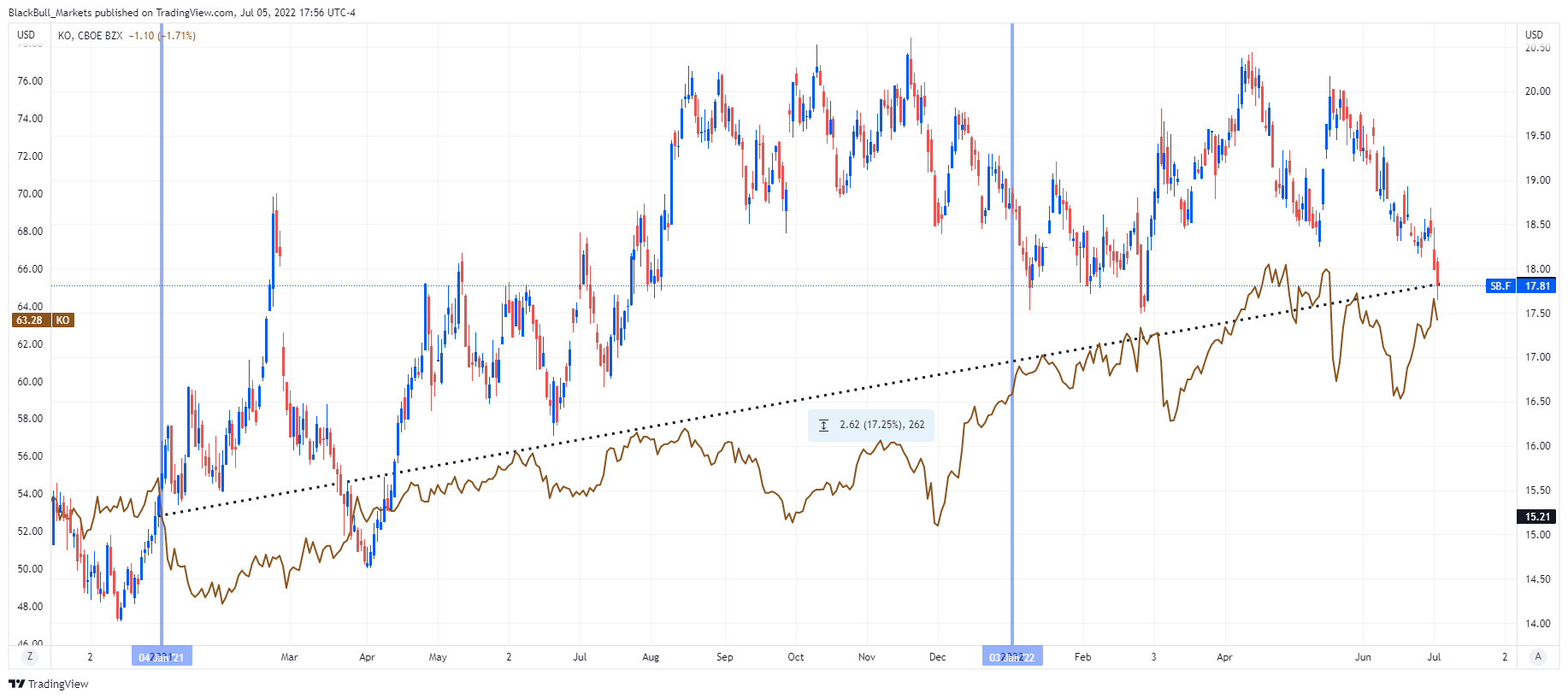
US sugar futures 1D vs Coca-Cola 1D
Banking on pricing power
"We control our supply chain basically all the way to the shelf. That puts us in a relatively better position, but I wouldn't say we're not going to have challenges. We're not immune to that," Johnston reportedly said.
PepsiCo’s stock climbed 13% over the past year as of Tuesday.
Coca-Cola CFO John Murphy echoed Johnston’s concerns, telling analysts in an earnings call in February that the company continues to expect commodity price inflation to have a mid-single-digit impact on comparable cost of goods sold in 2022.
But Murphy remains bullish on the company’s pricing power, saying commodity pressures will be offset by the company’s “pricing power and brand leadership.”
Start trading sugar futures and Coca-Cola CFDs
Author
Mark O’Donnell
Blackbull Markets Limited
Mark O’Donnell is a Research Analyst with BlackBull Markets in Auckland, New Zealand.

















