Gold Weekly Forecast: Sellers dominate on hawkish repricing of Fed interest rate outlook
- Gold came under heavy selling pressure and dropped to a fresh 2026 low below $3,900.
- Hawkish comments from Fed policymakers and October inflation data caused markets to reassess the bank’s policy outlook.
- The technical outlook suggests that the bearish bias remains intact in the near term.

Gold (XAU/USD) started the week on a firm footing and climbed above $4,100 before making a sharp U-turn and plunging to a fresh 2026 low below $3,900, pressured by growing expectations of the Federal Reserve (Fed) tightening policy at a more aggressive pace. With the economic calendar lacking high-impact data releases, comments from Fed officials and the action in bond markets could continue to influence the yellow metal’s performance in the near term.
Gold declines sharply on US inflation data, hawkish Fed rhetoric
Easing geopolitical tensions after US President Donald Trump’s weekend remarks that fresh attacks on Iran were “highly unlikely,” and falling crude Oil prices, helped Gold gather bullish momentum on Monday. While the barrel of West Texas Intermediate (WTI) lost more than 4% on the day, XAU/USD gained about 1.8% to close above $4,100.
On Tuesday, Gold came under heavy selling pressure amid surging US Treasury bond yields and lost more than 2.5% on the day. During the European trading hours, Fed Governor Christopher Waller said that a “half-point Fed rate hike may be needed in December, if October core Consumer Price Index (CPI) inflation comes in around 0.3% or higher.” Later in the session, the US Bureau of Labor Statistics reported that the headline CPI and the core CPI MoM rose 0.4% and 0.3%, respectively, in October. In turn, the benchmark 10-year US yield climbed back above 5% and the US Dollar (USD) Index, which tracks the Greenback’s performance against a basket of six major currencies, gained more than 0.5% on the day.
The USD rally continued midweek on additional hawkish Fed remarks, causing XAU/USD to extend its slide. Philadelphia Fed President Anna Paulson’s speech received a score of 8.1/10 from FXS Speechtracker, above the 7.6/10 historical average. The emphasis that the Fed “will move more aggressively if inflation landscape worsens,” alongside support for further “gradual” rate hikes and the need for “somewhat restrictive” policy, signalled a clear bias toward additional tightening while keeping optionality for faster action.
Following the Veterans Day holiday in the US, bond markets returned to action on Thursday and the 10-year yield gained more than 2% on the day to climb back above 5.1%. Consequently, Gold remained under bearish pressure as hawkish Fed rhetoric continued and fell nearly 3% on the day to touch its weakest level since October 2025 near $3,850. New York Fed President John Williams noted that inflation remains “stubbornly persistent and elevated” and added that the central bank “still has work to do” to reach the right monetary policy stance. Similarly, San Francisco Fed President Mary Daly emphasized that sticky services prices heighten upside inflation risks.
Analysts at ING highlight that “this week has seen a powerful, macro-driven rally in the Dollar,” with short-dated US yields now “close to 40bp higher since Tuesday morning, when the Fed's Christopher Waller mused over the need for a 50bp hike in December.” They note that the market has subsequently “adopted the view that back-to-back December and January hikes look likely, while extending the full Fed adjustment from here to a full 85bp of tightening.”
ING adds that “it is hard to see what is going to change this hawkish Fed/Dollar-positive mindset in the next few weeks.” While “the Fed centrists might try to emphasise the need for a gradual adjustment in policy,” the bank argues that “it is probably only a big US tech sell-off that can put a dent in short-dated US yields now.”
Although Gold found support on Friday and recovered to the $3,900 region, it failed to gather momentum and lost more than 4% on the week.
Gold investors will keep a close watch on Fedspeak
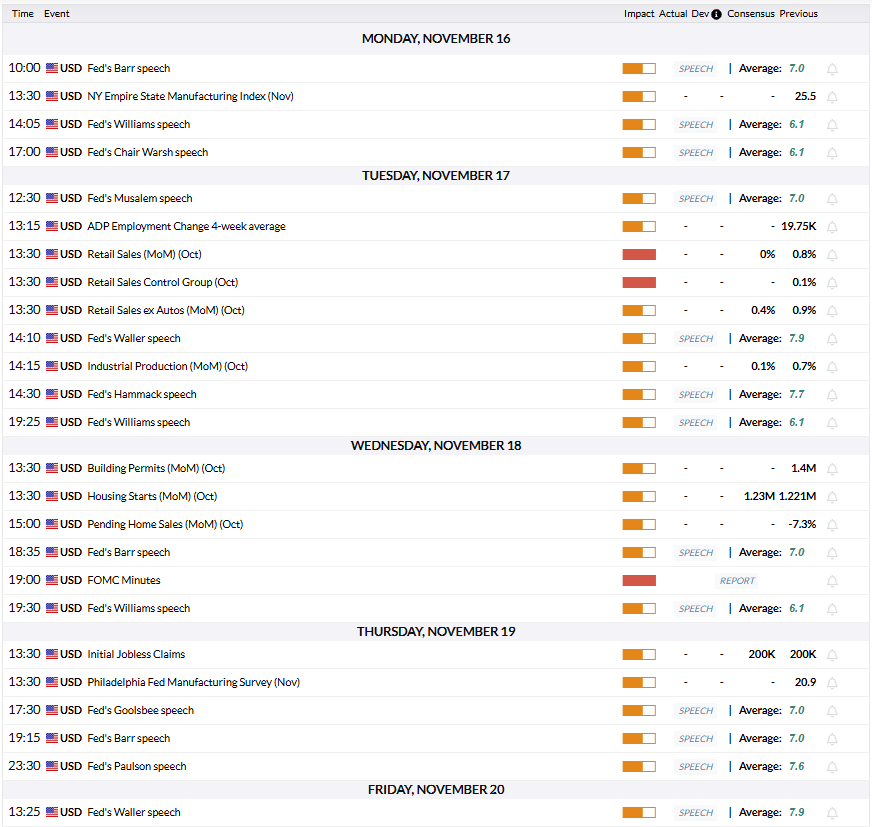
The US economic calendar will offer some mid-tier data releases next week, including October Retail Sales and Industrial Production on Tuesday, but they are unlikely to significantly influence the Fed’s policy outlook. Hence, investors will pay close attention to comments from policymakers.
The CME FedWatch Tool currently shows that a 25-basis-points (bps) interest rate hike in December is fully priced in, with an 87% probability, and a 12% chance of a 50-bps hike. Additionally, there is about a 70% probability that the Fed will raise interest rates by a total of at least 50 bps in the next two meetings.
In case Fed officials hint that they will need time to assess the impact of tighter policy on inflation dynamics and economic conditions before taking another step, investors could refrain from pricing in a January rate hike. In this scenario, the USD could correct lower and help XAU/USD stage a rebound. Conversely, additional USD gains and a leg higher in US T-bond yields are likely if policymakers leave the door open to the possibility of a larger 50 bps increase in interest rates at the next meeting, or consecutive 25 bps hikes.
On Wednesday, the Fed will publish the minutes of the October policy meeting. Because that meeting took place before the release of the October inflation data, the information offered in the document is likely to be outdated.
According to TD Securities, the US Dollar is expected to stay underpinned as the policy backdrop remains restrictive, with the bank arguing that "the USD will likely remain resilient until Fed hawkishness peaks." Strategists acknowledge that "the USD's efficacy as an equity risk-off haven asset has evidently declined, as shown by the falling correlation between the US dollar and US equity," but they still see fundamental support from rates. In their view, "rising US yields should still provide upward momentum for the USD, particularly if the market believes the Fed can out-hike other major central banks in the coming months."
In the meantime, headlines coming out of the Middle East could continue to play a role in Gold’s performance. If Oil prices rise with a renewed escalation of the conflict, investors could see this as an inflation driver. In this scenario, Gold is likely to stay on the back foot. Conversely, a sharp decline in Oil prices could have a positive effect on the precious metal in the near term.
Gold technical analysis: Bearish outlook persists
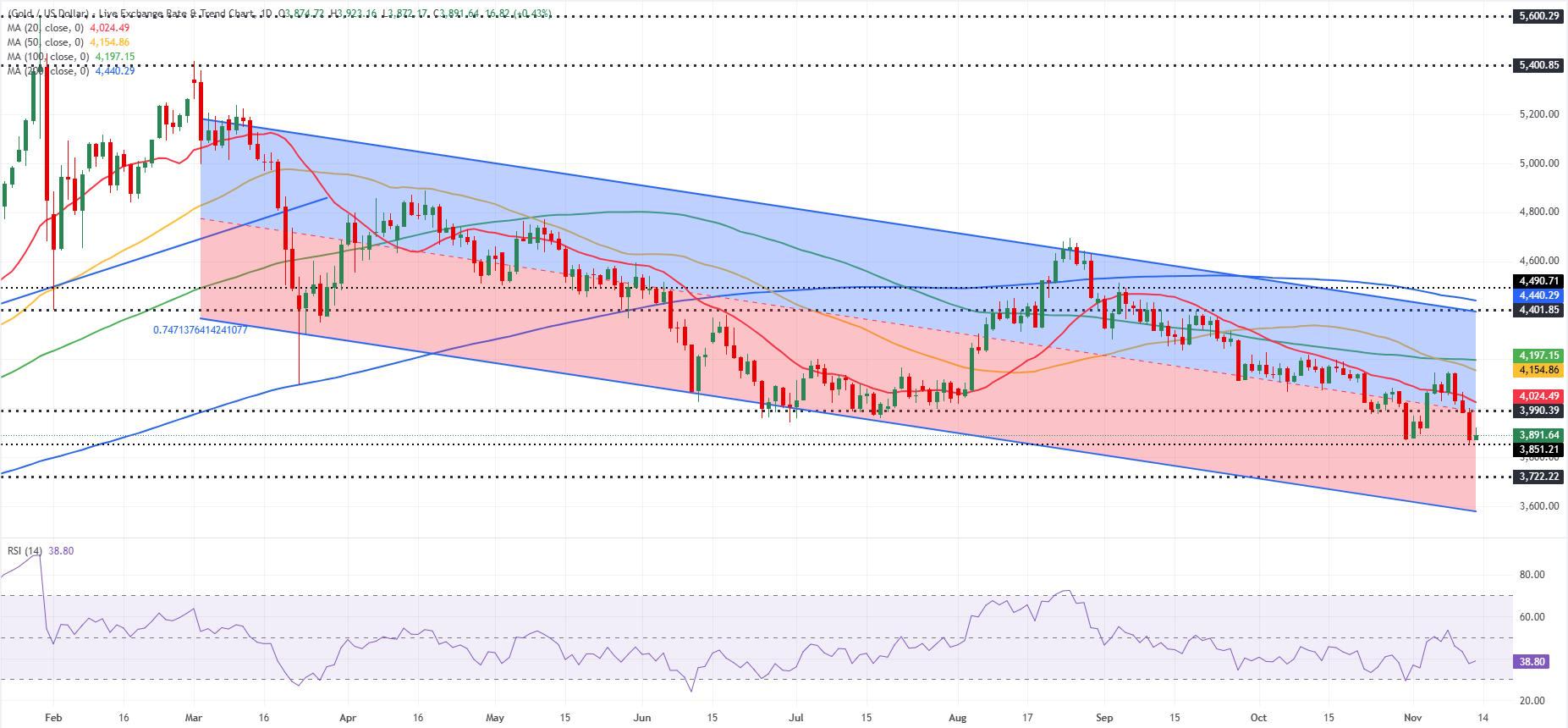
Gold trades in the lower half of the descending regression channel drawn from March, while the Relative Strength Index (RSI) indicator on the daily chart stays near 40, following a failed attempt to stabilize above 50 on Monday. Moreover, the 20-day Simple Moving Average (SMA) holds above the price, reiterating the bearish pressure.
On the downside, $3,850 (static level) aligns as an interim support level ahead of $3,720 (static level) and $3,600 (lower limit of the descending regression channel).
Looking north, the first resistance area could be spotted at $3,990-$4,025 (mid-point of the descending channel, 20-day SMA) before $4,155 (50-day SMA) and $4,200 (100-day SMA).
Gold FAQs
Gold has played a key role in human’s history as it has been widely used as a store of value and medium of exchange. Currently, apart from its shine and usage for jewelry, the precious metal is widely seen as a safe-haven asset, meaning that it is considered a good investment during turbulent times. Gold is also widely seen as a hedge against inflation and against depreciating currencies as it doesn’t rely on any specific issuer or government.
Central banks are the biggest Gold holders. In their aim to support their currencies in turbulent times, central banks tend to diversify their reserves and buy Gold to improve the perceived strength of the economy and the currency. High Gold reserves can be a source of trust for a country’s solvency. Central banks added 1,136 tonnes of Gold worth around $70 billion to their reserves in 2022, according to data from the World Gold Council. This is the highest yearly purchase since records began. Central banks from emerging economies such as China, India and Turkey are quickly increasing their Gold reserves.
Gold has an inverse correlation with the US Dollar and US Treasuries, which are both major reserve and safe-haven assets. When the Dollar depreciates, Gold tends to rise, enabling investors and central banks to diversify their assets in turbulent times. Gold is also inversely correlated with risk assets. A rally in the stock market tends to weaken Gold price, while sell-offs in riskier markets tend to favor the precious metal.
The price can move due to a wide range of factors. Geopolitical instability or fears of a deep recession can quickly make Gold price escalate due to its safe-haven status. As a yield-less asset, Gold tends to rise with lower interest rates, while higher cost of money usually weighs down on the yellow metal. Still, most moves depend on how the US Dollar (USD) behaves as the asset is priced in dollars (XAU/USD). A strong Dollar tends to keep the price of Gold controlled, whereas a weaker Dollar is likely to push Gold prices up.
Author

Eren Sengezer
FXStreet
As an economist at heart, Eren Sengezer specializes in the assessment of the short-term and long-term impacts of macroeconomic data, central bank policies and political developments on financial assets.

















