Gold slides to $4,127 as global PMI data and Dollar resilience pressure XAU/USD

Gold trades bearish at $4,127 — down sharply from yesterday's $4,195 recovery high as a resurgent dollar and risk-on sentiment triggered by better-than-expected global PMI readings drained safe-haven demand. The metal has broken below the $4,135–$4,150 support cluster, with chart structure pointing toward a test of the $4,098–$4,100 zone if selling pressure extends through the New York session.
Key levels
Bias: Bearish below $4,150.
Resistance: $4,135 → $4,150 → $4,168.
Support: $4,120 → $4,098–$4,100.
Session target: $4,098 (conditional on US PMI beat and no reversal above $4,135).
Invalidation: Reclaim of $4,150 on a closing 15-minute candle neutralises the bear thesis.
Catalyst of the day
The primary catalyst for Monday's session is the US Flash Manufacturing and Services PMI release at 4:45 PM UTC+3. Manufacturing is forecast at 54.6 (prior 55.1) and Services at 51.1 (prior 50.7). A reading that meets or beats expectations would reinforce the narrative that the US economy remains resilient, reducing the Fed's urgency to cut rates and lifting real yields — both headwinds for non-yielding gold. A miss, particularly in Services, would be the sole near-term catalyst capable of reversing the current bearish structure and pushing gold back toward $4,150.
Fundamental context
The macro backdrop has shifted against gold through the early European session. Flash PMI data released across Asia and Europe printed broadly above prior readings: Australian Manufacturing came in at 51.2 versus a 50.7 prior, Japanese Manufacturing held at 54.9, German Manufacturing edged to 50.3, and Eurozone Manufacturing matched its 51.6 prior. A consistent picture of stabilising global factory activity reduces the global recession premium that had been supporting gold's safe-haven bid near the $4,200 handle. When growth data beats across multiple regions simultaneously, capital tends to rotate out of defensive assets into risk.
The dollar's resilience is the transmission mechanism. Stronger-than-expected PMI data in the US last week, combined with FOMC members maintaining a cautious tone on rate cuts, keeps real yields elevated. Gold's inverse relationship with the US 10-year real yield remains the dominant structural driver: every basis point of upward pressure on real rates compresses gold's non-yielding return advantage. With FOMC Member Goolsbee speaking early in the session and Thursday's Core PCE release still ahead as the week's defining macro event, the risk-reward for chasing the downside accelerates on confirmation from today's US PMI print.
Chart analysis
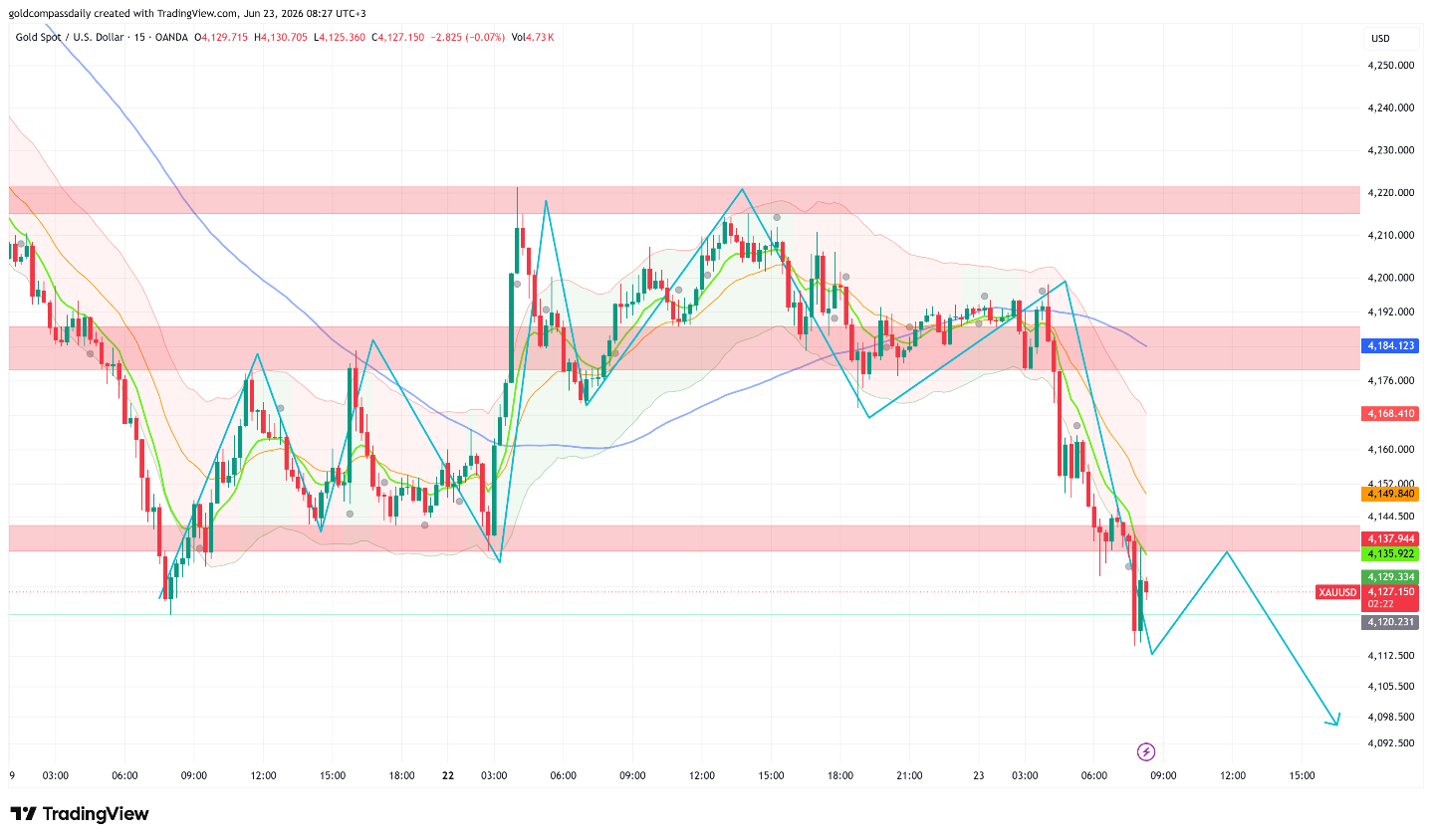
The 15-minute XAU/USD chart shows a decisive structural breakdown following a prolonged consolidation in the $4,192–$4,210 range across June 22. Price broke below the Bollinger Band midline and the short-term EMA stack — green and orange MAs now crossed bearish — beginning in the early hours of June 23, accelerating through the $4,135–$4,137 demand zone before printing a session low near $4,120. The blue long-period MA, which had been trending down since June 9, continues to act as dynamic overhead resistance near $4,184. The Bollinger Bands are wide and pointing lower, confirming momentum is with the sellers. The projected path targets a continuation toward $4,098–$4,100, with a minor bounce potential from $4,120 before the next leg lower. The $4,150 level — former support now flipped resistance — is the first structural test for any intraday recovery attempt.
Bull/bear scenarios
Bear scenario — Trigger: US Flash PMI meets or beats consensus AND price holds below $4,135 on the reaction candle. Target: $4,098–$4,100. A move through $4,120 on volume confirms the next leg lower. This is the base case given current EMA alignment and dollar strength.
Bull scenario — Trigger: US Flash Services PMI misses significantly (below 49.5) OR Goolsbee adopts a dovish tone that reprices rate cut expectations, gold reclaims $4,150 on a closing basis. Target: $4,168, then $4,184. This scenario requires both a catalyst miss and a structural reclaim and is not the base case for Monday.
Events ahead this week
Monday, 3:15 PM UTC+3 — ADP Weekly Employment Change (prior 25.5K): Proxy for labour market strength; stronger print adds to the hawkish Fed narrative and applies additional pressure on gold.
Monday, 4:45 PM UTC+3 — US Flash Manufacturing PMI (forecast 54.6) and Services PMI (forecast 51.1): Primary directional trigger for today's session. Beat = dollar bid, gold lower. Miss = only near-term bull catalyst.
Thursday — US Core PCE (May): The week's defining macro event. A hot reading above 2.6% y/y would cement Fed caution and extend gold's downside. A softer print is the only data release capable of reversing the weekly bearish structure.
Friday — FOMC Member speeches (rolling): Any shift in rate cut signalling, particularly language around July, will move gold intraday.
With the EMA stack bearish, the Bollinger Bands open to the downside, and the macro data calendar biased toward dollar-supportive outcomes, the base case for Monday's New York session is a continuation lower toward $4,098–$4,100. Yesterday's recovery to $4,195 has fully reversed. Bears retain structural control unless a material PMI miss forces a repricing of Fed expectations before Thursday's Core PCE.
Author

Tihomir Gospodinov
Independent Analyst
I have been actively following and analyzing financial markets for over nine years, with a primary focus on precious metals, particularly gold and silver, as well as broader macro-driven assets including equities, indices, and cryptocurrencies.