Gold sinks: Where does such strong pressure on precious metals come from?

Gold fell to 3,909 USD per ounce on Friday, its lowest level in almost a year. The metal is under pressure from fears of persistent US inflation and expectations of further interest rate hikes. The market’s focus now shifts to the US Producer Price Index (PPI) for October.
Geopolitical tensions are once again feeding into inflation. Donald Trump stated on Thursday that the US does not need an agreement with Iran, reducing the chances of an early end to the conflict. Following these comments, oil prices rose sharply, heightening fears of renewed inflationary pressure. For gold, higher energy prices increase the risk of tighter Fed policy and higher interest rates, reducing the appeal of the non-yielding metal.
The CPI released earlier in the week was also stronger than expected, reinforcing expectations of a Fed rate hike in December. Christopher Waller acknowledged that, with core inflation remaining high, the Fed should consider a 50-basis-point rate hike. Markets now estimate the probability of such a move at around 14.5%, versus almost zero before Tuesday’s inflation release.
The next key release will be the US PPI. Headline PPI is expected to rise 6.6% year-on-year in October, with the core measure expected to increase by 5.0%. Strong figures could strengthen expectations of further policy tightening and put additional pressure on gold.
At the same time, demand for safe-haven assets is partially offsetting the negative impact of higher rates. However, the Fed’s rhetoric remains hawkish, with some policymakers pointing to persistent inflationary pressures and the need to maintain a restrictive policy stance. This backdrop supports the dollar and remains a key obstacle to a sustained recovery in gold.
Technical analysis
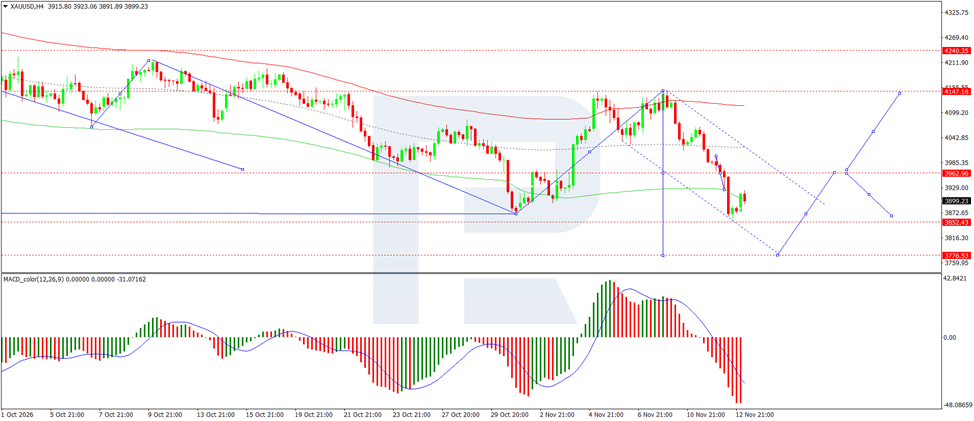
On the H4 XAU/USD chart, the downward structure remains intact following the reversal from 4,147 USD. The price fell to the 3,852 USD support area before staging a corrective rebound. XAU/USD is trading around 3,899 USD, below resistance at 3,963 USD. A sequence of lower highs indicates that sellers retain the advantage. The baseline scenario for 13 November envisages a retest of 3,852 USD. Consolidation below this level would open the way towards 3,777 USD. This target relates to a continuation of the downward wave, although reaching it in a single session is not guaranteed. The MACD indicator is below zero, with its signal line pointing downwards, confirming that negative momentum persists.
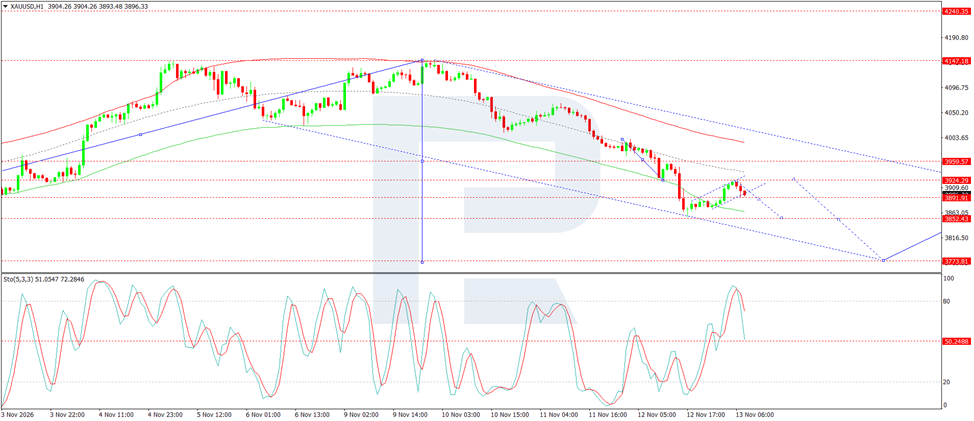
On the H1 XAU/USD chart, after the decline to 3,852 USD, the market corrected towards 3,924 USD and resumed its move lower. The nearest reference point is 3,892 USD. A sustained move below this level would increase the likelihood of a retest of the local low. A break below 3,852 USD would open the way towards the next target around 3,774 USD, in line with the hourly chart. The Stochastic oscillator turned downwards after leaving the overbought zone: the fast line approached 50, while the slow line remains below 80. This configuration supports the scenario of the correction coming to an end.
An alternative scenario involves consolidation above 3,924 USD followed by a recovery towards 3,960 USD. A return above this area would weaken the short-term bearish scenario and require a reassessment of the near-term targets. Until such confirmation, rebounds are viewed as corrective, and the downside remains the priority, with the identified support levels likely to be tested successively during the trading session.
Conclusion
Gold has fallen to its lowest level in nearly a year, weighed down by persistent US inflation fears and expectations of further Fed tightening, with attention now turning to the October US PPI release. Donald Trump’s comments that the US does not need an agreement with Iran have reduced hopes of an early end to the conflict, driving oil prices higher and reinforcing inflation concerns – an unfavourable backdrop for non-yielding gold. Stronger-than-expected CPI data and hawkish Fed commentary, including the possibility of a 50-basis-point rate hike in December, continue to support the dollar and put pressure on the metal. Technically, the downward structure remains intact, with support at 3,852 USD and a target at 3,777 USD if the decline continues. A corrective rebound towards 3,924 USD and 3,960 USD is possible, but the downward structure remains intact unless resistance is decisively broken.
Author

RoboForex Analysis Department
RoboForex
RoboForex Analysis Department provides timely market insights, expert technical analysis, and actionable forecasts across forex, commodities, indices, and equities.