Gold braces for make-or-break moment ahead of US Nonfarm Payrolls data

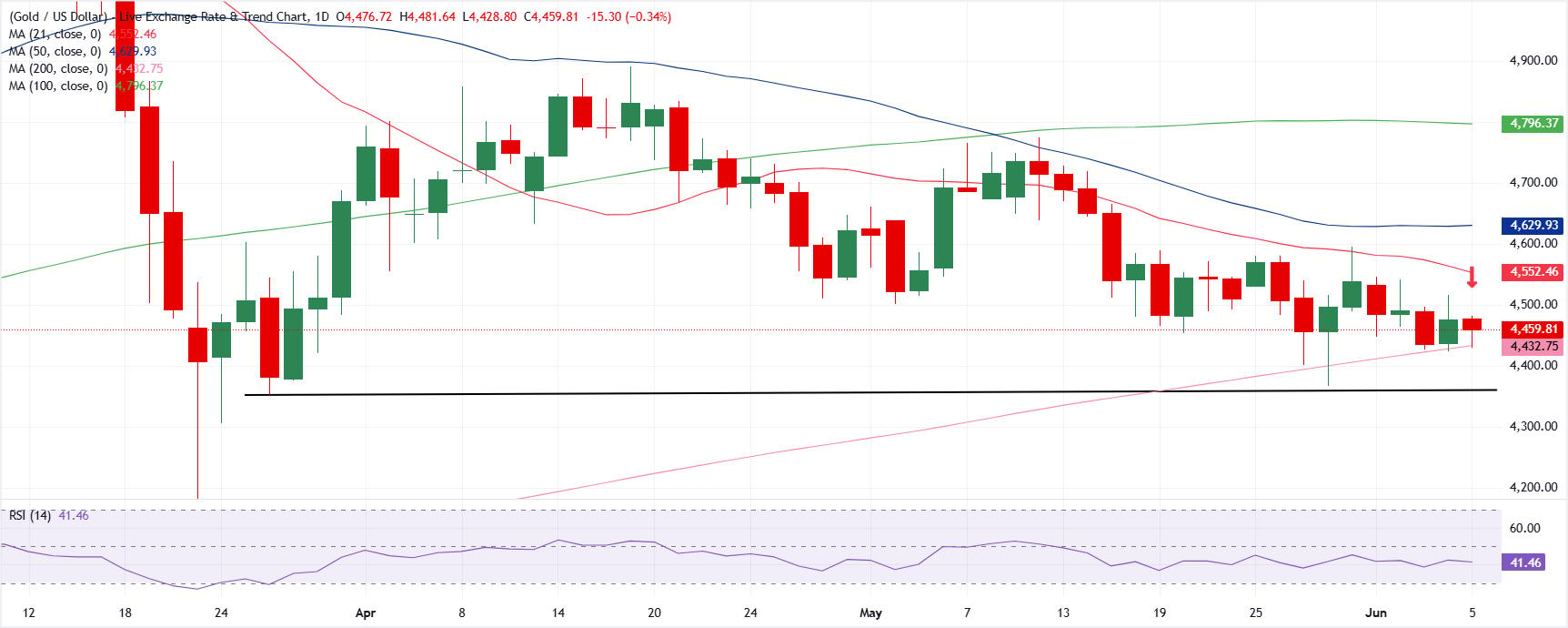
Gold is sitting at a make-or-break support level ahead of the all-important US employment report due Friday at 12:30 GMT. The upcoming May Nonfarm Payrolls (NFP) data could determine whether Gold breaks down toward $4,350 or rebounds above $4,560, as a single jobs report can change the market's entire trajectory.

Geopolitics and inflation are driving Gold’s market
Before analyzing the upcoming jobs report, geopolitical factors continue to influence the market layout. The US-Iran stalemate on a peace deal and the potential reopening of the Strait of Hormuz continue, and markets are currently assessing the durability of the latest ceasefire agreed between Israel and Lebanon. This cautiously optimistic market environment has left Gold miring in recent lows.
Inflation-related concerns remain elevated as Oil prices remain high. This high inflation, combined with robust US economic data, has bolstered expectations for a Federal Reserve interest-rate hike by the end of this year. The CME FedWatch Tool suggests more than a 50% probability of such a move, which is bad news for Gold.
Investors eagerly await the NFP data to help markets gauge the health of the US economy and better assess the prospects for a Fed rate hike. The big question now is whether the NFP data will double down hawkish Fed bets and trigger another fresh Gold bearish leg, or help infuse fresh life into Gold bulls.
Another strong employment report in the offing?
The US economy is expected to have added 85,000 new jobs in May, following an increase of 115,000 in April. Any number that deviates sharply from the estimate could trigger a big reaction in the Gold price. The Unemployment Rate is expected to remain at 4.3% and, unless there is a big surprise, it is unlikely to drive the market reaction.
Economic Indicator
Nonfarm Payrolls
The Nonfarm Payrolls release presents the number of new jobs created in the US during the previous month in all non-agricultural businesses; it is released by the US Bureau of Labor Statistics (BLS). The monthly changes in payrolls can be extremely volatile. The number is also subject to strong reviews, which can also trigger volatility in the Forex board. Generally speaking, a high reading is seen as bullish for the US Dollar (USD), while a low reading is seen as bearish, although previous months' reviews and the Unemployment Rate are as relevant as the headline figure. The market's reaction, therefore, depends on how the market assesses all the data contained in the BLS report as a whole.
Read more.Next release: Fri Jun 05, 2026 12:30
Frequency: Monthly
Consensus: 85K
Previous: 115K
Source: US Bureau of Labor Statistics
America’s monthly jobs report is considered the most important economic indicator for forex traders. Released on the first Friday following the reported month, the change in the number of positions is closely correlated with the overall performance of the economy and is monitored by policymakers. Full employment is one of the Federal Reserve’s mandates and it considers developments in the labor market when setting its policies, thus impacting currencies. Despite several leading indicators shaping estimates, Nonfarm Payrolls tend to surprise markets and trigger substantial volatility. Actual figures beating the consensus tend to be USD bullish.
Bearish scenario: US economic resilience
US economic resilience serves as a negative for Gold bulls. If the headline NFP data surprises with a reading above 100,000, it would be good news for the US economy. That should help Gold bears continue to thrive, enabling them to push below the super-important 200-day Simple Moving Average, which has helped Gold find support twice in the last few months.
A big beat would reaffirm 2026 Fed rate hike bets, providing additional legs to the USD uptrend while dragging Gold toward the $4,350 demand area. The next bearish target sits at $4,300, forming a deeper structural floor if selling pressure accelerates.
Bullish scenario: Labor market slack
A disappointment coming from NFP data would revive labor market concerns, scaling back bets for a rate hike this year. That could revive buying interest around Gold, providing a good buy-the-dip opportunity. In such a case, bulls could target the 21-day simple moving average (SMA) at roughly $4,560, followed by a move toward the 50-day SMA near $4,630. Traders navigating this highly volatile event should ensure they manage their risk properly.
(This article was created with the help of an Artificial Intelligence tool and reviewed by an editor.)
Gold FAQs
Gold has played a key role in human’s history as it has been widely used as a store of value and medium of exchange. Currently, apart from its shine and usage for jewelry, the precious metal is widely seen as a safe-haven asset, meaning that it is considered a good investment during turbulent times. Gold is also widely seen as a hedge against inflation and against depreciating currencies as it doesn’t rely on any specific issuer or government.
Central banks are the biggest Gold holders. In their aim to support their currencies in turbulent times, central banks tend to diversify their reserves and buy Gold to improve the perceived strength of the economy and the currency. High Gold reserves can be a source of trust for a country’s solvency. Central banks added 1,136 tonnes of Gold worth around $70 billion to their reserves in 2022, according to data from the World Gold Council. This is the highest yearly purchase since records began. Central banks from emerging economies such as China, India and Turkey are quickly increasing their Gold reserves.
Gold has an inverse correlation with the US Dollar and US Treasuries, which are both major reserve and safe-haven assets. When the Dollar depreciates, Gold tends to rise, enabling investors and central banks to diversify their assets in turbulent times. Gold is also inversely correlated with risk assets. A rally in the stock market tends to weaken Gold price, while sell-offs in riskier markets tend to favor the precious metal.
The price can move due to a wide range of factors. Geopolitical instability or fears of a deep recession can quickly make Gold price escalate due to its safe-haven status. As a yield-less asset, Gold tends to rise with lower interest rates, while higher cost of money usually weighs down on the yellow metal. Still, most moves depend on how the US Dollar (USD) behaves as the asset is priced in dollars (XAU/USD). A strong Dollar tends to keep the price of Gold controlled, whereas a weaker Dollar is likely to push Gold prices up.
Author

Dhwani Mehta
FXStreet
Residing in Mumbai (India), Dhwani is a Senior Analyst and Manager of the Asian session at FXStreet. She has over 10 years of experience in analyzing and covering the global financial markets, with specialization in Forex and commodities markets.
















