|

GBP/USD escapes bearish trap but yet to turn bullish

  • GBP/USD rebounds near key support, breaks resistance trendline.
  • Short-term risk is not bullish yet; an extension above 1.3570 is needed.

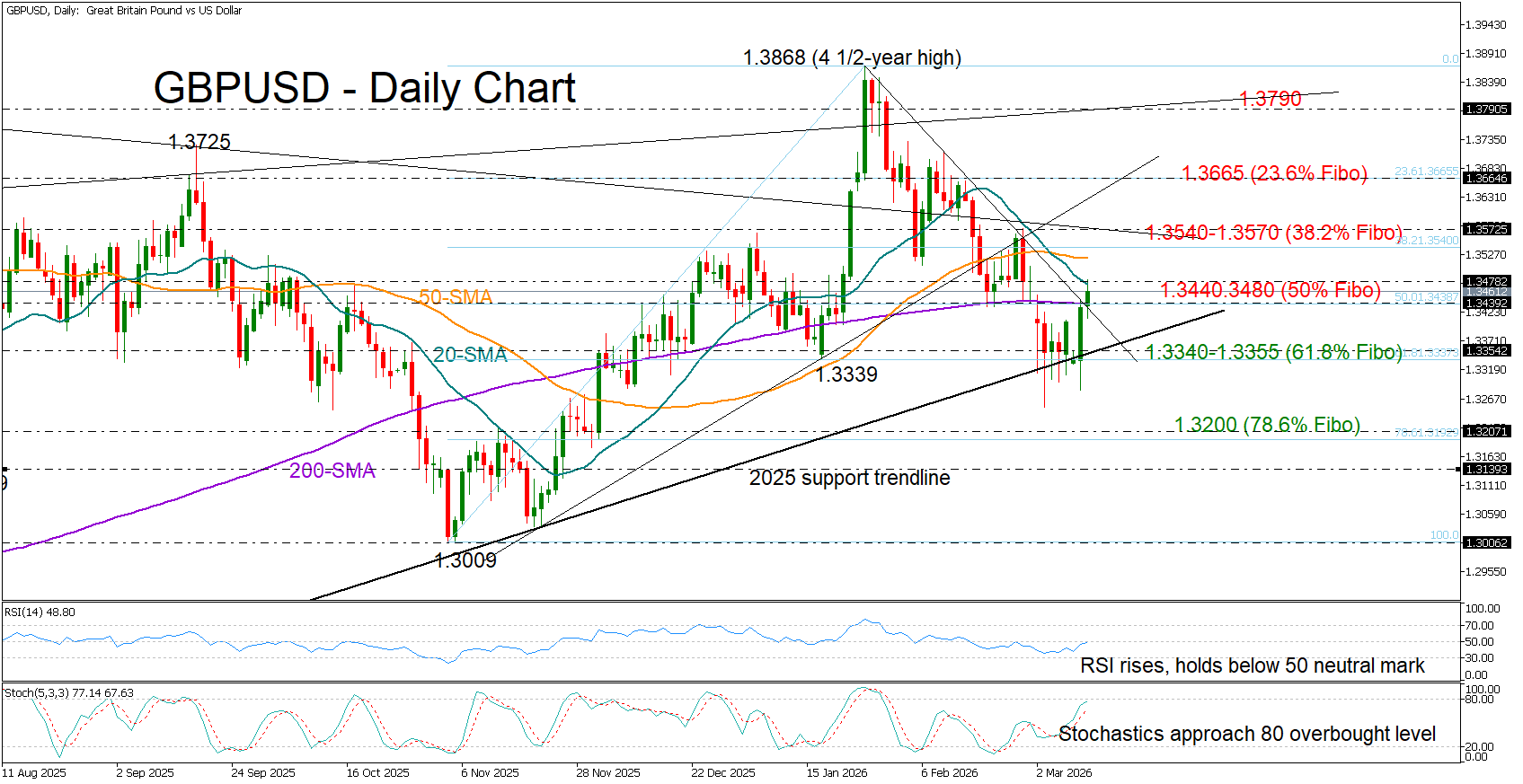
GBP/USD staged a relief rally towards 1.3479 as the US dollar retreated following President Trump’s comments that the conflict in Iran could end "very soon”. While he later cautioned a more powerful response should Iran interfere with tankers at the Strait of Hormuz, the initial optimism provided the cable with much-needed breathing room.

The pair held a strong footing near the support trendline from January 2025 and climbed above the short-term descending trendline drawn from the January peak, raising hopes that a new bullish phase is underway.

Despite this progress, the pair is not yet out of the woods. The price action remains tightly constrained within a resistance zone between 1.3440 and 1.3480, while also being squeezed between its 20-day and 200-day simple moving averages (SMAs). The 1.3540–1.3570 region represents the next major barrier for buyers; a decisive break above this area is necessary to fully eliminate fears of a broader bearish trend reversal. Should the bulls clear that hurdle, a breakout above the 1.3665 area would be the primary catalyst for a continuation toward the 1.3790 target.

The technical indicators are also indicating that the bulls lack conviction as the RSI has yet to climb above its 50 neutral mark, while the stochastic oscillator is already flirting with overbought levels. Nevertheless, only a decisive close below the 1.3340–1.3355 floor would significantly worsen the outlook, potentially unleashing a sharp sell-off toward 1.3200. If the bears claim the 1.3140 former support area as well, the next stop could be near the November low of 1.3000.

In a nutshell, GBP/USD continues to trade in a caution area. While a close above 1.3480 may activate fresh buying interest, the recovery phase toward previous highs might be complex and fraught with technical friction.

Author

Christina Parthenidou

Christina joined Trading Point in May 2017. She holds a master degree in Economics and Business from the Erasmus University Rotterdam with a specialization in International economics.


More from Christina Parthenidou
Share:

Editor's Picks

GBP/USD bounces off lows, back above 1.3200

After bottoming out near 1.3160, GBP/USD manages to regain a bit of shine and reclaim the 1.3200 mark and beyond at the end of the week. Stronger-than-expected UK Retail Sales data seem to be helping the British Pound limit its losses, while the chaotic UK political environment keeps the bulls at bay for now.

EUR/USD looks consolidative around 1.1460

EUR/USD stages a modest rebound after slipping to a three-month low below 1.1420 at the end of the week. That said, the pair now looks to consolidate humble gains just above 1.1460 despite growing uncertainty surrounding the next round of US-Iran negotiations, which keeps the US Dollar’s downside contained.

Gold slips back to six-day lows, targets $4,100

Gold retreats for the third consecutive day on Friday, eroding gains seen in the first half of the week and approaching the key $4,100 mark per troy ounce. Indeed, the precious metal continues to face headwinds from the Fed's hawkish stance and renewed uncertainty surrounding the next round of US-Iran negotiations.

Solana extends correction despite ETF inflows, RWA adoption

Solana (SOL) price edges below $70 extending its losses for the fourth straight day this week. The institutional demand for Solana is building, with steady inflows so far this week and Morgan Stanley’s amended S-1 filing for a Solana-focused Exchange-Traded Fund.

The Iran war didn't break the US economy, but what happens next?

Nearly four months after the start of the Iran war, the US economy remains remarkably resilient. While the conflict initially triggered a severe disruption to global energy markets and a sharp rise in Oil prices, recent diplomatic progress between Washington and Tehran has eased concerns about a prolonged supply shock.

Regime change: Inside Kevin Warsh's first move to make the Fed unreadable on purpose

The rate did not move. That was the least interesting thing about Kevin Warsh's first meeting in charge of the Fed. The FOMC held its benchmark at 3.50%-3.75% for the fourth straight meeting, exactly as priced, and then the new chair used his first press conference to dismantle the machinery the market has leaned on for a decade.