|

GBP/USD – Breaks below 0.618 support arc – Confirmed breakdown

British pound/US Dollar (GBP/USD): Arc cycle analysis™
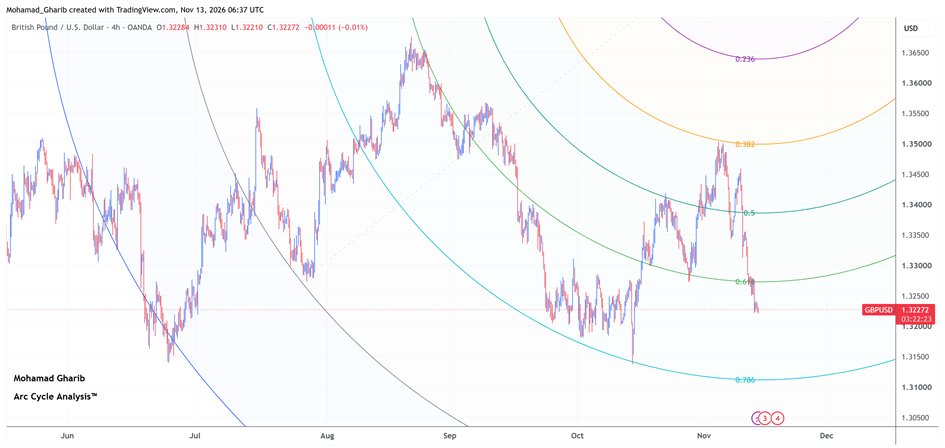
Chart

Figure 1: GBPUSD 4h chart with Arc Cycle levels. British Pound / U.S. Dollar (GBPUSD) on the 4h chart with the Arc Cycle levels used in this analysis. Source: TradingView chart; Arc Cycle Analysis™ by Mohamad Gharib.

Overview

Based on Arc Cycle Analysis™ applied to the 4h chart, GBPUSD is breaking below the 0.618 Support Arc, confirming a bearish breakdown within the current arc cycle. The next level in focus sits at 1.3185.

Table 1: GBP/USD arc cycle analysis summary

Metric

Reading

Market Bias

Bearish

Preferred Scenario

Breakdown / Decline Toward Next Level

Downside Target

1.3185

Scenario Invalidation

Sustained close above 1.3280

Current Arc Level

Below the 0.618 Support Arc

Cycle Status

Breakdown / Declining Toward Next Level

Arc Integrity

Weakening

Table 1: Key Arc Cycle readings for GBPUSD. Source: Arc Cycle Analysis™ by Mohamad Gharib.

Market outlook

GBPUSD is breaking below the 0.618 Support Arc, confirming a bearish breakdown within the current arc cycle. The broken arc is now expected to act as resistance, with the next level in focus at 1.3185.

A sustained close above 1.3280 would fade this bearish scenario and make this signal no longer valid.

Author

Mohamad Gharib

Mohamad Gharib

Independent Analyst

Mohamad Gharib is a Financial Markets Analyst and Quantitative Researcher with more than 18 years of experience in financial markets, including 15 years as an FX Quant Trader.


More from Mohamad Gharib
Share:

Editor's Picks

AUD/USD seems vulnerable near 0.6800, 10-month low amid bullish USD

AUD/USD languishes near a 10-month low during the Asian session on Friday, awaiting a break below 0.6800 before the next leg up amid a bullish US Dollar. Firming Fed rate-hike expectations, along with fading hopes for US-Iran diplomacy, help the USD hold gains at its highest level since April 2025. Moreover, the RBA’s dovish tilt undermines the Aussie and backs the case for further losses.

USD/JPY bulls turn cautious near 160.00 amid intervention risks

USD/JPY enters a bullish consolidation phase around its highest level since early September as bulls turn cautious amid intervention risk near 160.00. Meanwhile, the downside seems cushioned as the wide US-Japan interest rate gap keeps the Yen carry trade active. Furthermore, the possibility of a jumbo Fed rate hike and Middle East uncertainties hold the US Dollar near a 19-month top, supporting the currency pair.


Gold sticks to gains above $3,900; bulls lack conviction as Fed and Iran risks support USD

Gold clings to modest recovery gains above the $3,900 mark during the Asian session, snapping its three-day losing streak to the lowest level since late September set the previous day. The US Dollar takes a breather after a strong three-day rally to its highest level since April 2025, offering some support to the commodity. However, firming US Federal Reserve rate-hike expectations and Middle East uncertainties continue to support the Greenback. This keeps a lid on any further upside for the precious metal.

Bitcoin slips below $70,000 for the first time since August

Bitcoin is attracting some serious sellers, pushing it below $70,000 on Friday after an over 3% decline the previous day. The Crypto King is down over 5% so far this week, and a bearish close could mark its sixth consecutive week of losses. The technical outlook for Bitcoin is bearish, with sellers tightening their grip despite overextending the downtrend to oversold levels.

Asian stocks post mixed results amid Nvidia leadership turmoil, Anthropic IPO buzz
Asian stocks post mixed results on Friday, with Japan’s Nikkei 225 Index climbing 0.91% to around 61,370 and China’s Shanghai Composite rising 0.22% to 3,660. Conversely, Hong Kong’s Hang Seng Index fell 0.82% to 23,810, while South Korea’s KOSPI declined 0.49% to near 5,320.
What the US CPI headline doesn’t tell you about inflation

Brent crude has fallen about a third since mid-October on hopes the Iran war is ending, but diesel, freight and fertiliser costs haven't followed. Those costs reach US consumer prices in stages through 2027 and could keep inflation high after gasoline gets cheaper.