EUR/USD Forecast: Overbought, so what? Stimulus hopes blind investors' eyes (for now)
- EUR/USD has been advancing as US stimulus talks remain alive.
- Investors are shrugging off Republican reluctance for a deal and surging eurozone cases.
- Tuesday's four-hour chart is showing overbought conditions.

The deadline is dead and talks are still alive – the ongoing talks in Washington and the positive commentary are boosting stocks and weighing on the safe-haven dollar.
House Speaker Nancy Pelosi and White House Chief of Staff Mark Meadows both acknowledged progress in talks and are reportedly working on drafting a bill. While both sides say that differences remain, the prospects of seeing a mutli-trillion deal agreed before the elections are inspiring markets.
However, it is essential to note that Senate Republicans have their doubts. According to the New York Times, Senate Majority Leader Mitch McConnell advised President Donald Trump not to pursue a deal. He prefers Congress to focus on the Supreme Court and also fears that fiscal hawks within the GOP would oppose an accord, tearing the party apart.
News about talks is set to rock markets and overshadow the elections. Can President Donald Trump win reelection? Tuesday was a relatively upbeat day for the current occupant of the White House, but he continues trailing rival Joe Biden ahead of the pair's televised debate late on Thursday.
The RealClearPolitics average gap between the contenders dropped to 8.6% while FiveThirtyEight's model edged lower and gave the president an 87% vs. 88% chance of losing. State polls from critical states such as Florida and Pennsylvania are critical.
There are 13 days left until election day, but around 38 million Americans have already cast the choices via mail-in and early voting. That accounts for 27.3% of the total votes counted in 2016, according to the US Elections Project. In Florida, the percentage is already 31.7%:
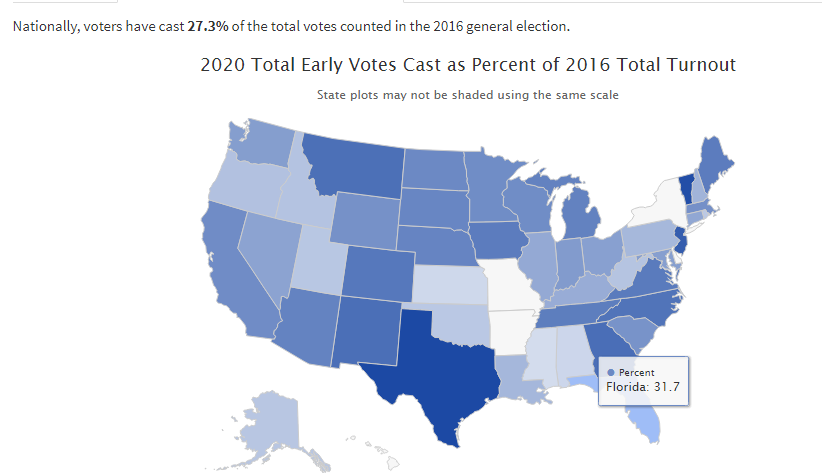
Source: US Elections Project
Investors seem to be dismissing the increase in COVID-19 cases in Europe. National, regional, and local governments continue curbing activity and results may take more time. In the meantime, the prospects for a double-dip recession remain elevated.
While coronavirus continues spreading, the efforts for clinching a vaccine remain in full force. Several firms are set to announce results of their Phase 3 trials in November, and markets hope that at least one would yield immunization. Mass-producing vaccine doses – which has already begun – and distributing it to the population could take more time.
Christine Lagarde, President of the European Central Bank, has spoken again on Wednesday, reiterating that her institution strives to price stability and wants to refrain from deflation. Is the ECB considering a new stimulus? Lagarde seems to be pushing in that direction, but she would need support from the hawks. The bank delivers its decision next week.
Overall, fiscal stimulus is the main theme, while COVID-19 cases – in Europe and also in the US – are lurking in the background.
EUR/USD Technical Analysis
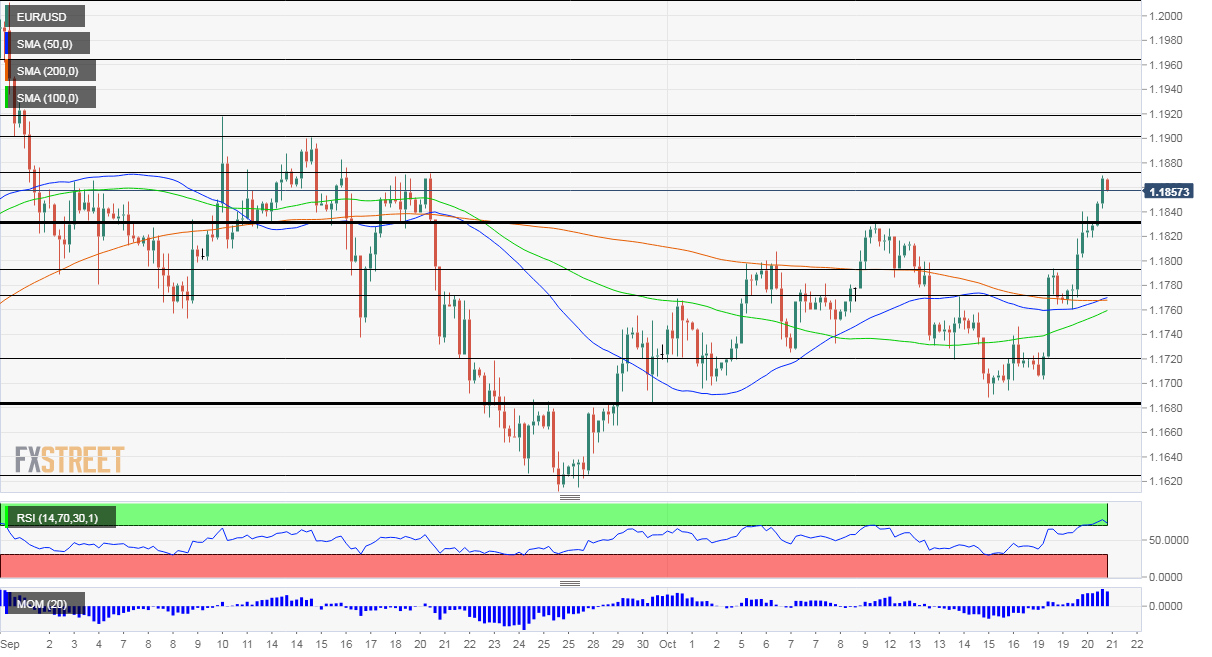
The Relative Strength Index on the four-hour chart is above 70 – indicating overbought conditions. This development implies a downside correction. On the other hand, euro/dollar benefits from upside momentum and trades above the 50, 100, and 200 Simple Moving Averages.
Resistance awaits at the fresh high of 1.1870. IT is followed by the round 1.19 level, and then by the September peak of 1.1920.
Support is at the former stubborn peak of 1.1830 and then by 1.1795 and 1.1770.
More 2020 Elections: Seven reasons why this is not 2016, time to focus on the Senate
Author

Yohay Elam
FXStreet
Yohay is in Forex since 2008 when he founded Forex Crunch, a blog crafted in his free time that turned into a fully-fledged currency website later sold to Finixio.