Commodity prices during and in the post-pandemic era


Inflation is and will continue to be one of the main issues of the economy at least for the current year. Given this issue, it would be interesting to see what has happened to the prices of some important commodities in the last two years that the pandemic has plagued the world.
In the whole two years of the pandemic, i.e., the years 2020 and 2021, the biggest positive change in the price, as we can see in the table below, was presented by the price of Coffee 76.4%, followed by Wheat 73.8%, Natural Gas 64.8%, and Aluminum 57.3%. Crude oil during this period showed a much smaller increase of 26.1%.
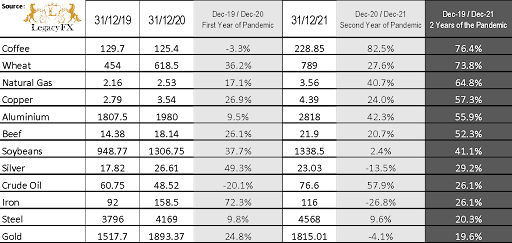
But if we look at the recent year of the pandemic, i.e., 2021, the picture is quite different. The biggest change in prices as shown in the following table is still noted by coffee, which in 2021 increased by 82.5%, but second is the increase in the price of Crude oil after it increased by 57.9%, followed by Aluminum with an increase of 42.3% and Natural Gas with increase 40.7%.
-637783954391554432.png)
The first year of the pandemic is also interesting, that is, in 2020, where despite the continuous lockdowns, the biggest change in prices, as shown in the following table, is marked by iron, which in 2021 increased by 72.3%, and silver, which increased. 49.3%, followed by soybean and wheat which increased by 37.7% and 36.2% respectively.
-637783954615428175.png)
In the same year, the price of crude oil fell sharply after closing with losses of -20.1%, while the price of Coffee, which closed with losses of -3.3%, also had negative performance.
It is also worth noting that many of the products, as we can see in the charts below, are far from the high levels that appeared mainly in 2022, although inflation persists to be strongly upward.
-637783954999943202.png)
-637783955234758089.png)
It is clear, that imbalances during the pandemic period may have led to high commodity prices accompanied by severe instability. The forthcoming rise in interest rates by central banks will try to smooth over the imbalances that have been created.
However, an interesting question is: given that in a period of intense uncertainty such as the pandemic, higher commodity prices have finally formed, what will happen if economies actually enter a phase of recovery and prices are driven by strong demand? Will supply be able to balance commodity prices or will they enter a new upward cycle?
And if so, what about inflation? which should be noted, that it is not so bad when price increases coincide with a rapidly improving economy!
Author
Nikolaos Akkizidis
Independent Analyst
Nikolaos Akkizidis is an Independent Financial Writer, Economist, Author, and Speaker with more than two decades of experience in financial services, capital markets, investment advisory, portfolio management, trading, risk manage