Behind the Barrel: Unveiling OPEC+'s Role in Shaping Tomorrow's Oil Market

As the events of 2024 unfold on the world stage, the Brent oil market is being driven by many factors. Most interestingly, 2023 ended with global oil inventories, especially Brent, at their lowest level since mid-2022. According to the International Energy Agency (IEA), this fluctuation in inventories has added an even more significant element of unpredictability to the market, so it is more important than ever to understand where the price of oil will move!
This analysis explores the intricacies of supply, geopolitical influences, economic conditions, and internal OPEC+ dynamics that combine to shape the trajectory of oil prices.
Geopolitical tensions and price forecasts
The geopolitical landscape in the Middle East remains a critical factor for the Brent market in 2024. Tensions in the Red Sea and Yemen pose significant risks to oil flow along major trade routes. For example, Brent prices experienced a spike following US and UK airstrikes on Houthi targets, reflecting the market's sensitivity to regional conflicts.
Wall Street analysts expect a moderate recovery in Brent crude oil prices in 2024, averaging around $85 per barrel. Forecasts for Brent crude oil in 2024 present a diverse picture. The US Energy Information Administration (EIA) forecasts an average price of around $82 per barrel, while Barclays and Citi have adjusted their forecasts to $93 and $74 per barrel, respectively. These forecasts consider potential overproduction issues, geopolitical risks, and global economic growth trends. For example, S&P Global Commodity Insights emphasizes the impact of OPEC+ production decisions on these price forecasts.
But what about oil demand?
Global oil supply is set for a significant increase in 2024, with an expected rise of 1.5 million b/d, bringing the total to 103.5 million b/d. Key participants are non-OPEC+ countries such as the US, Brazil, Guyana, and Canada. However, this supply surge could lead to a glut in the market, especially if OPEC+ decides to abandon its additional voluntary cuts in the second quarter of 2024. At the same time, demand growth is expected to slow down, influenced by various factors, including technological advancements in energy efficiency and vehicle electrification.
Challenges of OPEC+
There are growing concerns within OPEC+ about the unity and future strategy of the group. Angola's recent withdrawal from the agreement has raised questions about the alliance's stability. This withdrawal and production adjustments from other member countries could significantly change the group's collective output. For example, Russia and Saudi Arabia, critical players in OPEC+, have different thresholds for acceptable oil prices - $85 and $100 per barrel, respectively. This difference in interests could lead to problems in reaching a consensus on production levels, potentially affecting global oil prices.
XBR/USD, Daily Timeframe
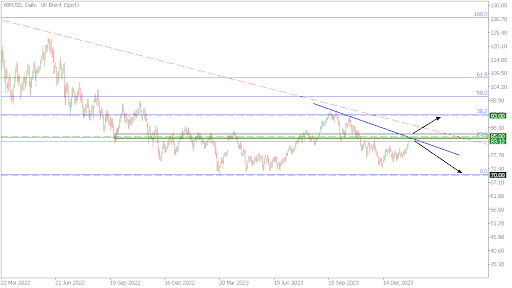
In the Daily timeframe, XBRUSD is moving in a downtrend, and the price is below the 23.6 Fibonacci level. In the short term, it is possible to expect a test of the 85.00 resistance area, which creates two possible scenarios. If the resistance of 85.00 is broken and the trend line is crossed, we can expect a rise to the level of 93.00, which corresponds to 38.2 Fibonacci. However, if the price bounces off the resistance, the target will be the support at 70.00.
OPEC+ faces many challenges that depend on whether the cartel members can continue to work in concert. However, current problems within the cartel, increased supply from non-OPEC+ countries, falling demand from significant consumers, and pressure from the green agenda could put severe pressure on Brent's price. In addition, the US and China, still leading in oil consumption, are not interested in prices rising above 75-85 dollars per barrel, which could have serious consequences. With similar dynamics, the oil price in 2024 could be 70-72 dollars per barrel.
However, prices could increase if OPEC+ can solve internal problems and reach a consensus. Also, one should not rule out the factor of geopolitical tension, which may push oil prices up and reach the level of 90-100.
Conclusion
To sum up, the oil market in 2024 is characterized by diverse and sometimes conflicting factors. Declining global inventories, heightened geopolitical tensions, differing price forecasts, and a complex supply-demand balance set the stage for a year of cautious navigation. The impact of OPEC+, while significant, is being tested by domestic challenges and external market dynamics, making forecasting oil prices more challenging than ever. This complex scenario emphasizes stakeholders' need for vigilance and adaptability as they respond to changing global oil market conditions.
FBS is an international brand present in over 150 countries. Independent companies united by the FBS brand are devoted to their clients and offer them opportunities to trade Margin FX and CFDs. FBS Markets Inc: license IFSC/000102/310. Tradestone Ltd.: CySEC license number 331/17. FCA temporary permit 808276. Intelligent Financial Markets Pty Ltd/: ASIC Licence number 426359.
Author

FBS Team
FBS
FBS team is a group of professional analysts focused on Forex, stock, and commodity markets. Each expert possesses a years-long experience in fundamental and technical analysis.