Banks recover some ground in 2021


While 2020 was a dreadful year for banks with record lows in a lot of bank share prices here, and in Europe, the outlook at the start of 2021 was slightly more positive as the vaccine program started to achieve escape velocity in terms of the rollout.
That aside there was still much uncertainty given the indefinite lockdown imposed by the UK government at the start of January, which at the time the Bank of England was forecasting could see a Q1 contraction of -4%, as well as speculation that they might seek to go down the controversial route of negative interest rates.
The topic of negative rates topic has been especially damaging with respect to the banking sector simply on the basis there is no clear evidence that imposing their works, and even less so for an economy which to all intents and purposes is partially locked down. All we need to do is look at where they’ve been implemented, in Europe for example to see that they are of little use, and in some cases, can make matters worse.
Having finished 2020 very much on an upbeat note, January turned out to be somewhat of a subdued start to the year for markets in general as it became quickly apparent that it was becoming a race between the speed of the vaccination program, and government’s ability to vaccinate their populations.
This also helped explain why the initial enthusiasm of January, along with the vaccine rollout plan, turned very quickly to concerns about extended lockdowns, and tighter restrictions for longer across Europe. There was also the added concern of disruption to vaccine supplies, as the EU weighed the prospect of export controls on vaccine materials, thus raising the political temperature amongst those who have managed to coordinate their vaccine rollout program better.
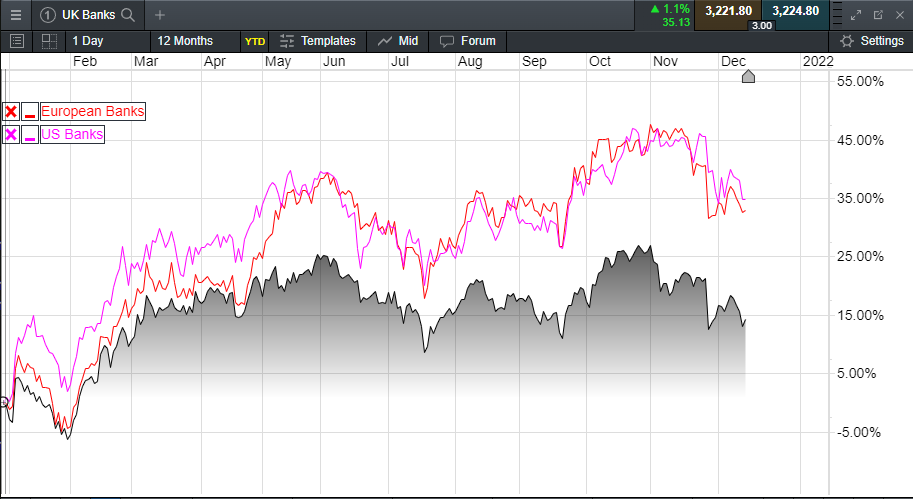
Since the January lows, the progress of European and UK banks has been one of decent moves higher, although once again this needs to be put into the context of the sector in Europe hitting a record low in 2020, unlike the UK which is well above its historical low points.
Comparison: UK, US, and EU banking basket
Source: CMC Markets
The European outperformance also probably has more to do with the fact that the biggest weightings appear to favor the Spanish banks which have done more than their European peers to address the problems of non-performing loans.
According to data released by S&P Global back in April, the biggest provisions in 2020 were set aside by Banco Santander, Bilbao Vizcaya, as well as French bank BNP Paribas who between them allocated over €23bn.
UK banks also set aside considerable amounts to deal with the prospect of possible loan defaults, with HSBC leading the way with over $8.8bn, or £6.5bn. Barclays came next, setting aside £4.8bn, Lloyds Banking Group, £4.25bn and NatWest Group £3.24bn.
The recovery in bank share prices also started to gain traction this year when it became apparent that US banks were looking to recycle a lot of their own provisions, which they set aside for the same reasons during 2020, raising the prospect that banks over here might well do the same thing.
This has been a key feature of this year’s recovery in bank share prices, along with the restoration of dividends, although it’s also notable that the banks that have performed the best have also benefited from the early year volatility in stock markets, which their investment banking operations have been able to take advantage of.
Increased fee revenues from M&A and IPOs have also been a key driver, something that the more domestically focussed banks will have missed out on.
UK banking headwinds
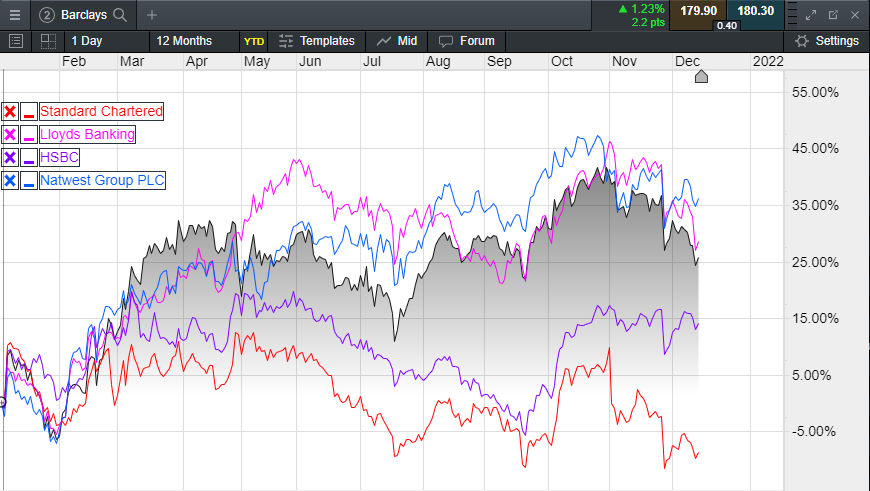
Like it did in 2020 the UK banking sector has underperformed this year, and while some of that can be put down to a central bank that appeared determined to hollow out their ability to generate income, with speculation about negative rates, that doesn’t help to explain the underperformance more generally, which has been notably more marked in the second part of this year.
It is true that there have been concerns about a UK-EU trade fissure to deal with and the Northern Ireland protocol, while the recent budget probably didn’t help due to concerns about what the various tax changes might do to business confidence.
Nonetheless, while the performance year to date has been disappointing, the numbers that we’ve seen come from the likes of Lloyds and NatWest have been encouraging despite their more domestic focus when compared to Barclays and HSBC, which have other revenue streams from their investment banking divisions, and in HSBC case its Asia markets, which accounts for a large part of its global revenue.
UK Banks performance YTD
Source: CMC Markets
As can be seen from the chart above the best performers have been Barclays, Lloyds, and NatWest Group, moving in lockstep with each other for most of this year, as improvements in the UK domestic economy, and in particular mortgage lending saw the banks return decent profits.
NatWest group
Having hit new record lows back in 2020, the perennial ugly duckling of the UK banking sector, the NatWest share price has performed well, and although it’s managed to see a rebound back to pre-Covid lockdown levels the share price is still shy of the highs seen in December 2019.
CEO Alison Rose has certainly done a decent job of giving the bank a makeover and polished up the paintwork, but it’s still paying for some of its legacy issues after the bank took a charge of £294m after pleading guilty to three criminal charges of money laundering in November.
On the numbers themselves, these have been much better despite the lockdowns that hampered the economy in the first half of this year, with the bank releasing money from its provisions pot, which in turn has helped boost profits in every quarter this year.
The perennial ugly duckling of the UK banking sector, we are starting to see signs of a bank that is finally turning a corner. The UK government has re-started the process of reducing its stake in the bank.
In Q1 the bank released £102m in loan loss reserves back onto the balance sheet, helping to boost profits to £620m, helped by a big increase in mortgage lending of £9.6bn, while customer deposits also rose by £7.3bn, compared the end of Q4 last year.
In Q2 the bank released another £605m from reserves helping to boost H1 profits by £707m, due to the low levels of loan defaults.
As a result, Q2 pre-tax profit came in at £1.22bn, helping to push H1 profits to £1.84bn, with the bank taking the decision to resume the dividend, declaring an interim payment of 3p per share. The bank also said it plans to buy back £750m of its own shares in the second half after the Bank of England removed restrictions on payouts a few weeks ago.
This also presents a nice windfall for the UK government as it looks to pare back further its 54% stake in the lender over the course of the next 12 months, with the bank saying it expects to distribute a minimum of £1bn per annum to shareholders from 2021 to 2023 via a combination of ordinary and special dividends.
In Q3, the picture was no less positive, with profits attributable to shareholders coming in at £674m, well above last year’s £61m, and while they were ahead of expectations, they were still almost half the level they were in Q2, with the bank adding back £242m in respect of non-performing loans, making a total of £949m added back so far year to date.
Looking past the quarterly numbers the bank is still well ahead of where it was a year ago, with profits year to date at £2.5bn, compared to a £644m loss over the same period in 2020.
The bank continues to struggle where net interest margins are concerned, as they fell back to 1.54%, from 1.61% in Q2.
In terms of lending and client activity, NatWest reported similar trends to Lloyds before it. With net loans to customers rising to £180.5bn, with mortgage lending quite strong. Personal loans and credit card lending was a little more subdued, however, it still rose by £100m, reflecting a willingness perhaps of the consumer to spend more money as the economy reopened over the summer.
Barclays
Barclays was a little more cautious when it came to the releasing of loan loss reserves at the beginning of the year, largely due to an abundance of caution over the wider outlook perhaps and the fact that the bank saw a 6% fall in total income in Q1, to £5.9bn. One thing the Q1 numbers did do was prove that CEO Jes Staley was correct to push back on activist shareholder Ed Bramson who has been pushing management to slim down the investment bank. It is true that the division has its weak spots but the fact that it is there offers Barclays something its more domestically focussed peers do not have a more diverse revenue stream.
In Q2 the bank fared much better than in Q1, adding back £742m from reserves, boosting profits before tax to just under £5bn in the first half of the year, well above forecasts, with the bank saying it would pay a dividend of 2p a share, as well as buying back £500m of its own shares.
One of the key drivers of this outperformance was investment banking, which saw pre-tax profit rise to £1.58bn, well above estimates of just over a £1bn, which was primarily driven by a 19% increase in banking fees from M&A.
The UK business also performed well with a modest rise in customer deposits, and customer loans through credit card lending saw a decline from the end of last year, a trend that continued into Q3, with the share price rising to three-year highs.
Once again, the bank released another £622m from its loan loss reserves, as the bank saw pre-tax profits rise to £1.5bn on Q3 revenues of £3.1bn.
One of the main themes from this year’s bank numbers has been a continued increase in customer deposits, a rise in personal lending in the form of mortgages, and a slowing in credit card borrowings as well as business lending.
Lloyds banking group
Unlike Barclays, Lloyds Banking Group’s fortunes are inextricably linked to the fortunes of the UK economy, with the first half lockdown of the economy raising concerns as to how the bank might cope with respect to the prospect of rising loan defaults.
At the start of its financial year, the bank was cautious saying that the outlook was highly uncertain given that more of its customers could well find themselves in financial difficulty in the months ahead, due to the latest lockdown, however, it still felt confident enough to resume the dividend.
As such the bank set is expected to see a stabilization in 2021, and that net interest margins were expected to remain above 240 basis points over the next 12 months. As it turns out Lloyds needn’t have worried as in its Q1 numbers the company posted statutory profits of £1.4bn, beating expectations, due to the release of credit loss provisions of £323m.
This was driven by loan demand for housing which was strong over the last quarter with its open mortgage book seeing a 6% increase from a year before, to £283.3bn, and a 2% rise over the quarter, though credit card spending was down 19% over the year, and 6% on the quarter at £13.5bn.
In July the bank raised its outlook for the year, recording statutory pre-tax profits of £2bn, for Q2, elevating profits in H1 to £3.9bn, well above expectations, as well as announcing the acquisition of savings and pensions firm Embark Group for £390m. The bank also confirmed it would pay a 0.67p dividend.
The bank also released another £333m from loan loss reserves, on top of the £323m in Q1 taking the total on H1 to £656m. the performance of the underlying business also saw improvements as net interest margin rose to 2.51%. On the customer, side mortgages saw an increase of £7.5bn to £447.bn, for H1 while deposits also grew to £474.4bn, a rise of £23.7bn.
In terms of the wider economy the loan book structure saw declines over the quarter in SME and corporate lending, suggesting that while consumers appear to be spending again, businesses are a little bit more reluctant to open the purse strings.
In Q3 the picture improved further with profits after tax coming in at £1.6bn, almost £1bn higher than a year ago, pushing profits, year to date to just shy of £5.5bn, with the bank adding back another £84m in terms of loan loss provisions, due to the improved economic outlook, taking total impairments added back to £740m year to date.
Having resumed dividends earlier this year and given how well the bank appears to be doing, and if we see a similarly robust Q4, shareholders could be forgiven for thinking that the full year numbers could see the bank improve its payout.
HSBC
HSBC also resumed its dividend this year, after reporting its full-year numbers back in February, albeit a modest $0.15c a share, it nonetheless spoke to an intent to accelerate its restructuring plan, as it reorientates its business towards Asia which contributes the bulk of its profits.
In Q1 the bank posted a decent set of numbers posting a 79% rise in profits after tax to $4.5bn, as the bank followed in the footsteps of its US counterparts in releasing $400m back onto its balance sheet from the money set aside last year for non-performing loans.
While the bank generates most of its profits from its Asia operations the outperformance of its UK operation saw returns of $1bn. Despite the rise in profits, revenues were lower overall, coming in at $13bn, which management blamed on the low-interest-rate environment.
Its Q2 numbers followed a similar pattern, posting profits after tax of $3.85bn, a much better than expected outcome, despite lower revenues. The headline numbers were helped by the bank releasing another $300m from provisions for non-performing loans, on top of the $400m released in Q1.
This boosted H1 profits after tax to $8.4bn with the bank announcing an interim dividend of $0.07c a share. the decline in revenues was largely down to lower interest margins across all the bank’s global operations, which fell from 1.43% a year ago to 1.21%.
The UK operation also had a good first half, generating $1bn of profits in Q1, and continued this trend with another $1.1bn in Q2. I
n Q3, HSBC followed up with another decent set of numbers as profits after tax rose to $4.2bn, taking total profits year to date to $12.66bn. Q3 revenues came in slightly better compared to a year ago, although there was a slight decline from the levels seen in Q2.
All areas of the bank showed a strong improvement, the most notable of which was the UK business which followed up its H1 contribution of $2.1bn with another $1.5bn of profits before tax in Q3. The Asia business contributed $3.3bn, while the headline number of $5.4bn was boosted by another release of credit impairment charges of $700m on top of the $700m released in H1.
The bank announced a $2bn share buyback, however unlike in the first half, when it paid a dividend of $0.07c a share, the bank won’t be paying a quarterly dividend.
In line with a lot of other banks, lending was subdued, with a fall in net loans and advances to customers over the quarter. Global Banking and Markets saw a modest decline in adjusted revenues to $3.6bn in Q3, with net interest margin remaining steady at 1.2%, well below the 1.35% from the same quarter last year.
Banks have had a decent year, headwinds remain
It’s been a decent year for banks in general, after the record lows of 2020. The outlook is much more positive now with the vaccine rollout helping to keep the economy open. The low levels of bankruptcies and loan defaults have been one of the plus points for the banks during 2021, however, headwinds remain.
Rising inflationary pressure while good for bank margins could well impact consumer borrowing patterns, particularly in mortgage lending which has been quite strong, even as credit card spending has been subdued.
Central banks will remain under pressure to contain the prospect of rate rises next year despite rising inflation expectations.
The broader economic recovery is already showing signs of slowing as winter approaches with consumers facing higher food and energy costs, not only in the UK but in the US and Europe as well. How transitory these are and consumers' ability to absorb them will dictate whether we can see the banks maintain their current positive momentum, improve their profit margins, and continue to pay decent dividends.
Author
Michael Hewson MSTA CFTe
Independent Analyst
Award winning technical analyst, trader and market commentator. In my many years in the business I’ve been passionate about delivering education to retail traders, as well as other financial professionals. Visit my Substack here.
















