|

Australian dollar dips, CPI next

The Australian dollar has reversed directions on Tuesday and recorded slight gains. In the European session, AUD/USD is trading at 0.7781, down 0.22% on the day.

Australian inflation next

Australian CPI showed a strong gain of 0.9% in the fourth quarter, and an identical gain is projected for the first quarter of the year. The economy is performing well, boosted by stronger demand for Australian commodities and ultra-low interest rates. Unemployment has been falling, undeterred by the end of the JobKeeper employment programme at the end of March.

Not surprisingly, inflation is also showing strength, reflective of the positive economic conditions. Consumers are again spending, as Retail Sales rebounded in March with a gain of 1.4%, after a decline of 0.8% beforehand. This beat the forecast of 1.0%. The economy continues to grow after being reopened, and consumer spending is expected to be a key driver in the economic recovery. The RBA is projecting that GDP and employment will reach pre-pandemic levels later in 2021, which is 6-12 months faster than the central bank had expected.

In addition to stronger domestic demand, Australia stands to benefit from a more robust global economy, which will translate into stronger demand for Australian exports. This bodes well for the Australian dollar, which has a tight correlation with commodity prices.

Despite the rosy economic picture, the RBA remains cautious and has not given any indication that it plans to raise interest rates or even taper its QE programme. At its last meeting, the bank noted that inflation remains low and below the central bank’s target, which is between 2-3 percent. The bank added that although the employment picture has improved, unemployment still remains too high for its liking.

AUD/USD technical
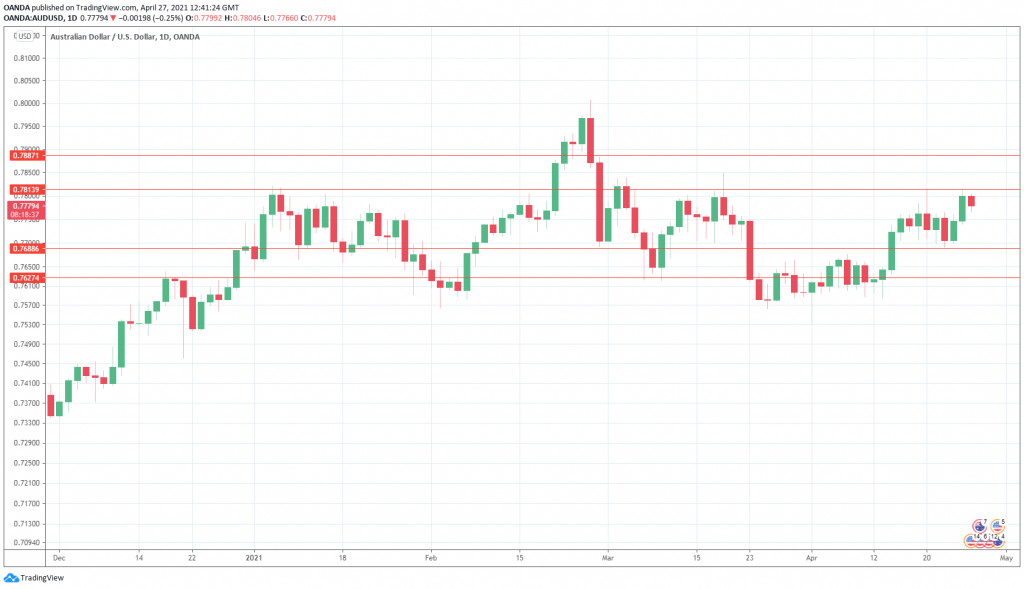
AUDUSD
  • AUD/USD is putting strong resistance at 0.7813. Above, there is resistance at 0.7887.

  • On the downside, there is support at 0.7688, followed by support at 0.7627.

Author

Kenny Fisher

Kenny Fisher

MarketPulse

A highly experienced financial market analyst with a focus on fundamental analysis, Kenneth Fisher’s daily commentary covers a broad range of markets including forex, equities and commodities.


More from Kenny Fisher
Share:

Editor's Picks

GBP/USD gains as easing Fed hike bets weigh on US Dollar

GBP/USD continues its winning streak for the ninth consecutive day, trading around 1.3390 during the Asian hours on Tuesday. The currency pair rises as the US Dollar faces headwinds as market participants scale back expectations for Federal Reserve rate hikes this month and in September. 

EUR/USD eases toward 1.1400 as Hormuz risks support USD

EUR/USD is easing toward 1.1400 in European trading on Tuesday, facing rejection at the 1.1450 level. The pair loses ground amid a modest recovery in the safe-haven US Dollar, as renewed tensions in the Strait of Hormuz and Asian tech sell-off fuel risk aversion.

Gold sticks to losses as inflation fears lift US bond yields and USD amid Hormuz risks

Gold maintains its offered tone heading into the European session, albeit it holds above the $4,100 mark. Crude oil prices edge higher amid renewed tensions in the Strait of Hormuz, reviving inflationary concerns. This, in turn, triggers a fresh leg up in US Treasury bond yields, offering some support to the US Dollar, and weighing on the non-yielding yellow metal for the second straight day.

Bitcoin loses steam around $63,000 – DeFi tokens rally

Bitcoin sustains above $63,000 at press time on Tuesday, upholding a streak of six consecutive days of gains despite Strategy selling 3,588 BTC on Monday. The broader crypto market sentiment holds while DeFi tokens such as DeXe and LayerZero emerge as top gainers over the last 24 hours.

Bye, forward guidance: How to trade when central banks choose silence
Central banks have spent years telling markets what might come next. Now, traders face the possibility that they say a lot less. From the Federal Reserve to the European Central Bank and the Bank of England, policymakers are pushing back against forward guidance, arguing that the current world demands more flexibility.
Bye, forward guidance: How to trade when central banks choose silence

Central banks have spent years telling markets what might come next. Now, traders face the possibility that they say a lot less. From the Federal Reserve to the European Central Bank and the Bank of England, policymakers are pushing back against forward guidance.