|

AUD/USD Forecast: Resting above a critical Fibonacci support level

AUD/USD Current Price: 0.6877

  • The PBOC trimmed lending rates in an attempt to boost economic activity.
  • Australian S&P Global PMIs are expected to show improved business activity in August.
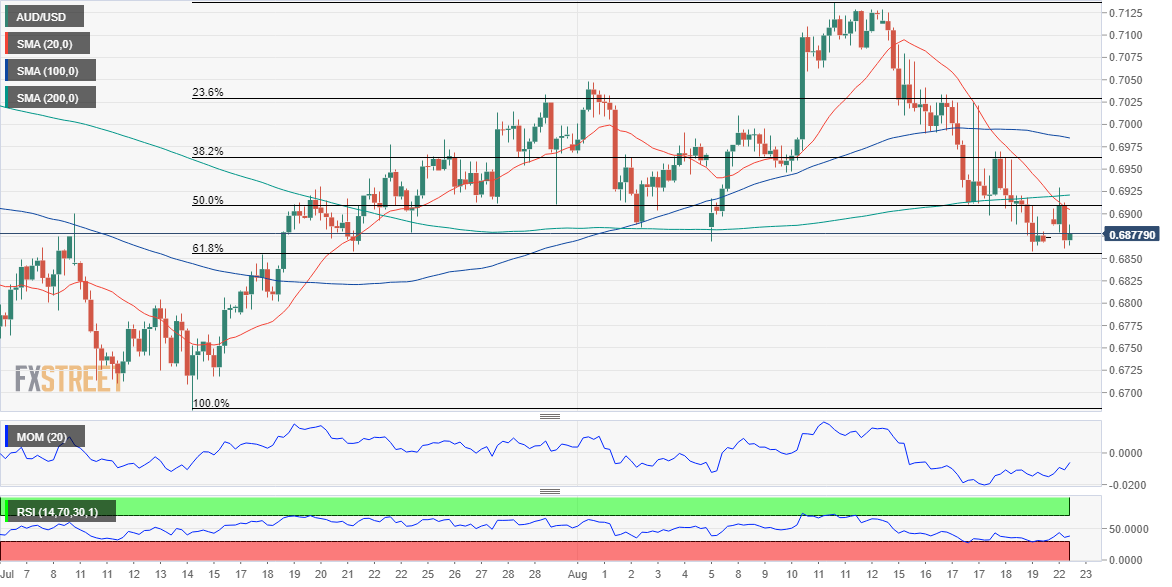
  • AUD/USD gains bearish strength, needs to break below 0.6855.
The AUD/USD pair advanced throughout the first half of the day to trade as high as 0.6928 but trimmed early gains to end the day unchanged in the 0.6870 price zone. The aussie benefited from the People’s Bank of China’s decision to trim its lending rates. The central bank cut the one-year Prime Lending Rate by 5 bps and the five-year rate by 15 bps in an attempt to boost economic activity.

Financial markets became risk-averse during London trading hours, pushing stock markets lower, which weighed on the aussie while boosting the dollar’s demand. Australia did not publish macroeconomic data on Monday but will release the preliminary estimates of the S&P Global August PMIs. Economic activity is seen improving from July levels, preventing AUD/USD from falling sharply.

AUD/USD short-term technical outlook

Technically, the AUD/USD pair is holding above a critical support level, 0.6855, the 61.8% retracement of its latest daily advance. The risk is skewed to the downside, according to the daily chart, as the pair remains well below bearish moving averages. Technical indicators, in the meantime, remain within negative levels although lacking directional strength.

The 4-hour chart shows that the 20 SMA heads firmly lower below its 100 and 200 SMAs, hinting at another leg south. Furthermore, technical indicators turned lower below their midlines, another sign of bears’ strength.

Support levels:0.6855 0.6810 0.6770  

Resistance levels: 0.6910 0.6955 0.6990

View Live Chart for the AUD/USD

Author

Valeria Bednarik

Valeria Bednarik was born and lives in Buenos Aires, Argentina. Her passion for math and numbers pushed her into studying economics in her younger years.


More from Valeria Bednarik
Share:

Editor's Picks

AUD/USD remains depressed near 0.6950 after RBA minutes

AUD/USD attracts follow-through selling during Tuesday’s Asian session, looking to extend the overnight rejection slide from 0.7000, or a two-week top, following the release of RBA meeting Minutes. The US Dollar retains a bullish undertone near its highest level since April 2025 as energy-driven inflation risks keep December Fed rate hike bets firmly on the table. Adding to this, geopolitical risks further underpin the safe-haven USD.

USD/JPY extends retreat below 158.50 as intervention risks loom

USD/JPY is dropping below 158.50 in the Asian session on Tuesday, snapping a two-day winning streak and pulling back from an over two-week top touched the previous day, despite Japan's soft PPI inflation print. Bulls turn cautious amid speculation that authorities will step in to prop up the Japanese Yen, which, in turn, weighs on the pair.

Gold advances to $4,200 amid retreating USD; Fed hike bets to cap further gains

Gold builds on its modest intraday move up and hits a fresh daily high around the $4,200 neighborhood during the Asian session. The US Dollar retreats from its highest level since April 2025 amid some profit-taking, offering support to the commodity. However, the US Federal Reserve's hawkish stance and escalating Middle East conflicts could limit deeper losses for the safe-haven buck.

Cardano: Retail support wanes as ADA tests a make-or-break level

Cardano price is up nearly 2% at press time on Tuesday, holding above its 50-day Exponential Moving Average (EMA) at $0.2302 and a near-term rising support trendline at $0.2264. ADA is losing retail demand in the derivatives market as its futures Open Interest declines and funding rates flip negative.

Indian Rupee gains further on RBI’s fresh measures to lower US Dollar’s demand

The Indian Rupee extends the Monday’s advance against the US Dollar on Tuesday, driven by the announcement of fresh Reserve Bank of India’s US Dollar-related measures to shore up the domestic currency. In the opening session, the USD/INR pair tumbles 0.6% to near 95.00, the lowest level seen in over a month.

Has Bitcoin really escaped the macro forces it was built to fight?
Over 17 years ago, Satoshi Nakamoto designed Bitcoin (BTC) on the back of a global financial crisis as an alternative to the global monetary system outside the control of central banks, governments and traditional intermediaries. This raises a key question: has Bitcoin really become independent of the macroeconomic forces it was built to challenge?















