Are we facing a recession even before the Fed acts?

Foreign Affairs: In Russia, the ruble fell as far as 111 from 83 on Friday, the biggest one-day drop ever, although the data is spotty since global banks and brokers are not trading it. One quote has it at dollar high of 117.75 and eSignal has a high of 109.27. As shown in the chart on the next page, Russian bonds have fallen to junk. The WSJ reports “the yield on a 5-year Russian dollar bond maturing in June 2027 jumped to more than 24% Monday from just under 10% Friday, according to Tradeweb.” The Bank of Russia raised the benchmark rate from 9.5% to 20%.
Bloomberg reported last evening that S&P Ratings downgraded Russian bonds below investment grade on Friday, while Moody’s will review for a downgrade–from one notch above junk now. Panic selling is reported by a St. Petersburg manager, which bodes ill for Blackrock, which has over $1.5 billion of Russian paper.
On Saturday, perhaps in response to popular demand, the US, UK, EU and Canada announced they will cut some Russian banks off from Swift. They will also take some unspecified action to prevent Russia from using its $619 billion in reserves–very little of which is in dollars. See the chart. The WSJ reports “Russia’s central bank holds just 6.6% of its reserves in U.S. securities, with Chinese securities accounting for 13.8%, French securities for 12.2%, Japanese securities for 10% and German securities for 9.5%. Before it moved away from dollar assets in mid-2018, the 2018 U.S. securities accounted for just under 30% of reserves…”
In the Russian invasion of Ukraine, Russia is finding it harder and longer-lasting than it must have expected. As of Saturday, Ukraine had shot down five Russian fighter jets, two aircraft and 11 helicopters, according to a Turkish website that is citing the Ukrainian Defense Ministry. Another earlier source had it as 14 aircraft, 8 airplanes and 102 tanks. Getting updates is hard–the coverage is continuous but fresh data is scarce. It was cool to see the Russians retreating in Kharkiv, though. A beer company converted production to Molotov cocktails.
It’s hard to find out how much money is being raised by charities for Ukraine–as of late Friday, it was $4 million, not bad for two days of fund-raising but as of 6 pm Sunday night, we can’t find an update. One of the problems–the minimum donation amount shown on various websites is pretty high–Red Cross Ukraine has $200 as its starting point and the International Rescue Committee has $60. At a guess, a number like $25 would do better. Zelensky said “volunteers welcome” (and more than once). While the US and other Nato members are not sending troops, armed private militias would be greeted happily. All those gun-happy militias in the US should be booking their flights.
Protests demanding countries do more for Ukraine were all over the world on the weekend–the US, UK, France, Austria and more. Russians flooded the streets again, too. On Saturday, the question of the week on the CNN Smerconish TV show was “Should NATO go to war for Ukraine” and over 38,000 watchers responded–77% saying “yes.” The heroic (if charmless) Col Vindman sees defeat at any moment while a retired Army general told Fox news that even if Putin takes Kyiv, he has already lost the war–Ukraine will be a hornets nest.
Nato is still debating how big a cyber-attack on a Nato member has to be, or a withholding of energy supply, to constitute enough provocation to trigger Article 5–an attack on one is an attack on all. They are probably burning up the phone lines on this very issue. The EU is shipping arms to Ukraine for the first time ever. Germany took the unexpected step of announcing higher military spending over the current cap.
Private companies are bailing. FedEx and UPS won’t deliver to Russia anymore. BP will exit is minority stake in Rosneft at a cost as high as $25 billion. Switzerland will decide today whether to follow the EU and freeze Russian assets. Equinor, Norway’s biggest energy company, will leave joint venture in Russia and the sovereign wealth fund will get rid of Russian assets.
In the US, individual states are combing purchase orders to halt buying from Russia, while the Gov of Ohio asked liquor stores to remove Russian vodka from the shelves. Musk is sending 50 Starlink satellites at Ukraine’s request. YouTube and Twitter won’t show ads from Russia. Apple may suspend sales in Russia. Bloomberg reports international hacktivists, who operated during the Crimea event, are re-building their base. Ukrainian computer capability is among the best in the world (Bloomberg has a newsletter on cyber-everything.) The list grows by the hour.
Meanwhile, Putin becomes ever more a pariah with sports and cultural events being directed elsewhere and Russians excluded, including the Euro Song contest and other shunning, like Putin removed as honorary president of the International Judo Federation. On Sunday afternoon, Putin put his nuclear forces on high alert in an attempt to intimidate.
In a nutshell, the condemnation of Russia’s unprovoked invasion of Ukraine is getting a vast and unprecedented negative response worldwide. The solidarity is really remarkable, although a nation cannot prevail on solidarity. We know the war is going to hit oil and other commodities very hard–equities, too–but does it hit the US, UK and eurozone financial system? Nobody knows, although there is a small doom-and-gloom crowd that see what is basically default by Russia requiring central banks to open up their wallets to maintain liquidity.
Another kind of fallout might be two “conservative” conferences, one by the Conservative Political Action Conference or CPAC and the other held by a white supremacist America First Political Action Conference, where participants including the former president and several currently serving members of Congress praised Putin. They bought into Ukraine and Nato having provoked Russia. How sad.
Finally, leaders from Ukraine and Russia are due to meet today in Belarus, which promises air-tight security. Consider the guts it takes for Mr. Zelensky to go.
Outlook: Aside from the Ukraine/Russia conflict, the main focus for the Fed is whether growth is slowing so badly that the first hike will by necessity be only the standard 25 bp and future hikes, now expected at six or seven, severely curtailed. In other words, are we facing a recession even before the Fed acts?
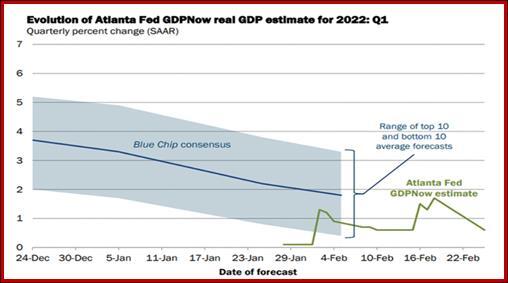
On Friday Morgan Stanley revised its Q1 forecast from 3.8% to 5.4% on the basis of consumer spending exceeding expectation, along with durables. The Atlanta Fed’s GDPNow estimate got slashed from 1.3% on Feb 17 to a lousy 0.6% on the drop in real personal consumption growth from 3.2% to 1.6%. Notice that’s real but not “disposable.” See below. We get another Atlanta Fed estimate tomorrow.
Personal income was flat in Jan from a gain of 0.4% in Dec, revised, better than the drop expected. Note this is nominal, not “real disposable.” Disposable income rose only 0.1% and in chained 2012 dollars, fell 0.5%. (https://www.bea.gov/news/2022/personal-income-and-outlays-january-2022). “Real” means after inflation and “disposable” means after taxes.
Spending was higher than expected at 2.1%, so combined with a 0.5% drop in real disposable income, the saving rate got slashed from 8.2% to 6.4%. Core PCE inflation rose 0.5% m/m as forecast or 5.2%, the highest since 1983. The headline version is 6.1% from 5.8%. So, higher and deserving of Fed attention.
WolfStreet has a killer chart showing the recent wild rise–but when we look at the same information at Trading Economics.com or the St. Louis Fed, it looks entirely different. We snooped around a little to try to find out why the two charts look so different. It must be a basis issue but we are not statistically competent enough to know for sure, and annualizing a monthly data point is devilishly difficult. WolfStreet attributes its data to the BEA, the same as the others so it’s not a different source.
The Fed meeting is March 16. Before then, we get the Reserve Bank of Australia overnight and the Bank of Canadas on Wednesday. A slew of Feds speak this week, with chief Powell’s testimony to Congress on Wednesday and Thursday. As for data, see the calendar. But data is secondary to the developments in Ukraine.
But back to Ukraine: the western banks closing off Russian banks via Swift is a big deal, causing a run on Russian banks over the weekend and sending the ruble down some more. The problem is that autocrats have no concern for the well-being, financial or otherwise, of the citizens. The big shots that run the big Russian companies and banks owe their jobs to Putin and are not going to complain or try to influence him. Critics say ruining the already pitiful Russian economy will not do any good in halting Russian aggression against Ukraine–only halting oil sales would work (as in Iran). But of course sanctioning Russian oil hits Europe the hardest and is not something the US can “lead” Europe to do without offering full substitution, and we don’t have it to give.
Europe now knows why the US has been against NordStream 2 all along–it cements dependence on Russia. We are going to see a strategic plan from the EC to wean Europe off gas in the effort to cut fossil fuels by 40% by 2030–but that’s not an attainable target in the first place and not useful today. The EU gets about 20% of its total energy from gas and about 40% of that from Russia. As Bloomberg notes, “Shutting off Russian gas imports would not end Europe’s dependency on fossil fuels overnight. As when Germany decided to sunset its nuclear plants after the 2011 Fukushima disaster, the EU would become more reliant on coal as a result, even increasing CO₂ emissions in the process.” Bottom line–the green revolution just got a kick in the seat of the pants but has made too little progress to offer any fixes.
Nobody expect the meeting today in Belarus to amount to anything–it’s a show. Russia is beset from all sides, including the most unwelcome news of all–Germany will spend money on its own military as well as send weapons and fuel to Ukraine. The EU is sending fighter jets, and even neutral Sweden is sending weapons. Turkey calls the invasion a war and is blocking Russian warships through the Turkish straits into the Black Sea. Meanwhile, US intelligence estimates that Russia has deployed about 2/3 of its forces.
Can Putin get himself out of this mess of his own making? The experts doubt it.
This is an excerpt from “The Rockefeller Morning Briefing,” which is far larger (about 10 pages). The Briefing has been published every day for over 25 years and represents experienced analysis and insight. The report offers deep background and is not intended to guide FX trading. Rockefeller produces other reports (in spot and futures) for trading purposes.
To get a two-week trial of the full reports plus traders advice for only $3.95. Click here!
This is an excerpt from “The Rockefeller Morning Briefing,” which is far larger (about 10 pages). The Briefing has been published every day for over 25 years and represents experienced analysis and insight. The report offers deep background and is not intended to guide FX trading. Rockefeller produces other reports (in spot and futures) for trading purposes.
To get a two-week trial of the full reports plus traders advice for only $3.95. Click here!
Author

Barbara Rockefeller
Rockefeller Treasury Services, Inc.
Experience Before founding Rockefeller Treasury, Barbara worked at Citibank and other banks as a risk manager, new product developer (Cititrend), FX trader, advisor and loan officer. Miss Rockefeller is engaged to perform FX-relat

















