ePlanet Brokers review 2026: Registration, withdrawals and trading performance explained

For traders researching ePlanet Brokers in 2026, several questions are likely to matter more than a conventional list of account features. Where is the broker registered? How are withdrawals processed? How long do they take? What does the available data show about trading execution? And how does the broker handle verification, support and client complaints?
Some of these questions can now be examined using operational data published by ePlanet Brokers for the first half of 2026.
The company’s H1 2026 Transparency Report covers the period from January 1 to June 30, 2026 and provides data across KYC verification, deposits, withdrawals, trading execution, infrastructure reliability, customer support and formal complaints.
Where comparable data is available, the report also provides H2 2025 figures. This makes it possible to look not only at current operational metrics but also at how several areas changed between the two six-month periods.
The complete report, including its methodology, definitions and limitations, is available here.
This review examines what the disclosed information says about ePlanet Brokers in 2026, with particular attention to its registration and legal framework, withdrawal performance and trading infrastructure.
What Is ePlanet Brokers?
ePlanet Brokers is an online brokerage providing access to global financial markets across asset classes including forex, metals, energy, indices, stocks, cryptocurrencies and commodities.
The broker provides trading through MetaTrader 5 and cTrader, two established platforms used across the retail trading industry.
Its broader service offering includes Copy Trading, dedicated account management and 24/7 customer support.
For traders conducting due diligence, however, available products and platforms are only one part of the assessment. Legal structure, payment processing, verification procedures and operational reliability can be equally relevant.
This is where the company’s 2026 operational disclosures provide additional information.
Where Is ePlanet Brokers Registered?
Understanding the legal entity behind a broker is an important part of reviewing a financial services provider.
ePlanet Brokers LTD is incorporated and registered in Fomboni, Island of Mohéli, Comoros Union, under the International Companies Act 2006. The company’s International Business Company registration number is HY00923038.
The H1 2026 Transparency Report also states that ePlanet Brokers operates within established regulatory frameworks across multiple jurisdictions, including Vanuatu and the Comoros Union.
The company describes these arrangements as part of a broader framework covering responsible business practices, operational transparency and standards across its brokerage activities.
Legal and regulatory information should be considered separately from operational performance. Registration does not tell a trader how quickly a withdrawal will be processed or how reliably an order will execute, just as strong operational metrics do not replace the need to examine the relevant legal entity and applicable jurisdiction.
Both areas form part of broader broker due diligence.
How Do ePlanet Brokers Withdrawals Perform?
Withdrawals are one of the most important operational areas covered in the H1 2026 report.
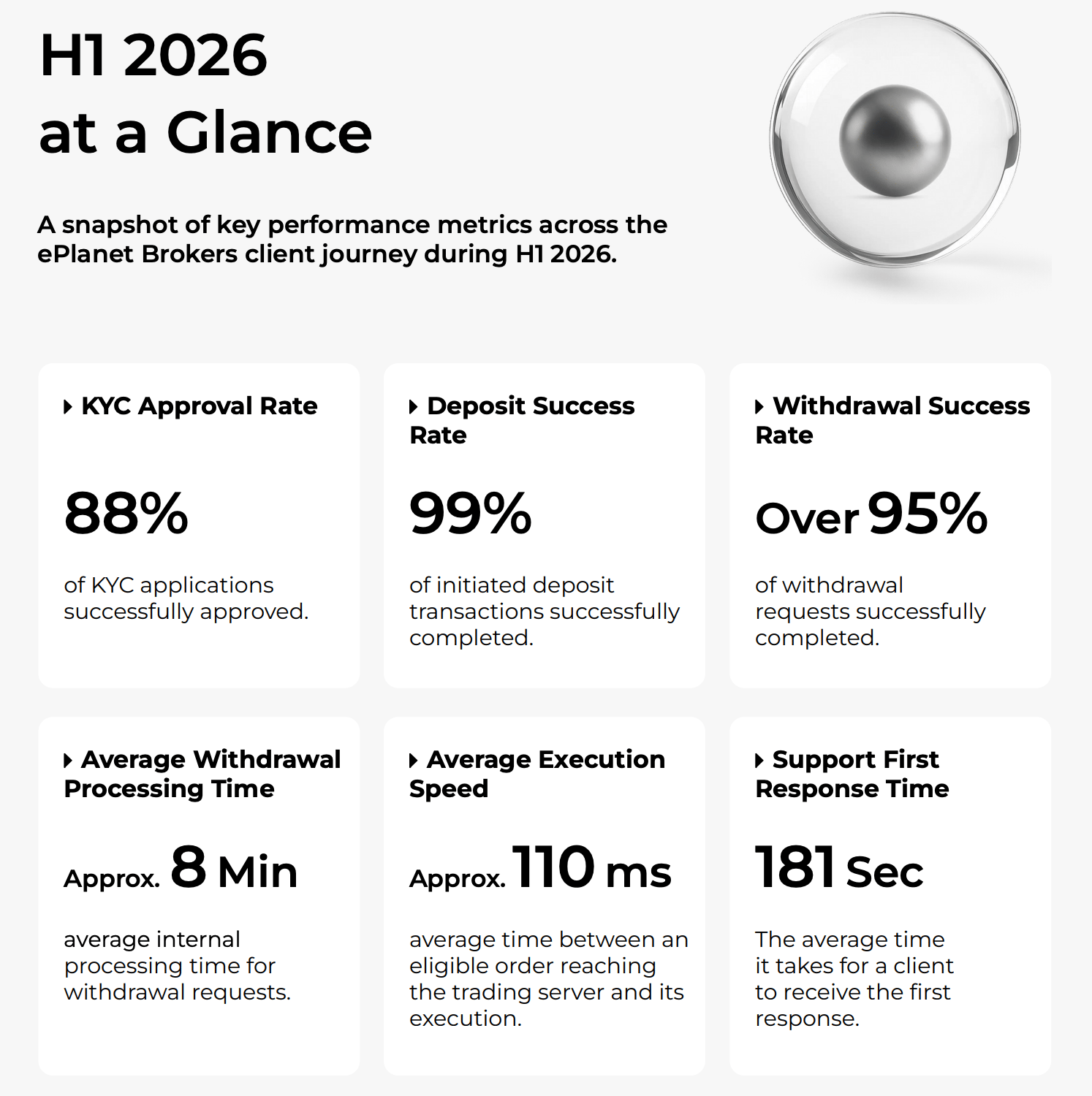
ePlanet Brokers reported a withdrawal success rate above 95% during H1 2026, compared with approximately 90% in H2 2025.
This represents an increase of more than five percentage points between the two reporting periods.
The broker also reported a substantial change in average internal withdrawal processing time.
In H2 2025, the average was under 20 minutes. During H1 2026, it declined to approximately eight minutes and remained below 10 minutes.
There is an important qualification behind this number.
The eight-minute figure measures internal withdrawal processing time. Specifically, it measures the period between a withdrawal request being submitted and the request being processed by ePlanet Brokers.
It does not represent a guarantee that funds will arrive in a client’s bank account, payment account or cryptocurrency wallet within eight minutes.
After internal processing has been completed, banks, payment providers, interbank settlement systems and blockchain networks can affect the final delivery time.
For traders comparing withdrawal experiences, the difference between internal broker processing and total end-to-end transfer time is therefore important.
How Much of the Withdrawal Process Is Automated?
The report also shows a significant increase in withdrawal automation.
During H2 2025, the automated withdrawal rate was approximately 10% or lower.
By H1 2026, more than 40% of withdrawals were being processed automatically.
Automation can reduce the amount of manual intervention required for eligible requests, although not every withdrawal will necessarily qualify for automated processing.
The broker has set further targets for the end of 2026.
These include reducing average internal withdrawal processing time to under five minutes, increasing the automated withdrawal rate to 50%, and processing approximately 40% of eligible withdrawals instantly.
For cryptocurrency withdrawals, completion following internal processing may still depend on confirmation by the relevant blockchain network.
These figures are targets rather than achieved H1 performance. Future operational disclosures will therefore be required to determine whether they were met.
Why Can ePlanet Brokers Withdrawals Be Delayed?
Aggregate processing times do not explain every individual withdrawal experience, so the report also identifies the main causes of delays.
The first is interbank transfer settlement delays.
The second involves bank-specific transaction restrictions.
The third category is additional review requirements, which may relate to account, payment, security or compliance considerations.
According to the report, requests requiring additional review represented less than 10% of total withdrawal requests during H1 2026.
This means an individual transaction can take longer than the reported average even where the broader withdrawal system is processing most requests more quickly.
External processing can create further differences depending on the withdrawal method selected.
Why Can a Withdrawal Be Rejected?
The report also identifies circumstances in which withdrawal requests may be rejected.
One relates to minimum holding period and trading activity requirements.
According to the disclosed information, at least 24 hours must have passed since a deposit and at least 0.02 lots of trading volume must have been completed before a withdrawal request is submitted.
If these requirements have not been satisfied, the request may be rejected and the client asked to submit it again after meeting the applicable conditions.
A second reason involves a mismatch between the withdrawal method and the deposit source.
Where cryptocurrency and other methods have been used to fund an account, for example, cryptocurrency withdrawals may be limited to the amount originally deposited through crypto, with the remaining amount processed using the applicable alternative method.
The third category involves confirmed trading violations.
The report states that where a violation is confirmed under applicable Terms and Conditions, the client is notified by email. The client may withdraw the original deposited amount, while profits attributable to the confirmed violation are not paid.
These requirements provide important context for interpreting withdrawal statistics because a rejected request is not necessarily the same as a failed payment transaction.
What Does the Deposit Data Show?
The other side of payment processing is deposits.
ePlanet Brokers reported a 99% deposit success rate during H1 2026, compared with approximately 95% in H2 2025.
Average deposit processing time was approximately one minute, although the company notes that processing varies depending on the payment method.
Most deposits use faster payment methods, which contributes to the approximately one-minute overall average.
For cryptocurrency deposits, incorrect wallet information and selection of the wrong blockchain network are among the identified reasons transactions may not be completed successfully.
For bank deposits, potential causes include incorrect or mismatched information and banking-system returns.
The report also states that deposits should generally originate from a source belonging to the client and that AML, KYC and verification controls may apply.
How Does KYC Work at ePlanet Brokers?
KYC and identity verification form another part of the broker’s operational framework.
During H1 2026, 88% of submitted KYC applications were successfully approved.
That compares with 71% in H2 2025, an increase of 17 percentage points.
The company’s automated identity verification process took less than 30 seconds on average.
The definition of this metric matters. It refers specifically to the automated identity verification process and does not mean every complete KYC case will necessarily be finalized in less than 30 seconds.
Cases requiring additional documentation, enhanced due diligence or specialist review can take longer.
The main reasons verification could not be completed on the first submission included duplicate accounts, document image or authenticity issues, and incomplete, damaged or non-compliant identity documents.
The report also notes that duplicate-account cases increased during H1 2026 and contributed to unsuccessful applications.
ePlanet Brokers states that it follows a risk-based verification approach, meaning additional documents or enhanced due diligence may be required depending on the circumstances.
How Did ePlanet Brokers Trading Execution Perform in H1 2026?
For active traders, execution performance is another significant part of broker assessment.
ePlanet Brokers reported an order execution success rate of 99.9% during H1 2026.
That compares with approximately 98% in H2 2025, representing an increase of around 1.9 percentage points.
Average execution speed also improved.
During H2 2025, the reported average was approximately 150 milliseconds. In H1 2026, this declined to approximately 110 milliseconds, an improvement of around 26.7%.
Average execution speed remained below 120 milliseconds during the first half of the year.
The report defines execution speed as the time between an eligible order reaching the trading server and its execution.
This definition is important because 110 milliseconds is an aggregate operational measurement. It should not be interpreted as a guaranteed execution time for every individual order.
What Can Affect Order Execution?
Actual execution can vary according to market conditions.
The report identifies market volatility, available liquidity, rapid price movements, trading-session conditions and technical or communication issues among the factors that may affect execution.
These factors can become particularly relevant during major economic releases or periods of unusually high market volatility.
An average execution figure calculated across six months therefore provides an infrastructure benchmark rather than a prediction of how a particular order will perform under specific market conditions.
The same principle applies to execution success.
A 99.9% historical execution success rate provides information about aggregate eligible orders during the reporting period. It does not guarantee that every future order will execute under every market condition.
The published report does not provide completed numerical H1 figures for average spread or average slippage, so those metrics cannot be included in an evidence-based assessment of the reported H1 performance.
How Reliable Is ePlanet Brokers’ Trading Infrastructure?
The report also provides information about system availability.
Trading-platform uptime was reported above 99.997% on a 2026 year-to-date basis.
For comparison, full-year 2025 trading-platform uptime was approximately 99.98%.
Client Portal uptime was above 99.982% for 2026 YTD, while payment-system availability was reported at 100% over the same YTD period.
There is an important methodological distinction here.
Unlike withdrawal, KYC and execution metrics that are specifically presented for H1 2026, the infrastructure availability figures are identified as 2026 year-to-date data.
The company has set a full-year 2026 target of more than 99.992% trading-platform uptime, corresponding to total trading-platform downtime below 40 minutes for the year.
Its stated infrastructure priorities include proactive monitoring, faster incident resolution, infrastructure optimization and reducing interruptions.
What Does the Customer Support Data Show?
Customer service provides another view of the client experience.
ePlanet Brokers reported an average first-response time of 181 seconds in H1 2026, compared with 248 seconds in H2 2025.
That represents a reduction of approximately 27%.
Average resolution time declined from 80 minutes to 67 minutes, an improvement of approximately 16%.
Customer support is available 24 hours a day, seven days a week.
The company also provides Dedicated Account Managers alongside its Customer Support team, offering an additional point of contact and coordination with specialist teams when required.
These figures are averages rather than service guarantees. Complex payment, account, technical or compliance cases may require more time than straightforward support requests.
What Do ePlanet Brokers Complaint Figures Show?
Formal complaints represented 0.2% of active clients during H1 2026, down from 0.3% during H2 2025.
The company also reported a formal complaint resolution rate above 99%.
The main complaint areas identified were account restrictions following trading or account reviews and concerns associated with market volatility and trading outcomes.
A limited number of account-review cases involved suspected or confirmed activity potentially breaching applicable Terms and Conditions, including prohibited arbitrage, fraudulent activity and multiple-account activity.
The complaint statistics require careful interpretation.
A resolution rate above 99% indicates that formal complaints were processed and resolved through the company’s complaint-handling framework. It does not mean that every complainant necessarily received the outcome they requested.
Similarly, the 0.2% rate specifically refers to formal complaints as a percentage of active clients. It does not represent every support conversation, external review, social media comment or informal complaint.
What Does the 2026 Data Tell Traders?
The H1 2026 figures show improvement across several measurable areas of ePlanet Brokers’ operations.
Withdrawal success increased from approximately 90% to above 95%, while average internal withdrawal processing fell from under 20 minutes to around eight minutes.
Withdrawal automation increased from approximately 10% or lower to more than 40%.
KYC approval rose from 71% to 88%, while deposit success reached 99%.
On the trading side, order execution success increased to 99.9% and average execution speed improved from approximately 150 milliseconds to 110 milliseconds.
Customer-support first-response and resolution times also declined, while the formal complaint rate fell from 0.3% to 0.2% of active clients.
These are historical aggregate metrics rather than guarantees.
Individual withdrawal times can depend on external payment infrastructure. Execution can change with market conditions. KYC cases requiring additional review may take longer, and complaint outcomes depend on the circumstances of individual cases.
ePlanet Brokers Review 2026: The Bottom Line
Reviewing a broker requires separating measurable facts from broader claims.
For ePlanet Brokers, the H1 2026 disclosure provides data covering several areas that traders commonly research before or after opening an account: registration, KYC, deposits, withdrawals, execution, infrastructure, customer support and formal complaints.
The most notable operational changes during the period were faster withdrawal processing, a substantial increase in withdrawal automation, higher KYC approval, improved execution speed and faster customer-support response.
At the same time, the methodology provides necessary context. Approximately eight-minute withdrawal processing refers to internal broker processing, 110-millisecond execution is an average for eligible orders, infrastructure figures are reported on a 2026 YTD basis, and complaint statistics cover formal complaints.
For traders researching ePlanet Brokers in 2026, these figures provide a measurable starting point rather than a definitive prediction of individual experience.
The next useful comparison will come from subsequent reporting. In particular, future data can show whether the broker maintains the improvements recorded in H1 and whether its targets for faster and more automated withdrawals are achieved by the end of 2026.