XLK eyes critical support as AI credit fears mount


Over the past month, the news cycle has been relentless for technology stock holders. Jensen Huang departed Nvidia on 12 November, the board rejected his proposed return, and then, on Monday, Nvidia announced his reinstatement as CEO.
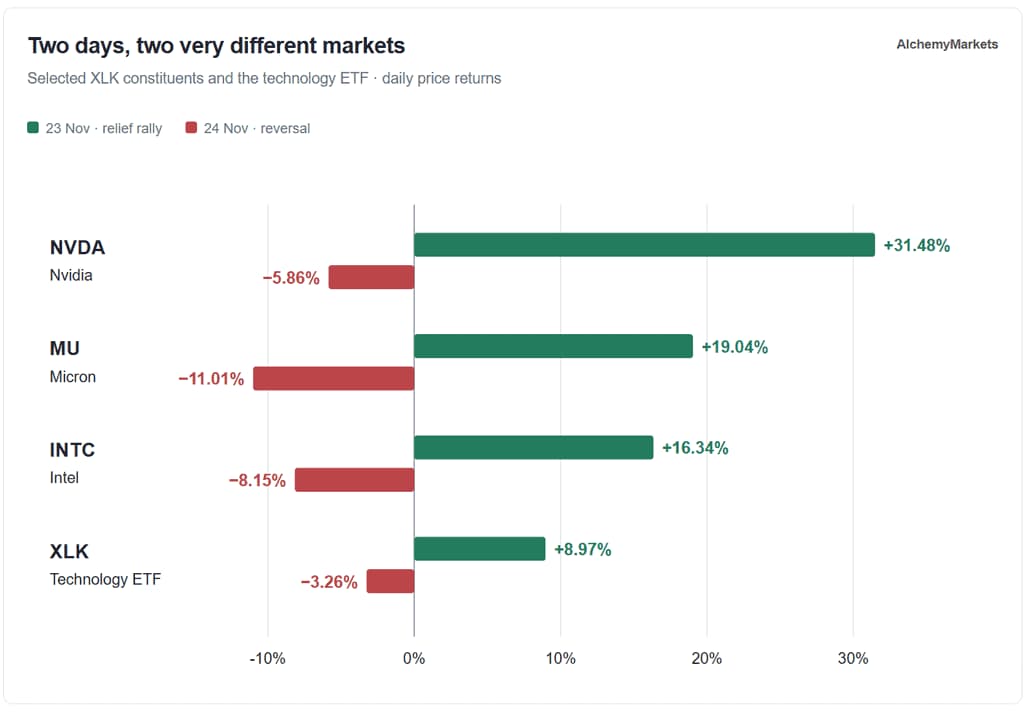
Nvidia surged 31.5% on Monday, pulling semiconductor stocks higher alongside it. XLK, the technology sector ETF, rallied nearly 9%. Yet Tuesday saw much of that optimism fade, with XLK falling 3.26% while several chipmakers suffered even steeper losses.
The two-day gain of 5.42% is still sizeable. But the reversal leaves an important question: has the relief rally done enough to restore XLK’s longer-term bullish structure?
XLK’s rising channel points to $142.66
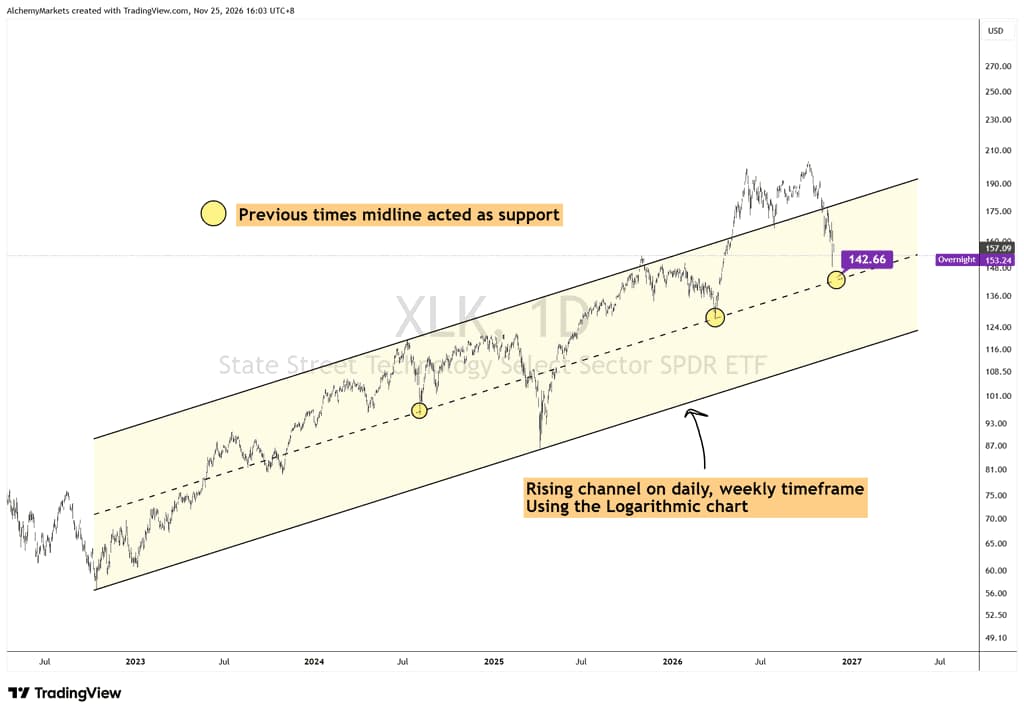
On the logarithmic chart, XLK has traded within a broad ascending channel since late 2022. Earlier this year, the ETF broke above the upper boundary as the AI trade accelerated. It has since returned inside the channel, suggesting that the pace of the previous advance has weakened.
The midpoint of the channel is the next major structural support to watch. At the time of the chart, it sits near $142.66, approximately 9.2% below Tuesday’s $157.09 close, or 6.9% below the overnight quote of $153.24.
The midpoint has previously attracted buyers during two corrections. A third test could therefore become particularly significant. However, XLK is also positioned to gap up today above a previous high at ~153, so the alternative scenario is that the sector is trying to stabilise now.
Jensen is back, but the AI industry’s problems remain
Huang’s return has reduced one source of uncertainty, but it has not resolved the economics of the AI investment cycle. Micron and Intel surrendered a substantial portion of Monday’s gains on Tuesday, highlighting the fragility of the semiconductor rebound.
Meanwhile, credit default swaps (the cost of insuring against a debt default) by Oracle and SoftBank have surged to 356 and 501 basis points, respectively.
In simple terms, this means investors are becoming increasingly concerned about whether AI companies can make enough money to repay the debt taken on to fund their massive infrastructure investments.
Should borrowing become more expensive, these companies may be forced to scale back their AI spending plans, potentially hurting future demand for semiconductors and putting further pressure on XLK.
While chip demand remains strong for now, the bigger question is whether AI companies can afford to sustain this level of spending.
So while despite Jensen Huang’s return as the Nvidia CEO, the CDS surges still imply those AI financing fears are mounting.
For companies increasingly reliant on external financing, rising borrowing costs could eventually force them to reconsider spending plans; which hurts the semiconductor companies that have supported the AI rally.
That does not yet establish a broad corporate credit crisis, but should these concerns spread beyond AI-linked companies, the wider stock market could come under significant selling pressure.
Tech is under pressure, but the wider market is holding up
Interestingly, Tuesday’s sell-off was not reflected across the entire US stock market.
While XLK fell 3.26%, nine of the eleven major S&P 500 sector ETFs finished higher, with healthcare, consumer staples and real estate among the strongest performers.
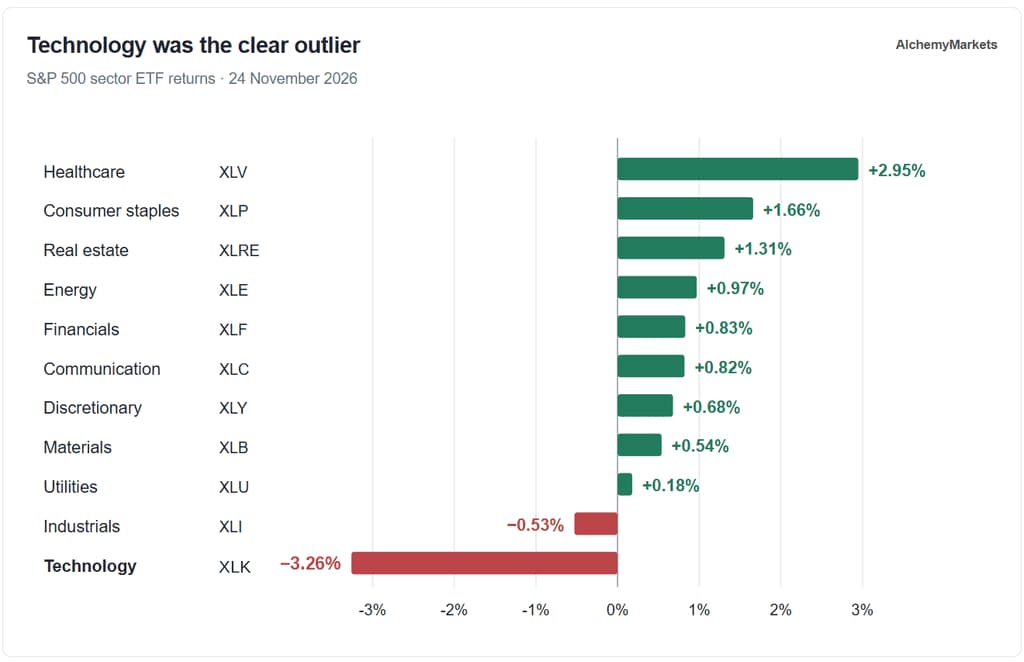
This raises an interesting possibility: investors may not necessarily be abandoning equities altogether, but instead reducing their exposure to technology and rotating into other areas of the market.
If this rotation continues, technology stocks could remain under pressure even if the broader US stock market stabilises.
What would make support hold?
For now, $142.66 is a projected technical reference rather than an inevitable downside target. A sustained recovery could develop before XLK reaches it, particularly if the ETF begins reclaiming lost ground and credit stress eases.
Support holds Watch for renewed buying pressure, semiconductor stabilisation and narrowing corporate credit spreads. | Support fails A decisive breakdown could expose XLK to a deeper correction towards the lower boundary of its rising channel. |
With US PCE inflation data due later today, investors will be watching closely for any indication that the Federal Reserve could adopt a less restrictive policy stance.
Softer-than-expected inflation could offer some relief to technology stocks. But until underlying credit concerns subside, any recovery may remain vulnerable to renewed selling pressure.
Author
Zorrays Junaid
Alchemy Markets
Zorrays Junaid has extensive combined experience in the financial markets as a portfolio manager and trading coach. More recently, he is an Analyst with Alchemy Markets, and has contributed to DailyFX and Elliott Wave Forecast in the past.

















