WTI Price Forecast: More gains look likely above $107 as Trump threatens military attacks on Iran
- The Oil price corrects to near $101.80, while its outlook remains broadly firm.
- US President Trump delivers fresh threats of military attacks on Iran.
- The Fed will likely deliver at least one interest rate hike this year.


West Texas Intermediate (WTI), futures on NYMEX, trade almost 1.5% lower to near $101.80 during the European trading session on Wednesday. The Oil price drops despite uncertainty surrounding the reopening of the Strait of Hormuz - a critical passage to almost 20% of global energy flows - remains intact.
On Tuesday, a spokesperson from Qatar’s Foreign Ministry said that communication between leaders in the region is ongoing and with conflict parties to prevent a return to escalation, while warning that normal traffic on Hormuz has not resumed yet.
Meanwhile, the negotiations deadlock between the United States (US) and Iran doesn’t appear to be resolving soon, following fresh military threats from Washington. US President Donald Trump said on Tuesday that Washington may have to give Iran another big hit in the coming few days, if it doesn’t agree to a deal, Bloomberg reported.
Going forward, the Oil price’s upside could be restricted by growing expectations that the Federal Reserve (Fed) will raise borrowing rates this year. According to the CME FedWatch tool, the odds of the Fed delivering at least one interest rate hike this year is 56.3%, a significant turnaround from two interest rate cuts anticipated before the onset of the Middle East war.
WTI technical analysis
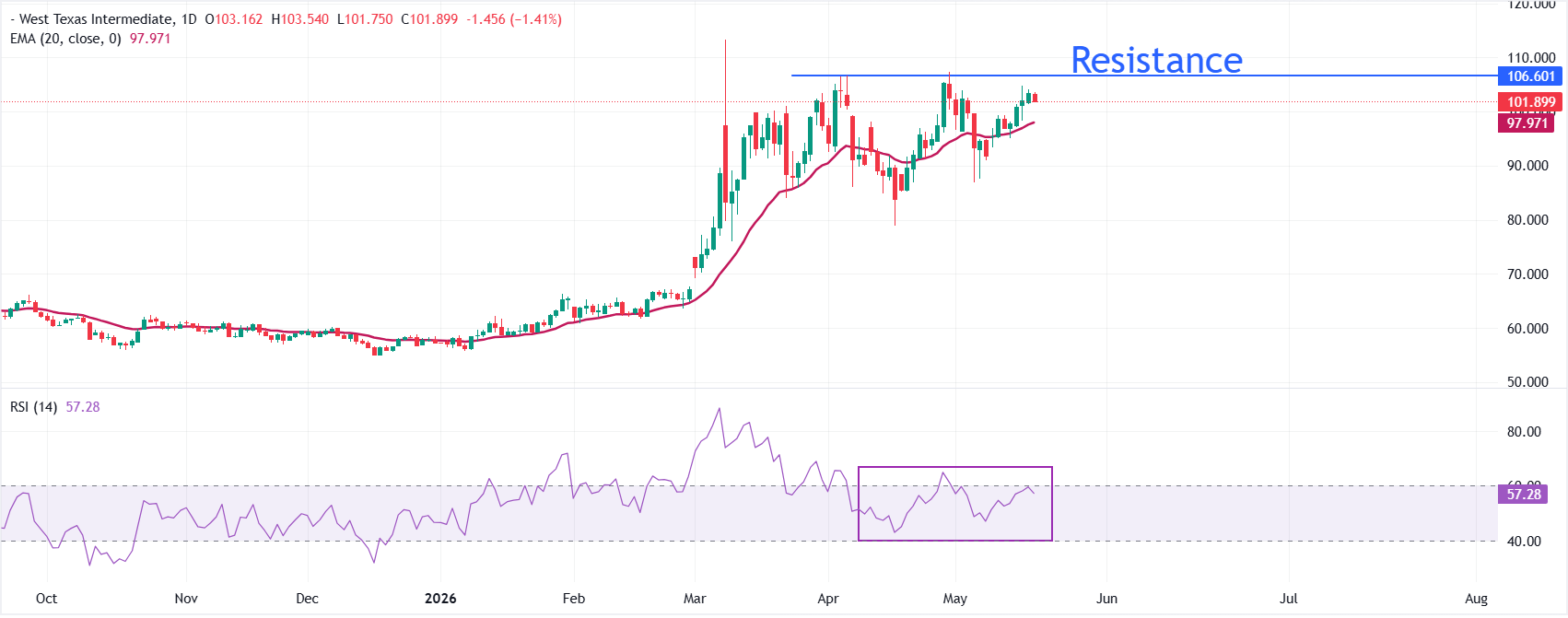
WTI US Oil trades lower at around $101.80 at the press time. However, the oil price maintains a bullish near-term bias as it holds above the 20-day Exponential Moving Average (EMA) at roughly $98. The price action staying comfortably over this dynamic support suggests that pullbacks are being bought, while the Relative Strength Index (RSI) around 57 keeps a constructive, yet not overbought, momentum backdrop.
On the downside, initial support is seen at the 20-day EMA near $98, where a break would hint at a deeper correction toward $90.00. As long as WTI holds above this moving average and momentum remains positive, the path of least resistance stays higher, with the market likely to treat dips as opportunities rather than signaling a clear top. Looking up, the oil price aims to revisit an over two-month high of $107.35.
(The technical analysis of this story was written with the help of an AI tool.)
WTI Oil FAQs
WTI Oil is a type of Crude Oil sold on international markets. The WTI stands for West Texas Intermediate, one of three major types including Brent and Dubai Crude. WTI is also referred to as “light” and “sweet” because of its relatively low gravity and sulfur content respectively. It is considered a high quality Oil that is easily refined. It is sourced in the United States and distributed via the Cushing hub, which is considered “The Pipeline Crossroads of the World”. It is a benchmark for the Oil market and WTI price is frequently quoted in the media.
Like all assets, supply and demand are the key drivers of WTI Oil price. As such, global growth can be a driver of increased demand and vice versa for weak global growth. Political instability, wars, and sanctions can disrupt supply and impact prices. The decisions of OPEC, a group of major Oil-producing countries, is another key driver of price. The value of the US Dollar influences the price of WTI Crude Oil, since Oil is predominantly traded in US Dollars, thus a weaker US Dollar can make Oil more affordable and vice versa.
The weekly Oil inventory reports published by the American Petroleum Institute (API) and the Energy Information Agency (EIA) impact the price of WTI Oil. Changes in inventories reflect fluctuating supply and demand. If the data shows a drop in inventories it can indicate increased demand, pushing up Oil price. Higher inventories can reflect increased supply, pushing down prices. API’s report is published every Tuesday and EIA’s the day after. Their results are usually similar, falling within 1% of each other 75% of the time. The EIA data is considered more reliable, since it is a government agency.
OPEC (Organization of the Petroleum Exporting Countries) is a group of 12 Oil-producing nations who collectively decide production quotas for member countries at twice-yearly meetings. Their decisions often impact WTI Oil prices. When OPEC decides to lower quotas, it can tighten supply, pushing up Oil prices. When OPEC increases production, it has the opposite effect. OPEC+ refers to an expanded group that includes ten extra non-OPEC members, the most notable of which is Russia.
Author
Sagar Dua
FXStreet
Sagar Dua is associated with the financial markets from his college days. Along with pursuing post-graduation in Commerce in 2014, he started his markets training with chart analysis.